
Super Hard Tool Materials: What They Are and When to Use Them
This page explains the cutting mechanics behind super hard tool materials, the grain sizes and edge preparations that decide performance, and the part features where they pay off. Written for engineers and buyers who need to pick a grade, not just a name.
In this article
- 1
- 2
- 3
- 4
- 5
- 6
- 7
What Makes a Tool Material Super Hard
Super hard tool materials sit above cemented carbide on the hardness scale. Diamond reaches roughly 10,000 HV and cubic boron nitride sits near 4,500 HV. Carbide, by comparison, runs about 1,600 HV. That gap changes how the edge wears. Instead of rounding over, a diamond edge tends to micro-chip or fail by graphitization when the temperature climbs.
Hardness alone does not decide the cut. Thermal conductivity and chemical stability matter just as much. Diamond conducts heat extremely well, so heat leaves the cutting zone quickly. That is why a diamond tool can hold Ra 0.2–0.8 μm on aluminum at high spindle speeds without burning the surface.
The limit is iron. Diamond is carbon, and carbon dissolves into iron at temperatures above roughly 700 °C. Machining steel with a diamond tool wears the edge fast, no matter how rigid the machine. This single fact decides most grade choices on the shop floor.
So the question is never 'is diamond harder'. It is 'does this workpiece chemistry and this surface requirement justify the grade'. A PCD insert on aluminum or a CBN insert on hardened steel can run for hours. The same diamond on 1045 steel may fail in minutes.
- 1Diamond ≈ 10,000 HVBest on non-ferrous, plastics, graphite and composites.
- 2CBN ≈ 4,500 HVStable against iron at high temperature; the choice for hardened steel.
- 3Carbide ≈ 1,600 HVStill the default for general milling and mixed jobs.
PCD, CVD Diamond and Grain Size Selection
Polycrystalline diamond (PCD) is a sintered layer of diamond grains bonded to a carbide substrate. It is not a single crystal, so a chip stops at a grain boundary instead of running through the whole edge. That is why PCD tolerates interrupted cuts better than natural monocrystalline diamond.
Grain size drives the trade-off. Standard grades run 002, 010 and 025, with average grain sizes of 2, 10 and 25 μm. Larger grains improve wear resistance. Smaller grains give a better surface finish. A 25 μm grade holds its edge on abrasive MMC or carbon fibre, while a 2 μm grade is the one to reach for when you need Ra 0.8–1.6 μm on 6061 aluminum.
CVD diamond is grown as a film from a low-pressure, high-temperature process rather than sintered from powder. It can be grown at different grain sizes and surface morphologies, so a single coating family covers both finishing and high-wear work. On a contoured milling cutter, a CVD film often holds a sharp edge longer than a brazed PCD tip.
The practical rule: pick PCD when you need a tough, repairable edge on a defined geometry. Pick CVD when the tool shape is complex, or when the edge has to stay sharp on a fine finishing pass.
- 12 μm PCDFinishing grade; better surface finish on aluminum and copper.
- 210 μm PCDGeneral purpose; balances edge life and finish.
- 325 μm PCDHigh-wear grade for abrasive composites and MMC.
- 4CVD filmComplex profiles and sharp-edge finishing tools.
Edge Preparation and Cutting Parameters
A super hard tool is only as good as its edge. Diamond and CBN are brittle, so a razor-sharp edge will chip on the first entry into a hard workpiece. Tool makers hone a small radius, typically 5–25 μm, to spread the load. Too small a hone and the edge chips. Too large a hone and the tool rubs instead of cutting.
Cutting speed matters more than feed on these grades. PCD on aluminum runs well at 500–2,000 m/min. CBN on hardened steel (45–65 HRC) typically runs 80–250 m/min. Push past the top of the range and the binder around the diamond grains starts to break down.
Feed per tooth should stay high enough to keep the edge cutting rather than rubbing. A common mistake is to slow the feed down to improve finish. On super hard tools that causes rubbing, heat build-up and premature edge wear. Keep the chip load in the recommended band and let the surface speed do the finishing work.
Coolant is a judgment call. Flood coolant helps on aluminum and keeps chips clear. On CBN turning hardened steel, many shops run dry or with minimal lubrication because thermal shock can crack the CBN layer. Match the coolant strategy to the grade, not to habit.
- 1Hone radius5–25 μm; larger for interrupted cuts.
- 2PCD on aluminum500–2,000 m/min surface speed.
- 3CBN on 45–65 HRC steel80–250 m/min, dry or minimal lube.
Machine Rigidity and Setup Requirements
Super hard edges do not forgive vibration. Because the edge is brittle, chatter that a carbide tool would simply wear through will chip a diamond or CBN insert. The machine needs enough static and dynamic stiffness to keep the tool engaged smoothly.
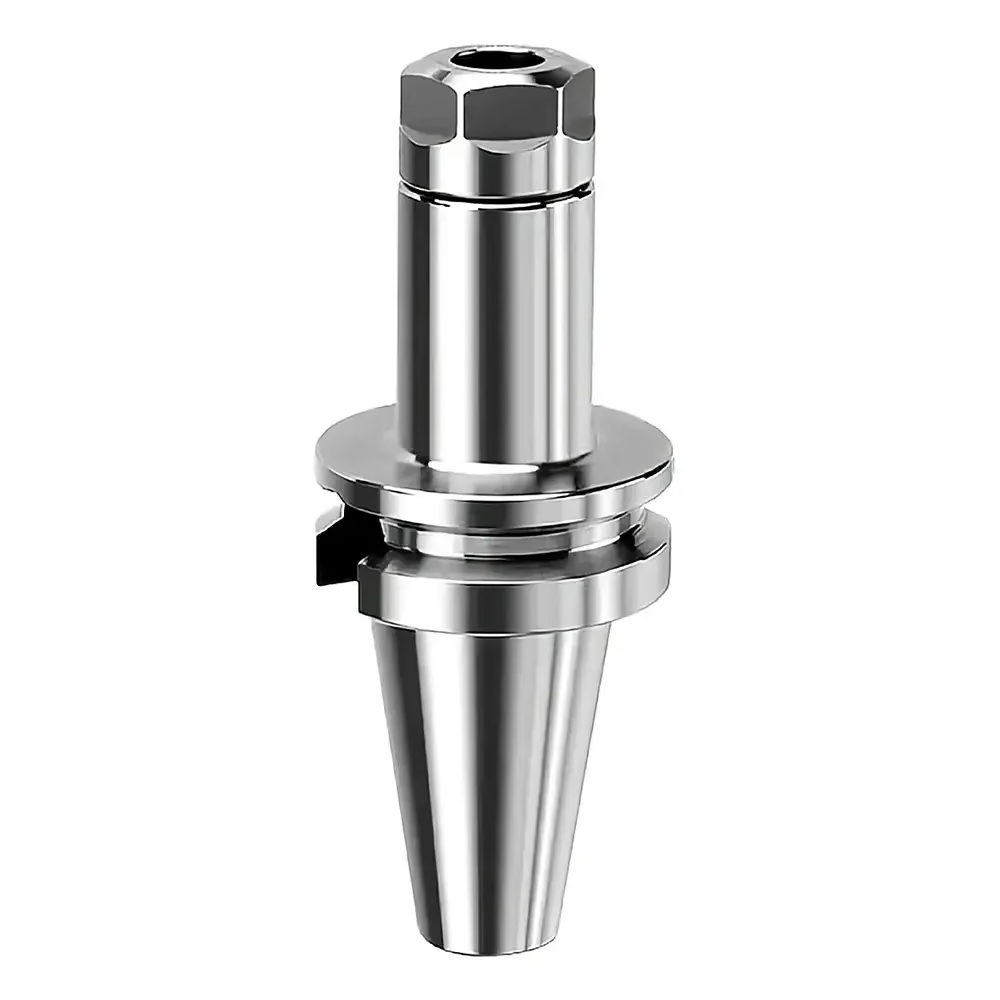
On our 5-axis machining centers, we hold ±0.005 mm on super hard tool paths by keeping tool overhang short and using a shrink-fit or hydraulic holder. A standard collet chuck with a long gauge length is the fastest way to lose an expensive insert. Rigidity first, then speed.
Runout is the second killer. A diamond tool with 20 μm of runout effectively cuts with one flute, and that flute wears twice as fast. Indicate the tool before the first cut. On a Ø400 mm rotary table job, a small runout error also shows up as a taper across the part.
Workholding matters too. Thin-wall aluminum parts can deflect under the cutting force, and the tool then rubs instead of shearing. Support the wall, reduce the radial engagement, and the same insert will hold tolerance across the run.
- 1Keep overhang shortShrink-fit or hydraulic holders over collets.
- 2Check runoutIndicate the tool before the first cut.
- 3Support thin wallsLess radial engagement to avoid rubbing.
Where Super Hard Tools Earn Their Cost
The economics are simple: a super hard tool costs more per edge but lasts far longer in the right material. On a run of 10,000 aluminum housings, a PCD face mill can replace several carbide tool changes. The saving is not the insert price, it is the spindle downtime and the scrap from a worn edge.
High-silicon aluminum is a classic case. Alloys with 12–18% silicon abrade carbide quickly. PCD holds its geometry, so the bore stays round and the surface stays consistent from the first part to the last. This matters on automotive and EV parts where the customer checks every bore.
Composites are the other strong fit. Carbon fibre and glass-filled plastics delaminate when a dull edge pushes instead of slices. A CVD diamond or fine-grain PCD cutter keeps the fibers cleanly sheared. The difference shows up as less fraying and fewer delamination rejects.
Hardened steel above 45 HRC is CBN territory. Instead of grinding after heat treatment, you can turn the hardened surface to size with a CBN insert and skip a process step. On a medical or tooling part that already runs several operations, removing one grinding setup often pays for the insert several times over.
- 1High-silicon aluminumPCD keeps bore geometry stable across long runs.
- 2Carbon fibre and compositesCVD or fine PCD reduces fraying and delamination.
- 3Hardened steel 45–65 HRCCBN turning can replace a grinding setup.
When Super Hard Tools Are the Wrong Choice
Diamond on steel is the clearest mistake. The carbon in the diamond diffuses into the iron chip at cutting temperature, and the edge wears almost as fast as carbide. For low-carbon steel like 1018 or 1045, stay with coated carbide or CBN.
Small batch and one-off work rarely justifies the cost. A prototype shop may run a single part with an unusual profile. Here a standard carbide tool with the right geometry is cheaper and faster to source. Super hard grades pay back on repeat work, not on a single setup.
Deep pockets and long reach are also a weak spot. A small-diameter diamond tool on a long holder will chatter, and chatter chips the edge. If the feature needs a long reach, use a carbide tool with a smaller depth of cut, or redesign the feature so a shorter tool can reach it.
Finally, an unstable process cannot be rescued by a premium insert. If the machine, holder or fixture is loose, the tool will fail. Fix rigidity first. The super hard grade only amplifies whatever the setup already does.
- 1Ferrous metalsDiamond diffuses into iron; use CBN or carbide.
- 2One-off prototypesCarbide is cheaper and faster to source.
- 3Long-reach featuresChatter chips brittle edges; redesign or use carbide.
Super Hard Tool Materials: Grade Comparison
Match the grade to the workpiece, not to the catalog order.
| Grade | Hardness (HV) | Best workpiece | Watch out for |
|---|---|---|---|
| Monocrystalline diamond | ≈ 10,000 | Optical surfaces, fine finishing | High cost; brittle on interrupted cuts |
| PCD (2 μm) | ≈ 8,000–10,000 | Aluminum, copper, finishing passes | Poor on ferrous metals |
| PCD (25 μm) | ≈ 8,000–10,000 | Carbon fibre, MMC, abrasive stock | Coarser finish; edge hone critical |
| CVD diamond film | ≈ 8,000–10,000 | Complex profiles, sharp edges | Film adhesion on reworked tools |
| CBN | ≈ 4,000–4,500 | Hardened steel 45–65 HRC | Not for aluminum; built-up edge |
| Coated carbide | ≈ 1,600 | Mixed jobs, general milling | Wear rate on abrasive stock |
The Verdict
Choose PCD or CVD diamond for non-ferrous, composite and finishing work; choose CBN for hardened steel above 45 HRC. If the metal is low-carbon steel or the run is a single prototype, stay with coated carbide and spend the money on rigidity instead.
Questions Engineers Ask
Can I run a diamond tool on stainless steel?
No. Stainless steel contains iron, and the carbon in diamond diffuses into the iron chip at cutting temperature. The edge wears quickly even at moderate speeds.
Use CBN for hardened stainless, or coated carbide for 303, 304 and 316 in the annealed state. CBN is stable against iron at high temperature.
How do I choose between 2 μm and 25 μm PCD?
Start from the surface requirement and the abrasive content of the workpiece. A 2 μm grade gives a finer edge and better finish, so it suits aluminum and copper finishing passes.
A 25 μm grade resists abrasion longer, so it suits carbon fibre, MMC and other abrasive stock. If the part needs both a fine finish and long life, rough with the coarse grade and finish with the fine one.
What surface finish can a super hard tool hold?
On aluminum and copper, a fine-grain PCD or CVD tool can hold Ra 0.2–0.8 μm in a stable setup. A general grade typically holds Ra 0.8–1.6 μm.
Finish depends on the whole system, not just the insert. Runout, holder stiffness and feed per tooth all show up in the measured Ra. A premium insert on a loose holder will not reach the same number.
Is CBN suitable for aluminum?
No. Aluminum tends to form a built-up edge on CBN, and the tool stops cutting cleanly. Aluminum is soft and gummy at cutting temperature, so a sharp, high-conductivity diamond edge works far better.
Use PCD or CVD diamond for aluminum. Keep the surface speed high and the chip load steady to avoid smearing.
Do super hard tools need a special machine?
They need a rigid machine, not a different category of machine. Vibration and runout are the main causes of edge failure, so a stable spindle with low runout matters more than the machine's age.
Check the holder first. Shrink-fit or hydraulic holders keep the tool concentric. A worn collet chuck will waste an expensive insert in a few parts.
When does CBN turning replace grinding?
When the part is above 45 HRC and the geometry allows a single-point tool to reach the surface. CBN turning can hold tight tolerance and skip a grinding setup, which often shortens the process route.
It is less attractive on complex profiles that need a small-radius wheel, or where the surface finish spec is below what a turning insert can hold. In those cases, grinding stays the right call.
Send Us the Part and the Material
We review the drawing, the material and the feature list, then tell you which tool grade fits and what it means for cost and lead time. Quotation and free DFM analysis within 12 hours.
12-hour quote100% inspection±0.005 mm
More CNC Knowledge
We publish setup notes, tooling trials and inspection data from the factory floor.











