
CNC Processing Prices: What Actually Drives the Number
An engineer's look at how CNC processing prices are built from machine time, setup, material and inspection. Written for buyers and design engineers who need to compare quotes from different countries without getting fooled by the hourly rate.
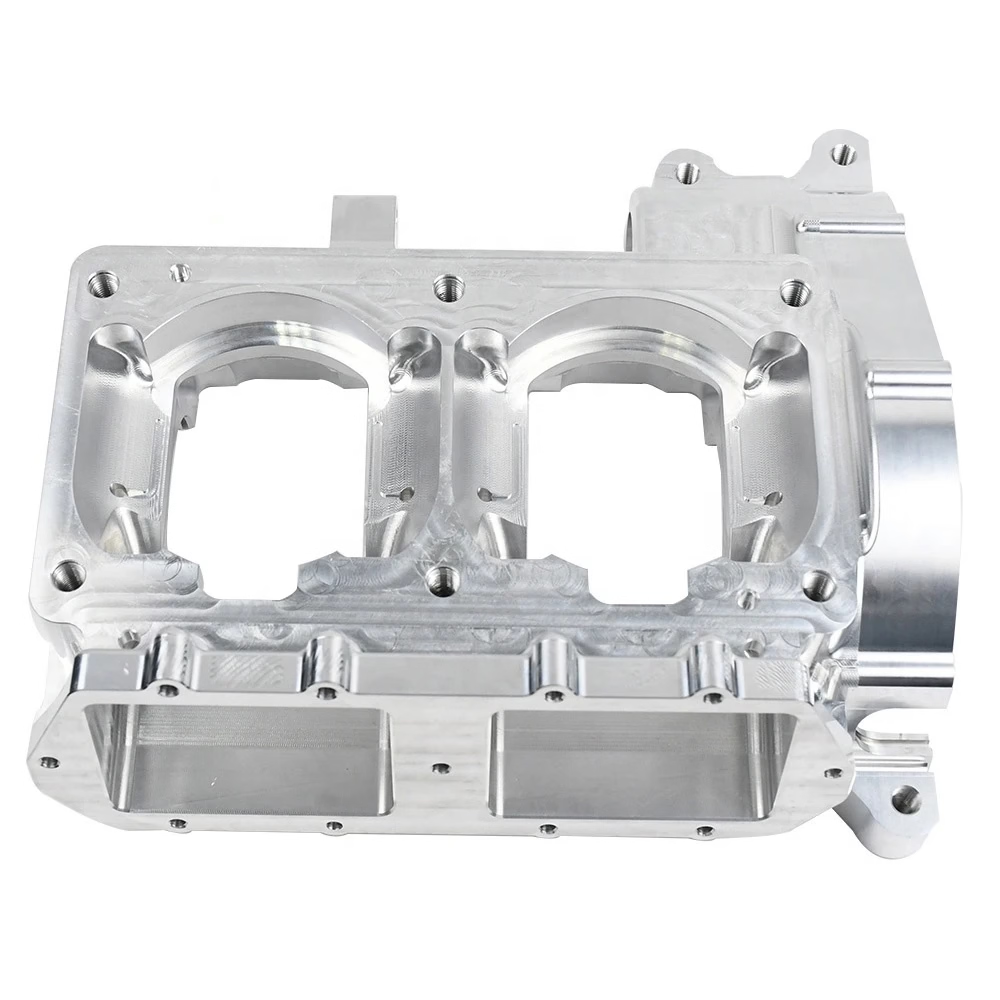
How CNC Processing Prices Are Built
Every machining quote is a sum of four things: setup, machine time, material, and inspection. Setup is the hours a programmer and operator spend turning a CAD file into a running job. Machine time is the cut itself, multiplied by an hourly rate. Material is bar stock or plate plus the scrap you never ship. Inspection is metrology labor, and it grows fast as tolerances tighten.
The hourly rate is the number everyone argues about, and it is the least important one on most parts. A shop charging a low rate with slow cycle times can cost more than a shop charging double but running the job in half the time. Ask for the cycle time, not just the rate.
Russian CNC processing prices are usually quoted the same way, with ruble-denominated labor and dollar-denominated tooling. That currency split is invisible in a headline rate but shows up in how a shop reacts when tooling prices move. It also shapes payment terms.
When you compare quotes, normalize them first. Convert everything to one currency, confirm whether material is included, and check whether inspection reports are billed separately. Only then do the numbers mean anything.
Machine Hour Rates and Why They Differ
A three-axis mill and a simultaneous five-axis machining center do not cost the same to run. The five-axis machine carries a higher capital cost, a more expensive control, and a programmer who can think in tool vectors. That is why the hourly rate can be two to three times higher, and still be the cheaper option on a complex part.
The crossover is geometric. If a part needs five setups on a three-axis machine, each setup adds fixturing, dial-in time, and a chance of stack-up error. One five-axis setup removes all of that. On a part with three or more angled faces, the five-axis route usually wins on total cost even at a higher rate.
Rigid, simple parts go the other way. A flat bracket with two holes and a milled slot has no reason to touch a five-axis spindle. Routing it there just moves money from your pocket to the machine's depreciation schedule.
Our own floor runs 127 high-precision CNC machines, including 16 simultaneous 5-axis centers and 27 three-axis machines. We quote the process the geometry actually needs, not the most expensive machine we own.
Setup Cost and Batch Size
Setup is fixed. Whether you run 1 part or 500, the programmer still writes the toolpath, the operator still loads fixtures, and the first article still gets measured. That fixed cost divided by quantity is what makes small batches look expensive per piece.
A single prototype can carry a setup cost that dwarfs its material cost. Add a second identical part to the same order and the per-piece price often drops by a third or more, because setup is now spread across two units. This is arithmetic, not a discount.
Batch size also interacts with material purchasing. Bar stock comes in standard lengths. If your part nests badly, you buy more stock than the finished parts weigh, and the leftover sits on a shelf. Ask the shop how they plan to cut the bar.
For low-volume work, the practical move is to group parts that share a material and a fixture. Running three different brackets from one 6061 bar in one setup is cheaper than three separate jobs.
Tolerance Bands and Their Cost Curve
Tolerance drives cost non-linearly. Loosening a callout from ±0.05 mm to ±0.1 mm rarely changes anything, because the process already holds it. Tightening from ±0.02 mm to ±0.005 mm changes the machine, the tooling, the temperature control, and the inspection method.
At ±0.005 mm you are fighting thermal growth. A spindle warming up by a few degrees moves the tool. So does a cold morning in an unheated bay. Shops that hold this band run climate control, use warm-up cycles, and measure parts at a stable temperature.
Surface finish follows the same logic. As-machined at Ra 1.6–3.2 μm comes off a normal finishing pass. Ra 0.8–1.6 μm needs a finer stepover or a separate finishing tool. Ra 0.2–0.8 μm usually means a secondary operation.
Read the drawing before you quote it. A tight tolerance on a cosmetic surface, or on a hole nobody measures, is money spent for nothing. Keep tight bands where they carry function.
Material Choice Moves the Price More Than Labor
Aluminum 6061 machines fast, cuts clean, and costs little. Titanium TC4 and Inconel do not. They work-harden, they heat the tool, and they eat inserts. Cycle times can triple, and tool life can drop to a fraction of what aluminum allows.
Stainless sits in the middle. Grades like 303 and 304 are routine. 17-4PH in the hardened condition is not. If your part needs corrosion resistance but not extreme strength, choosing 304 over a superalloy can cut the machining portion of the quote substantially.
Material form matters too. Plate, bar, and near-net forging carry different prices and different stock removal. A part cut from a forging may need less roughing but adds a purchased tooling cost and a longer lead time.
We stock and machine aluminum 6061, 7075 and ADC12, stainless 303 through 440C and 17-4PH, steels 1018 through 4340, copper alloys including C36000, plus titanium and magnesium grades. Tell us the function and we will tell you where the cost lands.
Inspection, Documentation and the Hidden Line
Inspection is where cheap quotes quietly become expensive ones. A shop that measures with calipers and ships is fast. A shop that runs a CMM program, records the data, and files it with the part is not. Both may quote the same part number.
For regulated work this is not optional. Aerospace, medical, and automotive programs require traceability from raw material certificate to final dimensional report. ISO 9001:2015 covers general quality management. IATF 16949:2016 covers automotive. ISO 13485:2016 covers medical devices. ISO 27001:2022 covers information security, which matters when your CAD files leave your network.
Our inspection flow is raw material check, in-process monitoring, and final inspection, with reports on request. Every part is inspected before shipment. That is why our qualification rate sits at 99.99%, and it is also why we will not pretend a fully documented part costs the same as a bare one.
If your drawing does not need a dimensional report, say so. Buying documentation you will never read is the easiest way to overpay.
Which Route Fits the Part
Match the geometry and volume to the process before comparing cnc processing prices.
| Part situation | Process that fits | Why | Cost behavior |
|---|---|---|---|
| Flat plate, 2-5 holes, one face | Three-axis mill | No angled features to reach | Lowest hourly rate, short cycle |
| Angled faces, 3+ setups needed | Simultaneous 5-axis | One setup replaces many | Higher rate, lower total cost |
| Turned shaft with milled flats | Mill-turn center | One chucking, no re-fixture | Fewer setups, tighter concentricity |
| Prototype, quantity 1-3 | Three-axis or mill-turn | Setup dominates the price | Per-piece cost falls fast with qty |
| Titanium or Inconel part | Any route, slow feeds | Tool wear and heat control | Cycle time 2-3× aluminum |
| ±0.005 mm bore, critical | Climate-controlled cell | Thermal growth must be held | Adds finishing and CMM time |
| Cosmetic anodized housing | Three-axis plus finishing | Geometry is simple, finish is not | Finishing billed separately |
| 10,000+ unit run | Dedicated fixture, 3-axis | Setup amortized to near zero | Per-piece approaches material cost |
The Takeaway on CNC Processing Prices
If your geometry is simple and the volume is real, chase the lowest hourly rate. If the part has angled faces, tight bores, or a documentation requirement, buy the process and the paperwork that actually fit, because the cheap quote will find that cost somewhere else.
Questions Buyers Ask Next
Are Russian CNC processing prices really lower than Western ones?
On labor-heavy, simple parts the headline rate is often lower. On parts that need five-axis time, certified material, or full dimensional reporting, the gap narrows or disappears, because those costs are driven by machine capital and metrology, not by wages.
Compare total landed cost: machining, material, freight, duty, and the engineering time you spend chasing the order. The rate is only one line.
What is the smallest order worth quoting?
One part. Setup is fixed, so a single prototype is expensive per piece, but it is still a real number and it tells you whether the design machines at all.
There is no minimum order quantity with us. Runs go from one prototype to 10,000+ parts, and the per-piece curve flattens as setup gets amortized.
How fast can a quote and parts come back?
We return a quotation and a free DFM analysis within 12 hours. Production can start within 24 hours of approval.
Typical parts ship in 3–5 days, and our historical late-delivery probability is below 2%. Complex geometry or purchased material extends that.
Does switching from three-axis to five-axis always cost more?
No. The hourly rate is higher, but the setup count drops. Once a part needs three or more angled setups on a three-axis machine, the five-axis route is frequently cheaper in total.
Below that threshold, stay on three-axis. The extra axis buys nothing on a flat bracket.
Can I get the same part made without a dimensional report?
Yes. Tell us what the part is for. If it is a fixture or a prototype fit check, a basic inspection is enough and we will not bill for a CMM program you do not need.
For regulated programs, we supply inspection reports on request and maintain ISO 9001, IATF 16949, ISO 13485 and ISO 27001 systems.
How do you handle confidential drawings?
Uploads are secure and confidential. We sign an NDA on request, and our ISO 27001:2022 certification covers the information security controls behind that promise.
Your files are used to quote and machine your parts, nothing else.
Send the Drawing, Get the Real Number
Upload your CAD file and we return a quotation with a free DFM analysis within 12 hours. Tell us the function of each tight tolerance and we will tell you which ones are worth paying for.
12-hour quote100% inspectionNo MOQ
More From the Shop Floor
We publish setup notes, tooling trials and inspection data from the factory floor.











