
Renovated CNC Center: What a Rebuild Actually Restores
A renovated CNC center is an existing machine brought back to a measured geometry, not a new one. This page explains which assemblies get replaced, which keep their wear history, and how to tell whether a rebuilt machine suits your part.
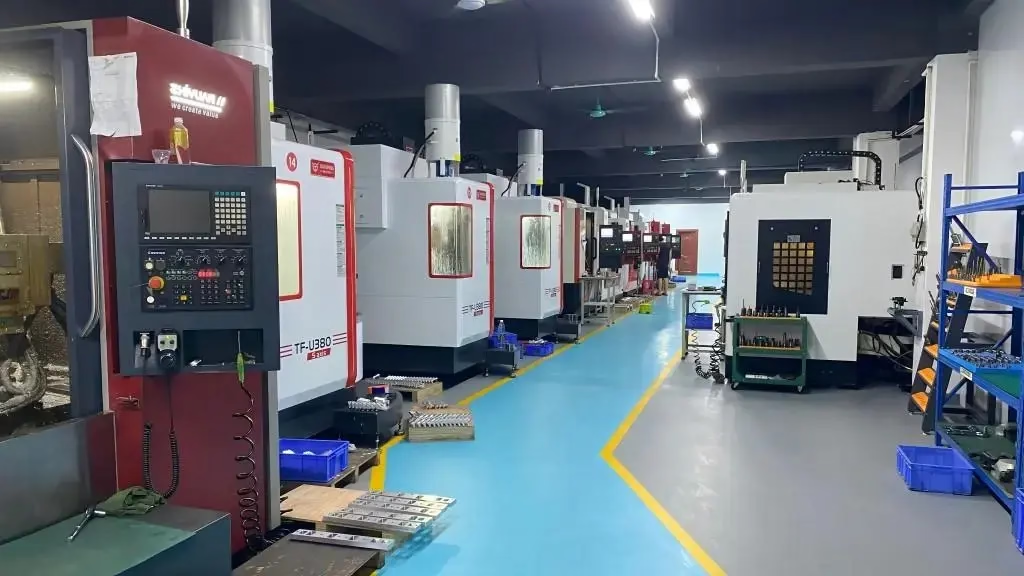
What a Renovated CNC Center Is, and What It Is Not
A renovated CNC center is a used machining platform stripped, inspected, and rebuilt. The frame and major castings usually stay. Spindle bearings, ballscrews, linear guides, way covers, lubrication lines, and the control cabinet get replaced or reconditioned. The result is a machine whose geometry has been re-established to a measured value, not a machine that rolled off a line this year.
The distinction matters because the frame carries the machine's history. Cast iron and welded steel structures move as they age. They stress-relieve, they take a set, and they can carry the imprint of a crash. A rebuild can scrape and realign those surfaces. It cannot make the casting younger. For most work this is fine. For a handful of jobs it is not, and the rest of this page is about telling those apart.
What a rebuild does not include is a new kinematic chain. If the original machine was a three-axis mill, a rebuild keeps it a three-axis mill. Adding a trunnion or a rotary table is a separate engineering project with its own alignment and post-processor work. Buyers who expect a rebuilt three-axis machine to behave like a five-axis center will be disappointed, and no amount of new bearings changes that.
So the honest framing is this: a renovated CNC center buys back accuracy and reliability at the assembly level. It does not buy back stiffness at the structure level, and it does not change the machine's basic motion architecture.
- 1Replaced or reconditionedSpindle bearings, ballscrews, linear guides, way covers, lube lines, control cabinet
- 2Usually retainedBase casting, column, saddle, and the machine's original axis configuration
- 3Never includedA change in axis count, travel envelope, or structural stiffness
Where a Machine Loses Accuracy First
Wear does not spread evenly through a machine. It concentrates in the motion chain, and it shows up in a predictable order. The ballscrew and its thrust bearings go first. Backlash grows, and the control has to compensate for a gap that keeps changing with position and temperature. Once compensation tables are doing more work than the mechanical assembly, the machine is no longer holding size on its own.
Linear guides come next. Recirculating ball guides develop wear in the loaded zone, which is usually the middle of the travel where most cutting happens. The symptom is a machine that holds tolerance at the ends of its stroke and drifts in the middle. That pattern is easy to miss on a spot check, because a test cut near the edge of the table can look perfect.
The spindle is the third wear point, and the most expensive to ignore. Bearing preload drops, thermal growth becomes erratic, and surface finish degrades before dimensional accuracy does. A spindle that sounds fine at 2,000 rpm can show runout at 12,000 rpm. That is why a rebuild inspection should include a spindle runout and thermal growth test at the top of the machine's speed range, not just at idle.
Alignment is the fourth item, and it is the one that a rebuild can genuinely improve beyond the original condition. Realigning and scraping the way surfaces resets the geometric relationship between axes. If the machine was crashed or has been sitting on a soft floor for years, this step can recover more than the parts replacement does.
- 1Ballscrew and thrust bearingsBacklash grows with position and temperature
- 2Linear guidesDrift in the middle of travel, tight at the ends
- 3Spindle bearingsFinish degrades before dimensions do
- 4Geometric alignmentThe one area a rebuild can improve past the original spec
How a Rebuild Is Scoped and Measured
A rebuild starts with a measurement pass, not with a parts order. The machine is leveled, then checked for squareness between axes, parallelism of the guideways, spindle axis to table relationship, and backlash on each axis at several points along the travel. Those numbers set the scope. A machine with 0.02 mm backlash on X and 0.005 mm on Y needs different work on each axis.
Tolerance targets should be written before the work starts, because they determine how far the rebuild goes. If the target is ±0.05 mm on a part with a 100 mm feature, replacing bearings and re-aligning is usually sufficient. If the target is ±0.005 mm, the rebuild has to include guideway reconditioning, screw replacement, and a full geometric realignment under temperature-controlled conditions.
The control side is often underestimated. An older control may not support the look-ahead, servo update rate, or thermal compensation needed to hit tight tolerances on complex geometry. Swapping a control is possible, but it changes the machine's dynamic behavior and requires retuning every axis. That work belongs in the scope and the schedule, not in a change order halfway through.
Finally, a rebuild should end with a verification cut, not a checklist. Machine a test part with features that exercise the full travel, then measure it. The numbers from that cut are what the buyer actually receives. Everything before it is preparation.
- 1Start with measurementSquareness, parallelism, spindle-to-table, backlash at multiple points
- 2Write the tolerance target firstScope follows the target, not the other way around
- 3Control capability is part of the scopeLook-ahead, servo rate, and thermal compensation set the ceiling
- 4End with a verification cutA measured test part is the deliverable
When a Renovated CNC Center Is the Wrong Choice
A rebuilt machine is a poor fit when the part geometry demands stiffness the frame cannot provide. Thin-wall aerospace parts, deep-rib aluminum structures, and long slender shafts all push the structure. Chatter shows up before dimensions do, and no amount of new bearings removes it. In those cases the limiting factor is the casting, and the casting is what a rebuild keeps.
It is also the wrong choice when the process itself changes. Moving from three-axis to five-axis work, from aluminum to titanium, or from prototype quantities to high-volume production changes the load case. A machine rebuilt for the original job may not be the machine the new job needs. That is a purchasing decision, not a rebuild decision.
Volume matters too. A rebuilt machine that runs eight hours a day can hold its geometry for years with normal maintenance. Push the same machine to three shifts in hard steel and the wear rate climbs. The rebuild interval shortens, and the cost advantage over a new machine shrinks with it.
There is a practical upside to weigh against all this. Because the frame, casting, and enclosure already exist, a rebuilt platform can be ready in a fraction of the time a new build takes, and the capital outlay is lower. For prototype and low-to-mid volume work in aluminum, brass, and stainless, that trade usually favors the rebuild.
- 1Chatter-limited partsThin walls, deep ribs, slender shafts: the frame is the limit
- 2Changed processNew material or new axis count is a different load case
- 3Heavy duty cyclesThree shifts in hard steel shortens the rebuild interval
- 4Where it winsPrototype and low-to-mid volume work in aluminum, brass, stainless
New Machine vs Renovated CNC Center vs Used As-Is
Compare by what actually constrains the job.
| Factor | New machine | Renovated CNC center | Used as-is |
|---|---|---|---|
| Geometry source | Original build spec | Re-measured and realigned | Unknown, seller's word |
| Wear parts | All new | Bearings, screws, guides replaced | Original, unknown hours |
| Axis configuration | Configured to order | Same as donor machine | Same as donor machine |
| Lead time to cut parts | Long build queue | Short, frame already exists | Immediate if power is on |
| Best fit | Tight tolerance, heavy duty | Prototype to mid volume | Non-critical, loose tolerance |
| Main risk | Cost and lead time | Frame stiffness ceiling | Hidden wear and crash damage |
The Call We Would Make
If your parts are aluminum, brass, or stainless at prototype to mid volume and you need ±0.005 mm on moderate features, a renovated CNC center with a documented measurement pass is the better buy. If your parts are thin-wall, high-hardness, or running three shifts, pay for the new frame.
Questions Engineers Ask Next
Can a rebuilt machine hold ±0.005 mm?
Yes, if the scope includes guideway reconditioning, screw replacement, and a full geometric realignment, and the part features are within the machine's stiffness range.
The tolerance applies to the finished part, not the machine. Deep pockets, long tools, and thin walls add deflection that a rebuild does not remove.
How do I verify the rebuild before accepting the machine?
Ask for the measurement report from the rebuild: squareness between axes, guideway parallelism, spindle-to-table relationship, and backlash at multiple points along each axis.
Then ask for a verification cut on a part that uses the full travel. Measure that part yourself if you can. The cut is the real acceptance test.
Does a rebuild change the machine's maximum part size?
No. The travel envelope is set by the casting, and a rebuild keeps it. A 750 × 1,150 × 550 mm machine stays that size.
If your part is larger, you need a different donor machine, not a deeper rebuild. Rebuild shops can quote to a target envelope if you state it up front.
What materials are a good fit for rebuilt platforms?
Aluminum alloys like 6061, 2024, and 7075 cut cleanly on a rebuilt spindle and are the most common fit. Brass and copper alloys behave similarly.
Stainless 303, 304, 316, and 17-4PH are workable but load the spindle more. Titanium and Inconel are possible on a rebuilt machine only if the rebuild included a spindle rated for the torque.
How long does a rebuilt machine stay accurate?
It depends on duty cycle and material. Light work in aluminum over one shift can hold geometry for years with normal lubrication and periodic backlash checks.
Heavy cutting in hard steel shortens that interval. Track backlash monthly. When compensation tables start growing again, schedule the next rebuild pass.
Is a rebuilt machine suitable for regulated industries?
The machine is a tool, not the certification. Aerospace, automotive, and medical work is judged on the part and the process control behind it.
What matters is that inspection records, material traceability, and in-process checks are in place. Those are process decisions, and they apply equally to a new machine.
Send Us the Part, Not Just the Drawing
Upload a model and we will come back with a quotation, a free DFM analysis, and a process note on which machine class fits the geometry.
Quote and DFM in 12 hoursProduction starts in 24 hoursParts ship in 3–5 days100% inspection before shipment
Follow GreatLight
We publish setup notes, tooling trials and inspection data from the factory floor.











