
Glue for 3D Printing: 5 Secrets to Perfect Adhesion
PVA glue is not tape. It is a thin, high-surface-energy film that lets molten polymer wet out the build plate. This page explains the five variables that decide whether your first layer holds, and the point where glue stops being a process control and becomes a variable you cannot manage.
In this article
- 1
- 2
- 3
- 4
- 5
- 6
Why PVA Glue Sticks: Hydrogen Bonding at the Plate
Polyvinyl alcohol is a linear polymer with a high density of hydroxyl groups along the chain. Those -OH groups are polar. Glass, PEI sheet and polyimide tape also present polar or mildly polar surfaces. When a water-based PVA film dries on the plate, the hydroxyl groups form hydrogen bonds with the plate surface. That is the whole mechanism. No chemical cure, no crosslinking.
The film that remains is thin, roughly 10–30 μm when applied correctly. It is not sticky in the tape sense. It raises the surface energy of the plate so the molten filament can wet out. Wetting means the polymer spreads into close molecular contact instead of beading. Good wetting is what resists warping, because the first layer grips over its full area rather than at a few contact points.
Two plate conditions ruin this. Oils from fingerprints block hydrogen bonding sites, so the film sits on top of the oil instead of the glass. Dust and dried filament fragments create high spots where the nozzle drags and the film tears. Wipe the plate with isopropyl alcohol before every application and let it flash off completely.
Application thickness matters more than brand. One thin pass with a glue stick or a 1:8 PVA-to-water mix sprayed from 150 mm gives an even film. A thick, wet layer traps water under the print. That water flashes to steam at 100 °C and lifts the corner right off the plate.
- 1Polar surface winsGlass, PEI, polyimide bond well; bare aluminum and oily steel do not.
- 2Thin film only10–30 μm. If you can see ridges, it is too thick.
- 3Clean firstIPA wipe, then dry. Oil kills hydrogen bonding.
Bed Temperature: Stay Below the PVA Glass Transition
PVA has a glass transition temperature around 85 °C. Below that, the dried film behaves like a rigid solid. Above it, the film softens and turns tacky. A tacky film deforms under the weight and thermal contraction of the part. That is why bed temperature is a hard limit, not a suggestion.
For PLA, a bed at 50–60 °C is the usual window. The film stays glassy, the polymer wets out, and the part releases with a light flex once the plate cools. For PETG, 70–80 °C works but leaves less margin. At 85 °C and above, the film is at or past its transition and adhesion becomes unpredictable.
The thermal gradient does as much work as the chemistry. As the part cools from the extrusion temperature down to the bed temperature, it shrinks. The PVA film absorbs some of that shear stress at the interface. It acts as a compliant interlayer. Without it, the same shrinkage loads the plate-to-part bond directly and the corner lifts.
Engineering polymers break this model. Nylon and polycarbonate shrink hard and print at bed temperatures of 100–120 °C. The PVA film is well past its glass transition there. It cannot hold those materials, and it should not be asked to.
- 1PLABed 50–60 °C. Film stays rigid, release is clean.
- 2PETGBed 70–80 °C. Works, but the margin shrinks.
- 3Nylon / PCBed 100–120 °C. PVA is past its limit; use a dedicated adhesive.
Over-Adhesion and Release: When the Part Will Not Come Off
Too much PVA is a real failure mode. A thick film bonds so well that removing the part pulls chunks of glass or tears the PEI sheet. The paradox is that the same film that prevents warping also prevents release. Both effects come from the same source: full-area molecular contact.
The fix is control, not force. Cool the plate to below 40 °C first. PVA and the thermoplastic shrink at different rates, and the differential stress at the interface drops as the plate cools. Most parts then release with a light flex or a thin spatula at a corner. Never pry a hot part off glass.
Film thickness is the preventive control. One thin pass, fully dry, gives a bond you can break. Two or three wet passes give a bond you cannot. If a part has a large flat footprint, reduce the film rather than adding more. Brims and rafts add mechanical grip and make release harder, so use them only when the geometry needs them.
For repeated production runs on the same plate, reapply after every two or three prints. The film wears thin in the center where most parts sit. A worn film gives uneven adhesion, which is worse than a fresh one because the failure is not repeatable.
- 1Cool before pryingBelow 40 °C. Differential shrinkage helps release.
- 2Thin beats thickOne dry pass. Two wet passes will fight you.
- 3Refresh the filmEvery 2–3 prints. Worn film gives uneven grip.
Chemical Compatibility: Resins, Solvents and Plate Materials
PVA is compatible with PLA, PETG and most styrenic filaments at their normal bed temperatures. It is not compatible with everything. Solvent-based adhesives, ABS slurry and some specialty bed coatings can attack polyimide tape or leave residue that blocks the next PVA film from bonding.
Resin printing is a separate case. PVA glue has no role in the vat. Build plate adhesion for SLA and DLP depends on plate surface finish, lift speed and exposure time. Applying PVA to a resin plate adds a layer that resin will bond to and then tear off with the part.
The plate material itself decides which chemistry you can use. Borosilicate glass tolerates water-based PVA, IPA and most mild cleaners. PEI sheet is less forgiving: strong solvents and repeated scraping wear the coating, and once it is worn, PVA will not wet out evenly. Polyimide tape is a consumable. Treat it that way and replace it when the surface gloss dulls.
If you switch filaments on the same plate, clean between them. PLA residue and PETG residue do not mix well under a single PVA film. A quick IPA wipe and a fresh film take two minutes and remove a whole class of first-layer defects.
- 1Works withPLA, PETG, most styrenic filaments below 85 °C bed.
- 2Not for resin vatsSLA/DLP adhesion comes from plate finish and exposure, not glue.
- 3Match the plateGlass tolerates more chemistry than PEI or polyimide.
From Prototype to Production: Where Glue Stops Scaling
In a hobby setup, PVA glue is a reasonable tool. In a production environment, it is a variable. Drying time depends on humidity. Film thickness depends on hand pressure. Plate temperature varies across the bed. Each of those shifts the result, and none of them is recorded on a process sheet.
The first place this shows up is repeatability. Run the same part on Monday and Friday and the release force differs. Run it in a humid month and the film takes longer to dry, so the first layer goes down on a damp surface. That is not a defect you can trace to a parameter.
The second place is material. Functional parts increasingly need Nylon, PEEK, polycarbonate or filled grades. These print at bed temperatures where PVA has already softened, and they shrink hard enough that no glue film will hold a large footprint flat. The process has to change, not the glue.
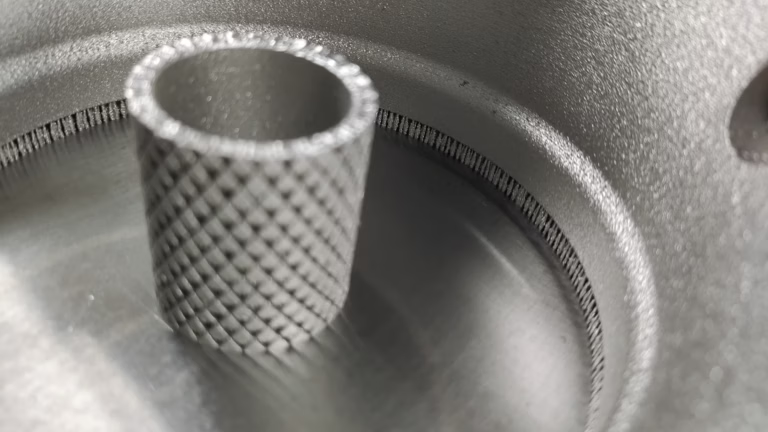
That is the transition point. When a part needs ±0.005 mm tolerance, a documented material certificate and a finish of Ra 0.8–1.6 μm, additive adhesion tricks are the wrong control. We machine those parts instead. For geometries that should stay printed, we use SLM and other industrial additive routes where the build plate and thermal model are controlled equipment parameters, not operator habits.
- 1Humidity shifts dryingA damp film is a first-layer defect you cannot log.
- 2High-shrink polymersNylon, PC and PEEK need more than a glue film.
- 3When tolerance is tight±0.005 mm calls for machining, not bed adhesion tuning.
PVA Glue vs Other Bed Adhesion Methods
Match the method to the filament and the plate, not to habit.
| Method | Best For | Bed Temp | Main Risk |
|---|---|---|---|
| PVA glue stick | PLA and PETG on glass or PEI | 50–80 °C | Thick film causes over-adhesion |
| PVA + water spray | Large flat PLA footprints | 50–60 °C | Water boils if the film is wet |
| ABS slurry | ABS and ASA only | 90–110 °C | Attacks tape and PEI coating |
| PEI sheet, no glue | PLA and PETG, clean release | 50–70 °C | Wears out; needs periodic replacement |
| Dedicated nylon adhesive | Nylon and polycarbonate | 100–120 °C | Hard to remove; needs a release agent |
| Textured build plate | PETG and flexible filaments | 60–80 °C | Texture transfers to the part face |
| Raft or brim only | Small footprints, tall thin parts | Any | Extra material and post-processing |
When Glue Is Right, and When It Is Not
For PLA and PETG prototypes on glass or PEI, a thin PVA film below 85 °C is the cheapest reliable answer. For Nylon, PEEK, polycarbonate, or any part that must hold ±0.005 mm in a repeated run, skip the glue and change the process: dedicated adhesives for high-shrink polymers, or CNC machining when the tolerance and finish are the real requirements.
PVA Glue and 3D Printing Adhesion Questions
How thick should the PVA layer be?
Aim for 10–30 μm, which is one thin pass of a glue stick or a light coat from a 1:8 PVA-to-water mix. If you can see ridges or the surface looks milky and wet, it is too thick.
A thick film traps water. That water turns to steam at 100 °C and lifts the part corner. It also bonds so well that removal damages the plate.
Can I use PVA glue with Nylon or Polycarbonate?
No. Those materials print with bed temperatures of 100–120 °C, well above the PVA glass transition of about 85 °C. The film softens and stops holding.
They also shrink harder than PLA or PETG. Use an adhesive made for high-shrink polymers, or move the part to a machining process if the tolerance matters.
Why does my part stick so hard I cannot remove it?
Almost always too much film. Two or three wet passes create full-area bonding that you cannot break without prying, and prying cracks glass and tears PEI.
Cool the plate below 40 °C first, then flex the plate or use a thin spatula at a corner. Reduce to one thin pass next time.
How often should I reapply the PVA film?
Every two to three prints on the same plate, or sooner if the center looks polished where parts sit most often. A worn film grips unevenly.
Uneven grip is worse than no grip, because the failure moves around and you cannot trace it to a parameter.
Does humidity affect PVA adhesion?
Yes. In humid conditions the film takes longer to dry, and a damp film produces steam under the first layer. Drying time also varies with how thick you applied it.
In a controlled shop, log the room humidity or dry the film with the heated bed at 60 °C for a few minutes before starting the print.
When should I stop tuning adhesion and machine the part instead?
When the requirement is dimensional, not visual. If the drawing calls for ±0.005 mm, a specific alloy and a documented inspection report, bed adhesion is not the controlling variable.
We machine those parts from aluminium, stainless, titanium and engineering plastics, with finishes from Ra 0.2–0.8 μm up to as-machined. Upload the model and we return a quote and DFM analysis within 12 hours.
Send the Model, Get a Machining Quote
Upload your STEP file and we return a quotation with free DFM analysis within 12 hours. No minimum order quantity, from one prototype to 10,000+ parts, with 100% inspection before shipment.
12-hour quoteNo MOQ100% inspectionNDA on request
GreatLight in the Field
We publish setup notes, tooling trials and inspection data from the factory floor.











