
CNC Machining for Aluminum: How the Metal Shapes the Process
Aluminum is the most common material that crosses our machines, and it behaves differently from steel at every step. This page explains what drives tool choice, tolerances and cost in CNC machining for aluminum parts. It is written for design engineers and buyers who need to decide on an alloy, a tolerance band and a finishing route before releasing a drawing.
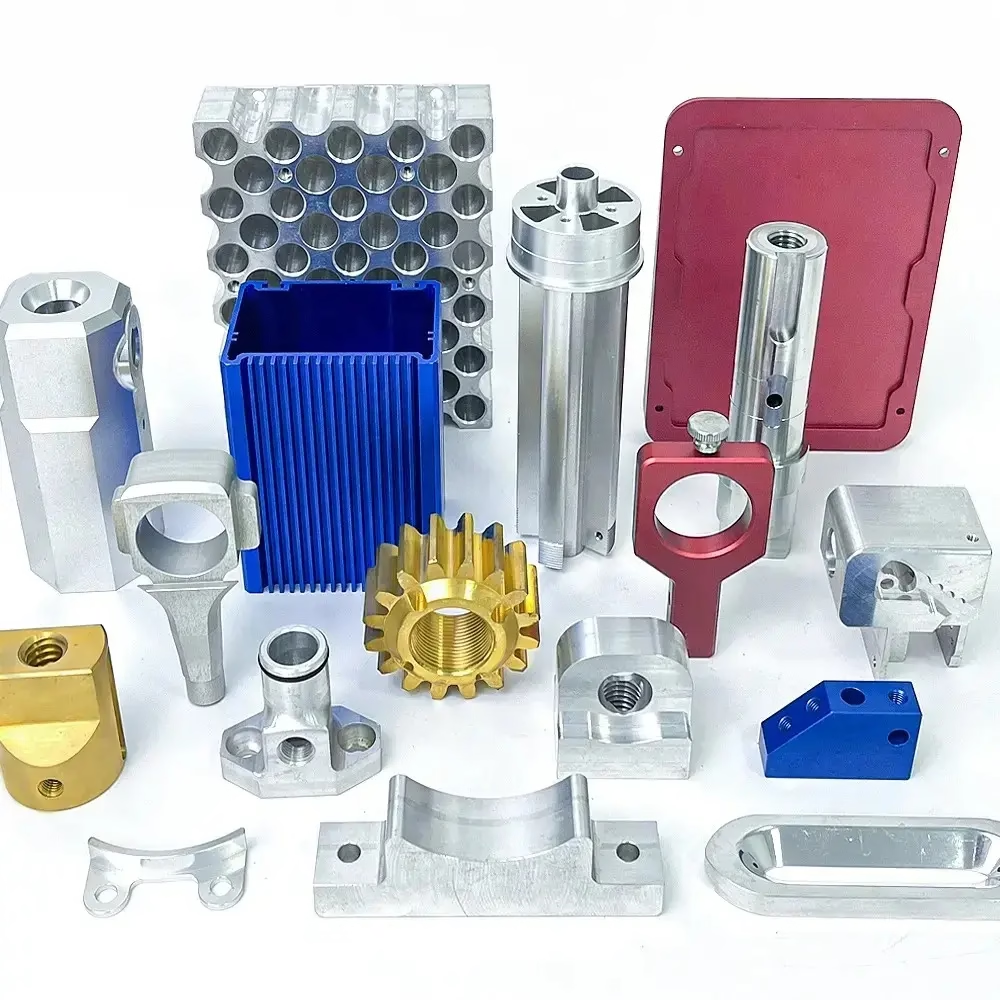
What makes aluminum different at the spindle
Aluminum cuts fast. Cutting speeds run five to ten times higher than on 304 stainless, and a sharp cutter leaves a finish that often needs no secondary operation. That speed is the reason aluminum parts are cheap to machine in small and mid volumes. It is also the reason a shop can scrap a good part quickly. Aluminum has little ability to absorb heat through the chip, so a dull tool or a starved cut pushes heat into the workpiece. The part moves, the finish tears, and the dimension drifts out of band.
The metal is soft, roughly one third the density of steel, and that low density sets up a specific problem. Clamping force that would be normal on a steel block will deflect an aluminum wall. Thin ribs and tall bosses spring away from the cutter, then spring back after the vise opens. A part that measured in tolerance on the machine can be out of tolerance on the bench.
Thermal expansion matters more than most drawings admit. Aluminum expands about 23 × 10⁻⁶ per °C, roughly twice that of steel. A 300 mm aluminum part that warms 10 °C during roughing grows about 0.07 mm. That is more than ten times a ±0.005 mm band. Temperature control, not just a good machine, is what holds tight tolerances on long aluminum parts.
None of this makes aluminum hard to machine. It makes aluminum sensitive to setup decisions. Feed, speed, clamping and coolant have to be chosen together. Change one and the others usually need to change too.
- 1Low densityLight parts, but also easy to deflect under clamping load
- 2High thermal expansionAbout twice steel; long parts grow measurably when warm
- 3Soft and gummy at low speedBuilt-up edge forms when feeds are too light
- 4Fast chip evacuation neededDeep pockets fill with chips and recut them
Alloy grade decides more than strength
The alloy you pick controls chip formation, surface finish and how the part behaves after anodizing. It also decides whether a thin wall will hold its shape. Two aluminum parts with the same geometry can machine completely differently if one is 6061-T6 and the other is 7075.
6061-T6 is the default for structural and enclosure work. It machines cleanly, welds well, anodizes to a consistent color, and is available in bar, plate and extrusion. Tolerances down to ±0.005 mm are routine. If a part has no special requirement, 6061-T6 is usually the right first answer.
7075 has roughly double the yield strength of 6061 and is used where stiffness or fatigue life matters, such as aerospace brackets and racing components. It cuts to a better finish but costs more and is less weldable. 2024 is another high-strength option with good fatigue behavior, though its corrosion resistance is lower and it is often clad or coated.
For corrosion resistance near salt water or marine air, 5052 and 5083 are the usual picks. They form well and resist stress corrosion cracking, but they are gummy to machine and less rigid. 6082 sits close to 6061 with slightly higher strength, and 6063 is chosen mainly for extrusion or cosmetic parts where finish matters more than load.
ADC12 is a die casting alloy, not a billet grade. It appears in our list because we machine castings as well as solid stock. Machining a casting is a different job: the skin is hard, the interior may contain porosity, and the first cut tells you what the casting really is.
- 16061-T6General structural and enclosure work; best all-round choice
- 27075High strength and stiffness; aerospace and racing
- 32024Fatigue resistance; needs coating for corrosion
- 45052 / 5083Marine and chemical exposure; gummy to cut
- 5ADC12Castings; hard skin, possible internal porosity
How setups and cutters are chosen for aluminum parts
Aluminum is normally machined dry or with a light mist. Flood coolant is used mainly to clear chips, not to cool the cut, because the chip carries most of the heat away. High-pressure through-spindle coolant helps in deep pockets where chips would otherwise pack and be recut. Recutting a chip is the fastest way to a torn surface and a chipped edge.
Tool geometry favors two or three flutes rather than four. Fewer flutes leave more room for the chip in the groove, which matters at the feed rates aluminum allows. Polished flutes and a sharp edge reduce built-up edge. Carbide is standard; diamond-coated tools are used on abrasive grades and on long production runs where tool life dominates.
Rigidity is the limiting factor, not spindle power. A 4,000 mm part on a machine with a long reach will chatter before the cutter is loaded. We keep three travel classes for this reason: 4,000 × 400 × 150 mm for long extrusions and rails, 750 × 1,150 × 550 mm and 600 × 600 × 600 mm for general plate work, and 500 × 500 × 450 mm or 500 × 310 × 200 mm for compact parts where a smaller machine is stiffer.
Five-axis work changes the economics. A part with features on four or five faces can often be cut in one setup on a simultaneous 5-axis center, which removes the repositioning error that comes with three or four separate fixtures. We run 16 simultaneous 5-axis machining centers, 12 four-axis mills, 27 three-axis machines and 16 mill-turn centers. The right answer is the smallest machine that holds the tolerance, not the largest one available.
Fixturing deserves as much attention as the cutter. Soft jaws machined to the part profile spread the load. Vacuum plates work well on thin plate but need enough surface area. For thin walls, a two-stage approach helps: rough leaving 0.5–1.0 mm of stock, let the part cool, then finish with light passes. That single change often decides whether a 1.5 mm wall stays flat.
- 1Chip clearance firstThrough-spindle coolant in pockets deeper than three diameters
- 2Two or three flutesMore chip room at the feeds aluminum allows
- 3Smallest rigid machineStiffness beats travel for tight tolerances
- 4Rough, cool, then finishKeeps thin walls flat without special tooling
Tolerances, finishes and where aluminum stops
Aluminum holds tight tolerances well when the part is small and the setup is rigid. We work to ±0.005 mm (±0.0002 in) where the drawing calls for it, and inspect 100% before shipment. On a 20 mm bore that is a reasonable target. On a 400 mm aluminum rail it is not, because thermal expansion and residual stress from the plate will move the part more than that between the machine and the inspection bench.
Surface finish follows the same logic. As-machined aluminum sits around Ra 1.6–3.2 μm. A careful finish pass reaches Ra 0.8–1.6 μm, and fine work with the right cutter and a stable setup reaches Ra 0.2–0.8 μm. Chasing a mirror finish on aluminum usually costs more than the function requires. If the part is going to be anodized, the anodic layer will change the surface anyway and can hide or amplify tool marks.
Anodizing is the finish most aluminum parts receive. Clear and colored anodizing build a thin oxide layer that adds roughly half the layer thickness to each dimension. Hardcoat builds more. If a bore has a tight fit, the drawing should state whether the tolerance applies before or after coating. This one note prevents a surprising number of rejected assemblies.
Aluminum is the wrong material in a few clear cases. Wear surfaces that rub against steel will gall and wear quickly. Parts that see continuous service above roughly 200 °C lose strength fast, because many aluminum alloys age-soften well below their melting point. High-cycle fatigue in a stress concentration is a poor match unless the alloy and geometry are chosen for it. In those cases steel, stainless or titanium is the honest answer, even though it costs more to machine.
- 1Small and rigid±0.005 mm is realistic on bores and short features
- 2Long and thinExpect looser bands; expansion and stress dominate
- 3Anodize allowanceState whether the tolerance is pre- or post-coating
- 4Wrong for aluminumSteel-on-aluminum wear, hot service, sharp fatigue
Matching aluminum alloys to the job
Use this to narrow the alloy before quoting.
| Alloy | Best for | Machinability | Watch out for |
|---|---|---|---|
| 6061-T6 | Brackets, enclosures, general parts | Excellent | Nothing unusual |
| 7075 | High-strength aerospace and racing | Good, better finish | Higher cost, poor weldability |
| 2024 | Fatigue-loaded aircraft parts | Good | Low corrosion resistance |
| 5052 / 5083 | Marine and chemical exposure | Fair, gummy | Low rigidity, poor chip control |
| 6082 | Structural parts in metric stock | Very good | Slightly higher cost than 6061 |
| 6063 | Extrusions and cosmetic covers | Excellent | Low strength for loaded parts |
| ADC12 | Die cast housings and covers | Good after skin cut | Internal porosity, hard skin |
When aluminum is the right call
Choose 6061-T6 when the part is structural, anodized and cost-sensitive. Move to 7075 or 2024 only when strength or fatigue actually drives the design, and switch to steel or titanium when the part rubs against steel, runs hot or sees sharp fatigue cycles.
Common questions on aluminum machining
Can you hold ±0.005 mm on a long aluminum part?
On short, rigid features, yes. On parts several hundred millimeters long, thermal expansion and residual stress from the plate make that band unrealistic. We would quote a wider tolerance or add a stress-relief step, and we would say so before the job starts.
If the drawing needs ±0.005 mm over a long span, the honest move is to shorten the critical feature, split the part, or use a material with lower expansion.
Does anodizing change my dimensions?
Yes. Clear and colored anodizing add a thin oxide layer, and hardcoat adds more. The growth is roughly half the layer thickness per surface.
State on the drawing whether a tight bore tolerance applies before or after coating. That single note avoids most fit problems on anodized aluminum assemblies.
Which aluminum alloy gives the best surface finish?
6061-T6 and 6063 cut to the cleanest finish in normal work, and 7075 also finishes well. The 5000-series alloys are gummier and tend to tear.
Cutter condition matters as much as alloy. A sharp, polished two-flute cutter with enough feed produces a better surface than a worn four-flute tool, whatever the grade.
Is aluminum cheaper to machine than stainless steel?
Usually, yes. Cutting speeds are far higher, tools last longer and fewer setups are needed for the same geometry. A stainless part with the same features often takes two to three times the cycle time.
That advantage narrows when the part needs a hardcoat, a tight post-coating tolerance, or a stress-relief step before finishing.
What is the largest aluminum part you can machine?
Our largest travel is 4,000 × 400 × 150 mm, which suits long extrusions, rails and beams. General plate work runs on machines with 750 × 1,150 × 550 mm or 600 × 600 × 600 mm travel.
Long parts are usually machined on the larger machines even when a smaller one could reach the feature, because the extra mass helps damp vibration.
Do you machine aluminum castings as well as solid stock?
Yes. We machine ADC12 and other castings, but the job differs from cutting billet. The cast skin is harder than the interior, and porosity may appear once the skin is removed.
For castings we plan the first cut to reveal the material condition, then adjust feeds before running the finishing passes.
Send a drawing and get a real answer
We review your aluminum part, flag any tolerance or alloy mismatch, and return a quotation with a free DFM analysis within 12 hours.
12-hour quote100% inspectionNo MOQ
More from the shop floor
We publish setup notes, tooling trials and inspection data from the factory floor.











