
Plastic mold solutions for extended style design with mechanical treatment
This page explains how a styled plastic part is defined by the mold, not by the drawing alone. We cover the machined inserts, the mechanical treatment of the cavity surface, and where the process breaks down. Read it and you can tell which parts belong in a machined mold and which do not.
In this article
- 1
- 2
- 3
- 4
- 5
- 6
- 7
What plastic mold solutions actually control in a styled part
A styled plastic housing is a set of surfaces that must agree with each other. A long sweep along the side, a parting line that follows the sweep, a rib field on the inside that stiffens the sweep without sinking the outside. The customer drawing shows the outside. The mold decides how much of it survives.
This is why plastic mold solutions are a machining problem before they are a molding problem. The cavity, the core, the slides and the inserts are cut metal. Every curve in your render becomes a toolpath, and every toolpath has a minimum radius, an entry angle and a reach.
When the design is extended over a large area, the number of surfaces goes up fast. A phone housing might carry one sweep over 150 mm. A car interior trim panel carries the same sweep over 900 mm, plus ribs, plus clips, plus a texture that has to run in one direction.
The engineering meaning is simple. Longer styled surfaces give the moldmaker fewer places to hide a witness line, and give the machine fewer options for holding tolerance. If the drawing does not define parting, draft and texture direction, the shop will choose them for you.
Machined inserts versus cast cavities
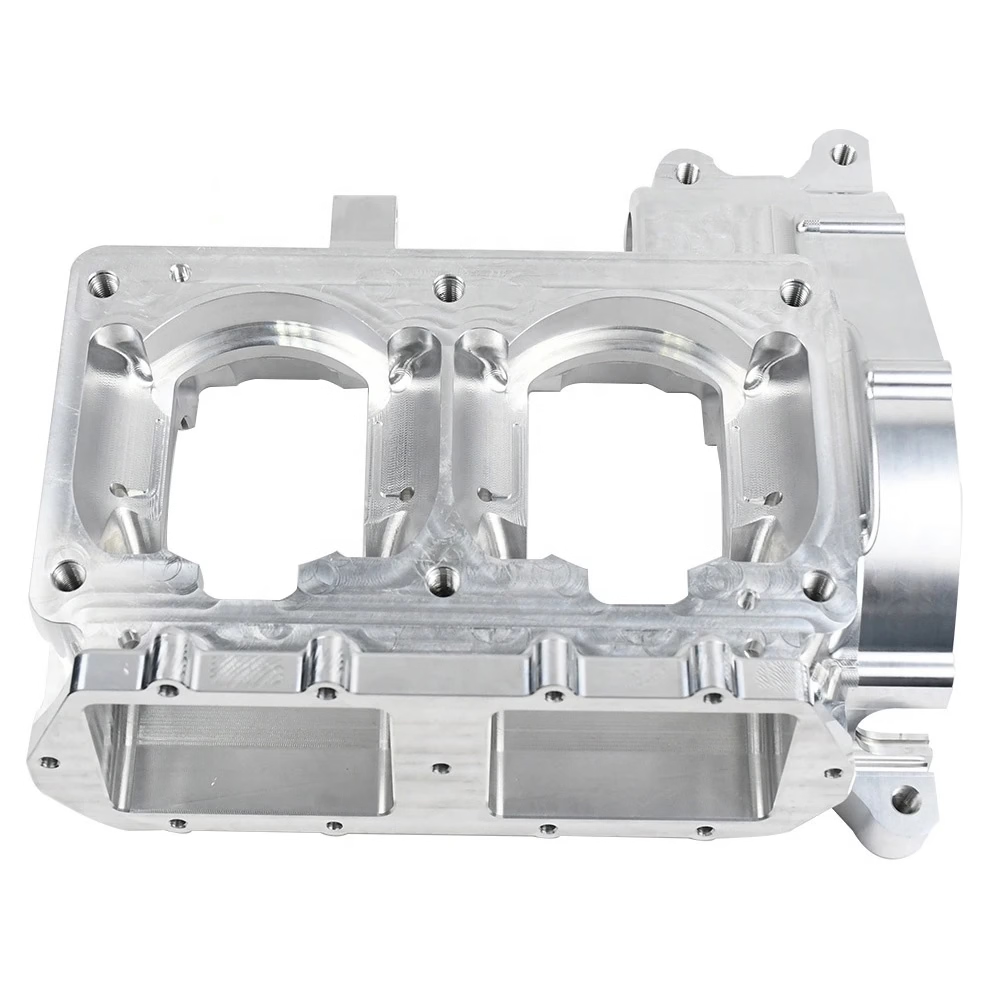
A cast cavity is poured from a pattern. It is cheap per unit when the geometry is simple and the surface is non-critical. A machined insert is cut from a billet of P20, 718H, NAK80, 1.2344 or similar mold steel. It is expensive per unit and predictable per unit at the same time.
The choice turns on two things: how tight the styled surfaces must match each other, and how much mechanical treatment the surface will receive afterward. Texture, bead blasting and polishing all remove or displace a thin layer of steel. If the cavity wall thickness varies across the part, that layer behaves differently in each zone.
For extended style design, the split is usually mixed. The main styled body runs on machined inserts because the sweep tolerance matters. Deep ribs, bosses and small detail go into inserts that can be replaced without scrapping the whole block.
We cut inserts on 5-axis centers so the tool can stay normal to a swept surface. A 3-axis cut on a 30° wall leaves step marks that no polishing budget can fix. Reach matters too: a 900 mm sweep needs a long tool, and a long tool deflects.
Mechanical treatment of the cavity surface
Mechanical treatment covers everything done to the steel after roughing: semi-finish, finish, EDM, polishing, bead blasting, laser texturing and engraving. Each step changes the surface and each step changes the next one.
A typical sequence runs rough at 0.3–0.5 mm stepover, semi-finish at 0.1–0.15 mm, then finish at 0.02–0.05 mm with a ball nose small enough to reach the corners. That last pass is where the visible surface is created. If it is skipped and the cavity goes to EDM, you get a recast layer and a matte surface that has to be polished back.
Texture is where extended surfaces get hard. A texture applied to a 1,200 mm panel must read the same at both ends. If the grain runs out because the steel was etched unevenly or the flow direction is inconsistent, the eye finds it immediately.
Mechanical engraving on a curved cavity is a machined operation, not a chemical one. We cut lettering with a minimum character height of 1.5 mm and keep the depth shallow, because deep engraving on a swept wall distorts when the plastic shrinks.
Draft, shrinkage and the parting line
Draft is not a cosmetic allowance. It is the angle that lets the part leave the steel. On a textured surface, the required draft rises with texture depth. A shallow matte finish may run at 1°, a heavy grain at 3° or more.
Shrinkage moves the part after the mold is cut. For unfilled ABS the shrink is roughly 0.4–0.7%. For glass-filled grades it drops. If the styled surface is defined on the finished part, the cavity must be cut oversized in the right direction. Get the direction wrong and the parting line lands on the visible face.
The parting line is the most expensive line in the drawing. Put it on a tangent edge and it disappears. Put it across a flat styled face and it becomes the first thing a customer sees.
We check all three together before cutting: draft against texture depth, shrink against the material grade, parting against the visible surface. A change here costs a drawing revision. A change after the cavity is cut costs an insert.
Where plastic mold solutions fail
The common failure is a wall that is too thin next to a wall that is thick. The thin wall fills first and freezes. The thick wall sinks. On an extended styled panel this shows as a low gloss patch or a visible ripple along the sweep.
Draft shortfall is the second failure. A wall modeled at 0.5° draft and a 0.1 mm texture will drag. The fix is not more release agent. The fix is a drawing change before the cavity is cut.
The third is tool reach. A 40 mm deep pocket in a styled wall needs a tool that is long enough to reach and stiff enough not to chatter. When the two conflict, we cut the pocket with a long tool at reduced stepover, then finish the visible band with a short tool from a different setup.
There is a point where the geometry should not be molded at all. A one-off styled enclosure, or a panel with features below 0.5 mm, is usually cheaper as a machined or 3D printed part. Molds pay back on repeat volume, not on shape alone.
How we sequence a styled mold job
- 1DFM on the drawingWe check draft, wall thickness, shrink direction and parting in one pass and return a report within 12 hours.
- 2Insert layoutSplit the cavity into inserts by surface function, not by size, so the styled band stays in one piece.
- 3Rough and semi-finishCut at 0.3–0.5 mm then 0.1–0.15 mm stepover, leaving 0.2 mm on the styled surfaces.
- 4Finish passBall nose at 0.02–0.05 mm stepover, tool normal to the sweep on a 5-axis center.
- 5Mechanical treatmentPolish to Ra 0.2–0.8 μm where gloss matters, bead blast where it does not, then texture.
- 6Fit and spotClose the mold on blue, check parting contact, adjust the shut-off before first shot.
- 7First articleMeasure the styled surfaces and the parting line against the drawing before releasing the tool.
Which mold route fits your part
Read the row that matches your geometry and finish requirement.
| Condition | Machined insert | Cast cavity |
|---|---|---|
| Sweep tolerance must hold across 600 mm+ | Preferred | Risky |
| Surface will be heavily textured | Preferred | Uneven grain |
| Prototype or low volume | Preferred, no MOQ | Pattern cost too high |
| Simple flat geometry, matte finish | Acceptable | Lower cost |
| Deep ribs plus tight outside face | Split insert set | Poor control |
| Lead time under 5 days | Cut from billet | Needs pattern first |
When to machine and when to mold
If the styled surface must match across a long sweep and the volume is under a few thousand parts, machine the part or the insert and skip the cast cavity. If the volume is high and the geometry is simple, a cast cavity with a machined styled insert is the cheaper route.
Questions engineers ask
How much draft does a textured styled surface need?
Draft rises with texture depth. A light matte finish may run at 1°, a coarse grain at 3° or more on vertical walls. Deep texture on a long sweep needs the most.
Can you cut a mold insert from the same CAD file as the part?
Yes, but the part model has to be offset for shrink and split for the parting line first. We work from the styled surface and build the steel around it.
What tolerance can you hold on a cavity insert?
±0.005 mm on critical fits, with 100% inspection before shipment and reports on request. Styled surfaces are usually held to the drawing plus a texture allowance.
Which materials do you machine for mold work?
Mold steels such as P20, 718H, NAK80 and 1.2344, plus aluminium grades like 7075 and 6061 for prototype tooling where cycle count is low.
How do you handle engraving on a curved cavity?
We machine it with a small ball nose rather than etching. Minimum character height is 1.5 mm, and depth stays shallow so the plastic does not distort the lettering.
Do you sign an NDA for mold drawings?
Yes. Uploads are secure and confidential, and an NDA is available on request before you send any data.
Send the styled surface, get a mold route
Upload the part model and we return a DFM report and quotation within 12 hours, with insert layout and texture notes on the same sheet.
12-hour quote100% inspectionNo MOQ
More machining notes
We publish setup notes, tooling trials and inspection data from the factory floor.











