
When a Packaging Company Recycles Old Drinks Cartons Into 3D Printed Furniture
This guide is for engineers and sourcing staff who need to judge whether a packaging company recycles old drinks cartons into a usable board, filament or pellet, and whether that output fits 3D printed furniture. It covers material behavior, process limits, tolerances, MOQ and the checks that separate a working line from a demo.
In this article
- 1
- 2
- 3
- 4
- 5
- 6
- 7
- 8
Key takeaways
Which output form fits which furniture part
Compare the three common outputs from a carton recycling line before you pick a supplier.
| Output form | Typical part | Process fit | Main risk |
|---|---|---|---|
| Pressed board | Shelf, drawer front, panel | CNC routing, edge banding | Moisture swell at cut edges |
| Filament | Small brackets, trim, knobs | FDM printing, 0.4–0.8 mm nozzle | Diameter drift jams the feeder |
| Pellet compound | Seat shell, leg, large shell | Large-format extrusion printing | Batch-to-batch color shift |
| Molded pulp | Packaging insert, tray | Thermoforming, pulp molding | Low stiffness, no screw threads |
| Hybrid with virgin resin | Load-bearing frame | Injection molding, printing | Higher cost per kilogram |
What to put on the RFQ so quotes come back comparable
| Item | What to state | Why it matters |
|---|---|---|
| Output form | Board, filament or pellet | Sets the process and the machine |
| Part size | Length × width × thickness in mm | Fixes the press or printer envelope |
| Tolerance | ±0.2 mm board, ±0.5 mm printed | Stops suppliers quoting metal-grade numbers |
| Recycled content | Target fiber and polymer share | Drives the input stream choice |
| Finish | Sealed faces, laminate, paint or raw | Sealing controls moisture swell |
| Volume | One prototype to 10,000+ parts | Sets tooling and unit cost |
| Certifications | ISO 9001:2015, plus any industry add-on | Confirms a documented quality route |
| Inspection | Thickness, weight, hole position | Gives an objective accept/reject rule |
Board for flat parts, metal for the load path
Recycled carton stock works well for panels, shelf boards and drawer fronts. When the part carries a repeated load or needs a precise fit, pair it with a machined metal frame instead of pushing the recyclate past its limit.
What a packaging company recycles old drinks cartons into
A beverage carton is not paper. It is a sandwich of paperboard, a thin polyethylene film and, in aseptic grades, a layer of aluminum foil. When a packaging company recycles old drinks cartons, the fiber is the bulk of the mass, but the polymer and foil do not disappear. They either stay bonded in the fiber or are separated in a hydropulper and recovered as a mixed stream. That leftover stream is what feeds a 3D printing line.
Most lines take one of two paths. The first presses the separated fiber and polymer into a rigid board that is later routed or printed onto. The second compounds the polymer fraction with a carrier resin and extrudes it into filament or pellet. The first path is more forgiving. The second gives you a printable feedstock but demands tighter control of melt flow, moisture and pellet size.
For furniture, the board path usually wins. A shelf board or drawer front is a flat, low-stress part. You can route it on a standard 3-axis machine, drill shelf-pin holes and finish it with a laminate. A printed shell or leg is possible too, but only when the part is thick and the load path is short. Thin printed walls in a carton-based compound tend to creep under a sitting load over months.
The practical question is not whether the material is recycled. It is whether the supplier can hold the same density, thickness and color across batches. Ask for the fiber fraction, the polymer fraction and the moisture content of the incoming bales. A supplier who cannot state those three numbers is running a demo, not a production line.
Tolerances and geometry limits for carton-based furniture parts
Carton-based stock moves with humidity. A pressed board can swell 0.3–0.8% in thickness when relative humidity climbs from 50% to 80%. That is a real number for a 20 mm panel. If your assembly has a fixed slot, budget for the swell or seal all six faces. Printed parts show the same effect, plus warp from uneven cooling on long runs.
For machined board, a realistic working tolerance is ±0.2 mm on length and width, and ±0.15 mm on hole position when the panel is clamped flat. That is far looser than the ±0.005 mm a metal shop holds on aluminum, and it should be. Chasing a tight tolerance on a hygroscopic panel only adds cost and scrap.
For printed furniture, the layer height sets the surface. A 0.4 mm nozzle at 0.2 mm layers gives a visible ribbing. Sanding a carton-based print is difficult because the fiber tears. If the part is visible, print it slightly oversize and machine the mating faces, or design the ribbing into the look.
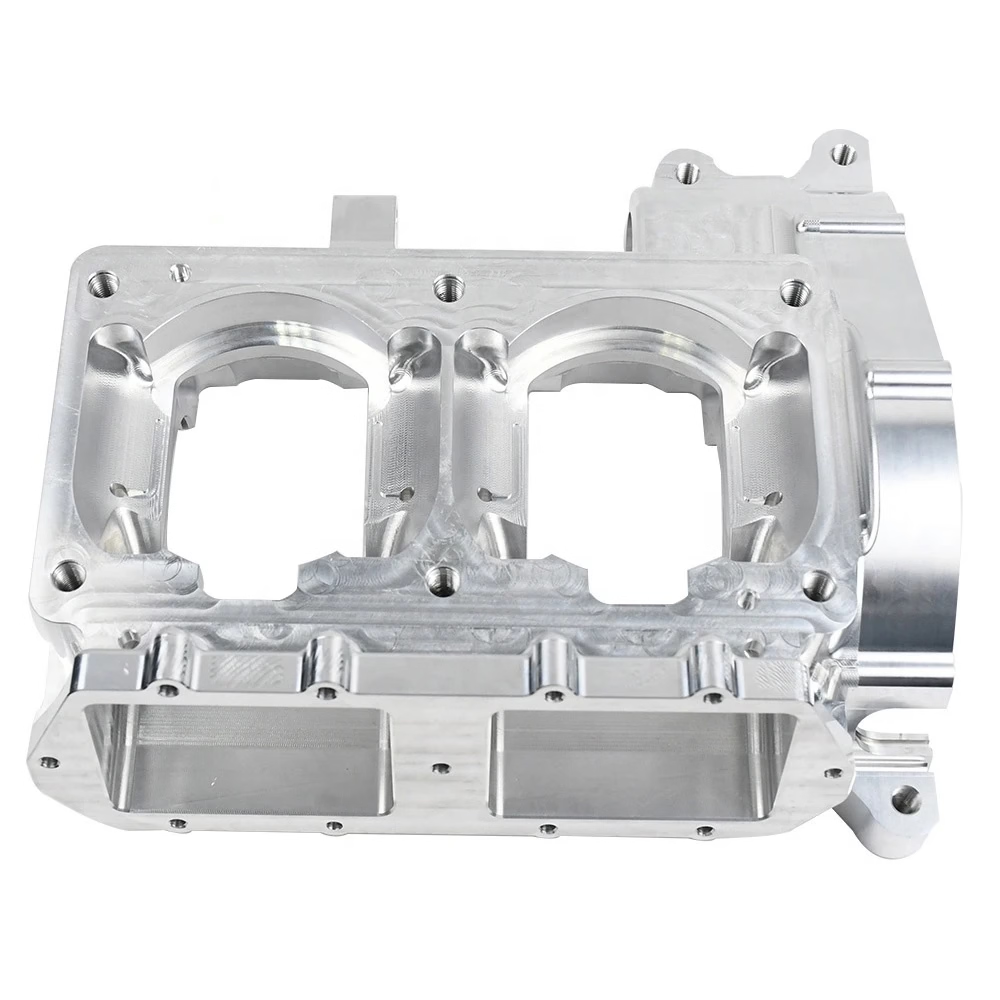
Screw threads are the weak point. A direct thread in carton-based board strips at low torque. Use through-bolts with washers, threaded inserts, or a metal bracket. GreatLight machines those brackets and inserts from 6061, 304 stainless or 4130 steel, so a mixed assembly of recycled panels and metal hardware is a normal job for us.
- 1Board, machined flat±0.2 mm on length and width, ±0.15 mm on hole position.
- 2Printed shell±0.5 mm on a 200 mm span once the part has cooled and settled.
- 3Thickness swell0.3–0.8% from 50% to 80% relative humidity; seal cut faces.
- 4ThreadsUse inserts or metal brackets, not direct threads in the board.
How to qualify a supplier who recycles old drinks cartons
Start with the input stream. A supplier should be able to say where the bales come from and how they are sorted. Mixed post-consumer cartons carry food residue, which raises odor and can feed bacteria in a damp board. Industrial offcuts from a converting plant are cleaner and more consistent, but the volume is lower. Neither is wrong; you just need to know which one you are buying.
Next, ask how the polymer and foil are handled. Some lines burn or landfill the reject stream. Others compound it into the printing feedstock. The second option is the one that gives the material its recycled content claim, but it also introduces the aluminum particles that wear a brass nozzle. A hardened nozzle, or a pellet-based large-format printer with a screw, avoids that wear.
Then look at the quality system behind the line. A furniture part still has to fit. If the supplier holds ISO 9001:2015, there is a documented inspection step and a route to a corrective action when a batch drifts. For a consumer-facing product, ask about ISO 27001:2022 if they handle your drawings and sales data, and ISO 13485:2016 only matters if the same part touches a medical application.
Finally, test the pilot. Order one board or one printed shell before you commit to a mold or a tonne of pellet. Measure thickness at five points, weigh the part, and leave a sample in a humid room for two weeks. The change you see in that sample is the change you will see in the field.
Where the cost sits and what drives delivery
The fiber is nearly free. The cost sits in drying, pressing and the reject rate. A line that recycles old drinks cartons spends most of its energy budget on removing water, so moisture control is the single biggest lever on unit cost. A supplier who accepts wet bales will pass the drying cost back to you.
Tooling is the second lever. A press mold or a large-format print nozzle is a one-time cost. If your volume is under a few hundred parts, a routed board is usually cheaper than a printed shell, because the CNC program is the only setup. Above a few thousand identical parts, a mold or a dedicated extrusion line starts to pay back.
Delivery depends on the input, not the machine. Clean industrial offcuts can move in days. Post-consumer bales need sorting and washing, which adds days. Build that into your schedule instead of assuming a fixed lead time.
For the metal side of the assembly, GreatLight quotes and returns a free DFM analysis within 12 hours, and production can start within 24 hours. Parts ship in 3–5 days, with a historical late-delivery probability below 2%. We run 127 high-precision CNC machines across three wholly-owned plants in Dongguan and Singapore, hold ±0.005 mm on metal parts, and inspect 100% before shipment. There is no minimum order quantity, from one prototype to 10,000+ part runs.
Step by step: turning cartons into a furniture part
This is the sequence we use when a customer brings a carton-based panel or print into a mixed assembly.
- 11. Characterize the inputTake a 1 kg sample of bales and measure fiber, polymer and aluminum share plus moisture. Reject bales above 12% moisture.
- 22. Separate and cleanHydropulp at 40–60 °C to lift the fiber, then screen the polymer and foil. Rinse the fiber to cut odor.
- 33. Dry to a targetDry fiber and polymer to 6–8% moisture before pressing or compounding. Wet stock blisters and warps.
- 44. Form the stockPress board at 180–200 °C and 3–5 MPa, or compound pellet at 190–220 °C with a carrier resin.
- 55. Condition the stockLet board sit 24–48 hours at 50% relative humidity so it reaches equilibrium before machining.
- 66. Machine or printRoute panels on a 3-axis machine, or print shells at 0.2–0.3 mm layers with a hardened nozzle.
- 77. Add metal hardwareMachine brackets, inserts and pivot pins from aluminum or stainless and press or bolt them in.
- 88. Seal and inspectSeal all cut faces, then check thickness at five points and hole position against the drawing.
Questions buyers ask before committing
Is carton-based board strong enough for a chair or a shelf?
For a shelf board or a drawer front, yes. Keep the span under about 800 mm and support it on both ends. For a chair seat, the load is concentrated and repeated, so a plain carton board will creep.
Use a hybrid: a carton-based panel for the visible surface and a machined aluminum or steel frame for the load path. That is how we usually build a mixed assembly.
Does the recycled content change the printing parameters?
Yes. A carton-based compound has a lower and less uniform melt flow than virgin PLA or PETG. Expect to drop the print speed by 20–30% and raise the nozzle temperature within the supplier's stated window.
Aluminum particles from the foil layer are abrasive. Fit a hardened steel or ruby nozzle, not a standard brass one, or the orifice will open up within a few kilograms.
What tolerance can I realistically hold on a machined carton panel?
±0.2 mm on length and width and ±0.15 mm on hole position, with the panel clamped flat during machining. Anything tighter ignores the humidity-driven swell of the material.
If a mating face needs a tight fit, machine that face in metal and let the panel float on a slotted hole.
How do I compare two suppliers who both claim recycled carton feedstock?
Ask both for the same four numbers: fiber share, polymer share, moisture content and density. Then ask for a batch record from the last three months.
A supplier with a documented inspection step, such as one holding ISO 9001:2015, can usually produce those records. If the numbers are missing, the recycled claim is unverifiable.
Can the same shop make the metal brackets and the recycled panels?
It can, and it is usually simpler. One drawing package, one inspection report and one shipment. We machine inserts, pivot pins and brackets from 6061 aluminum, 304 stainless or 4130 steel and pair them with the panel or print.
That avoids the tolerance stack you get when two vendors each hold their own reference.
What is the smallest order I can place to test the material?
There is no minimum order quantity on our side. One prototype part is a normal order, and so is a 10,000+ part run.
For a material test, start with a single board or a single printed shell and leave it in a humid room for two weeks before you approve the design.
Send your panel or print drawing
Upload the part and we return a quotation with a free DFM analysis within 12 hours, covering the recycled panel and any metal hardware it needs.
12-hour quote100% inspectionNo minimum order quantity
More process notes from the shop floor
We publish setup notes, tooling trials and inspection data from the factory floor.











