
Optical CNC Plastic Machining Services
This guide is written for engineers and sourcing teams who need plastic optics cut from solid stock, not molded. It covers the seven checks that decide whether a supplier can actually hit your wavefront, haze and flatness targets, plus the material limits and lead-time questions to settle before you send a purchase order.
In this buyer guide
- 1
- 2
- 3
- 4
- 5
- 6
- 7
- 8
What matters most
Common optical plastics and where each one fits
Values are typical for machined stock, not molded parts.
| Material | Best for | Machining note | Watch out for |
|---|---|---|---|
| PMMA (acrylic) | Visible lenses, light pipes, windows | High spindle speed, light depth of cut | Chips weld to the tool if coolant is weak |
| PC (polycarbonate) | Impact covers, safety optics | Sharp tools, air blast to clear soft chips | Turns gummy, leaves torn edges |
| COC / COP | Low-birefringence imaging parts | Rigid clamping, small stepover | Stress cracks if clamped too hard |
| PEEK | Hot or chemically aggressive environments | Carbide tools, moderate speed, anneal after | Abrasive, wears tool edges fast |
| PA (nylon) | Non-optical housings and spacers | Dry cut where possible | Absorbs moisture, moves after machining |
| POM | Mounts, retainers, gear blanks | Easy to cut, holds tolerance well | Not transparent, no optical use |
Where optical cnc plastic machining services differ from general CNC work
Standard CNC work is judged on dimensions. Optical cnc plastic machining services are judged on how light passes through the part. A bore can sit inside ±0.005 mm and still ruin an image if the wall carries tool marks, internal stress or a faint haze. Buyers who compare quotes on tolerance alone usually find the gap later, at first-article testing.
The reason is the material. Plastics cut with lower stiffness and higher thermal expansion than aluminium. A PMMA blank moves roughly ten times more than steel for the same temperature rise, so the heat going into the cut matters as much as the feed rate. Suppliers who run plastic on aluminium parameters get chatter, melted edges and a finish no polishing step will recover.
So the first two checks are simple. Ask what tolerance and what surface finish the shop will hold on your specific geometry, and ask how it plans to control heat. A credible answer names spindle speed, depth of cut, coolant type and the annealing schedule before you ask twice.
- 1Form toleranceCovers flatness, parallelism and lens-seat location, not just outside dimensions.
- 2Surface roughnessRa 0.2–0.8 μm is achievable on optical plastics; Ra 0.8–1.6 μm suits non-imaging parts.
- 3Haze and scratch limitsDefine an inspection method, because haze is subjective without one.
Machine setup and fixturing for plastic optics
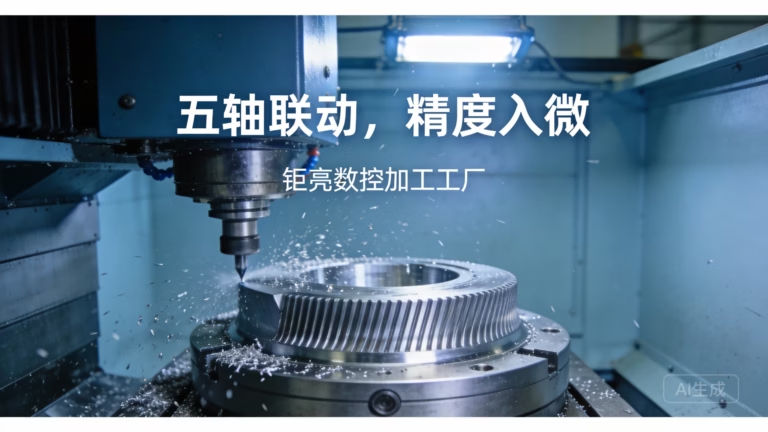
Every time a part is unclamped and moved, position error accumulates. On a lens barrel with three coaxial bores, that error shows up as decentration. This is why simultaneous 5-axis work matters here: a Ø400 mm rotary table plus a tilting head reaches multiple faces in one setup, so the relationship between bores stays locked to the machine, not to your fixture stack.
Fixturing is the other half. Soft jaws machined in place, vacuum chucks and low-pressure clamps spread the load so the blank is not distorted while cutting. A part that is squeezed into shape springs back after release, and the measured roundness you see on the CMM will not match the part that reaches your bench.
Ask the shop how it checks a thin wall. If the answer is a micrometer on the bench, expect movement. If the answer is an on-machine probe or a CMM under the same temperature conditions, the numbers are more likely to hold.
- 1Setup countFewer setups means less accumulated runout on coaxial features.
- 2Clamping pressureLight, distributed force. Never clamp a lens blank like a steel block.
- 3Thermal driftLet the part settle before final inspection, or measure warm and correct.
Material behavior and the post-processing chain
Optical plastics split into two rough groups. Amorphous grades such as PMMA, PC and COC give clarity and machine to a clean edge with diamond-coated tooling. Semi-crystalline grades such as PEEK and PA hold heat and chemicals better but scatter light, so they belong in mounts, retainers and structural optics rather than imaging paths.
Post-processing is where quotes diverge most. A fine cut from the machine may reach Ra 0.2–0.8 μm on PMMA. Getting below that means lapping, vapor polishing or flame polishing, and each method changes geometry slightly. Vapor polishing rounds edges. Flame polishing can introduce stress. Both must be planned, not added at the end.
Surface finishing for non-optical features is separate. Bead blasting, tumbling, anodizing and laser marking all apply to the metal parts around the optic, and laser marking needs a minimum character height of 1.5 mm to stay readable. Keep the optical surface masked through every step.
- 1Amorphous plasticsPMMA, PC, COC and COP. Clear, machinable, good for imaging surfaces.
- 2Semi-crystalline plasticsPEEK, PA, POM. Tougher, less transparent, better for structural parts.
- 3Polishing trade-offsVapor and flame polishing change edge geometry. Specify what must stay sharp.
Inspection, certification and what a quote should contain
A machined optic is only as good as the measurement behind it. Ask for raw material certificates, in-process checks and a final report. For imaging parts, that usually means a CMM sheet for dimensions plus a roughness or interferometer reading for the optical surface. If a shop cannot name its instrument, the tolerance claim is a guess.
Certification matters if your end product is regulated. ISO 9001:2015 covers general quality systems. IATF 16949:2016 applies to automotive work. ISO 13485:2016 covers medical devices. ISO 27001:2022 covers information security, which matters when you send CAD files of an unreleased product. A supplier holding all four can usually take a job from prototype through production without re-qualifying.
The quote itself should state tolerance, finish, material grade, inspection method and lead time. Vague quotes are the main source of disputes in this niche, because the buyer and the shop are often measuring different things.
- 1Inspection reportsAvailable on request, with raw material check, in-process monitoring and final inspection.
- 2ConfidentialityUploads are secure and confidential; an NDA is available on request.
- 3Quote detailA quote should carry a tolerance and a finish number, not just a price.
Lead time, order size and the pitfalls to avoid
Optical work is often prototype-driven, so order size flexibility matters. A shop that only runs 10,000-part batches is the wrong fit for a five-piece design iteration. Look for one that moves from a single prototype to a 10,000+ part run without changing process control.
On timing, a realistic chain is quotation and DFM feedback within 12 hours, production start within 24 hours, and parts shipping in 3–5 days for straightforward geometry. Complex lapped optics add time. Treat any promise of overnight delivery on a polished PMMA lens as a warning sign, because annealing and polishing do not compress.
The common pitfalls repeat. Undefined haze limits. No annealing step. Polishing added after the fact. A single setup count that hides three re-fixtures. Fix these in the RFQ stage, and first-article approval gets much shorter.
- 1Order sizeNo minimum order quantity, from one prototype to 10,000+ part runs.
- 2DFM feedbackFree DFM analysis alongside the quotation, before the toolpath is fixed.
- 3Late deliveryHistorical late-delivery probability below 2% across production work.
How to run the RFQ so quotes come back comparable
Follow these in order. Skipping step 2 is the most common reason quotes differ by 3×.
- 1Send a 3D model plus a 2D drawingPut every optical surface, datum and masked area on the drawing. A STEP file alone leaves finish and haze open to interpretation.
- 2State tolerance and finish separatelyWrite the form tolerance (for example ±0.005 mm) and the surface roughness (Ra 0.2–0.8 μm) as two line items. One number cannot carry both.
- 3Name the plastic grade and its conditionSpecify PMMA, PC, COC or PEEK and whether the blank is annealed. Ask the shop to confirm the annealing schedule it will use.
- 4Define the inspection methodSay what will be measured and how: CMM for dimensions, profilometer or interferometer for the optical face, visual standard for haze.
- 5Ask for the setup planRequest the number of setups and the fixturing approach. Fewer setups on coaxial features means less decentration risk.
- 6Confirm post-processing sequenceList lapping, polishing, coating and masking in order. Confirm which steps can change edge geometry.
- 7Agree on documentation before awardSettle the report package, certification needs and NDA at RFQ stage, not after the first article is rejected.
Questions buyers ask before awarding the job
Can machined plastic really match a molded lens?
For prototypes, low volumes and non-rotationally symmetric shapes, yes. Machining holds form without tooling cost, so a design change costs a new toolpath instead of a new mold.
Molding wins on unit cost above a few thousand parts and on surface replication. Below that, machining is usually faster and cheaper to iterate.
What tolerance should I expect on a plastic optic?
±0.005 mm is a realistic target on machined plastic features with proper fixturing and thermal control, and it is what we quote.
Thin walls, deep pockets and long unsupported spans will move more. Flag those features early so the shop can plan support.
How do you stop the part from warping after machining?
Stress relief is the main control. The blank is annealed before cutting, and the finished part is annealed again at a lower temperature to relax the stress the toolpath introduced.
Clamping pressure and coolant choice matter too. Light, distributed clamping avoids forcing the part into shape.
Which plastic should I pick for a visible-light lens?
PMMA is the usual first choice for machined visible optics. It is clear, machines to a clean edge and polishes well.
PC is the pick when impact resistance outranks clarity. COC and COP are worth the extra cost when low birefringence is the deciding requirement.
Do you sign an NDA for unreleased optical designs?
Yes. An NDA is available on request, and uploads are handled as secure and confidential.
We hold ISO 27001:2022 for information security, which covers how design files and drawings are stored and shared.
What does a quote include?
Quotation and free DFM analysis come back within 12 hours. Production can start within 24 hours, and parts ship in 3–5 days on straightforward geometry.
Inspection reports are available on request. Ask for them at RFQ stage so the report format matches your receiving inspection.
Send the drawing and get a real tolerance and finish number back
We quote optical plastic parts from one prototype to 10,000+ runs, with DFM feedback inside 12 hours and 100% inspection before shipment.
12-hour quote and DFMNo minimum order quantity±0.005 mm / Ra 0.2–0.8 μmISO 9001 · IATF 16949 · ISO 13485 · ISO 27001
More from the shop floor
We publish setup notes, tooling trials and inspection data from the factory floor.











