
One Stop CNC Milling Turning Service: How to Choose a Supplier
This guide is for engineers and buyers who would rather place one order than manage four vendors. We cover the checks that actually predict whether a one stop CNC milling turning service can hold your tolerances, hit your dates and keep your drawings confidential.
In this article
- 1
- 2
- 3
- 4
- 5
- 6
- 7
What matters before you send an RFQ
Fragmented supply chain vs one stop CNC milling turning service
Use this table when you are deciding whether to consolidate. The middle column is the everyday reality of splitting work across job shops.
| Factor | Split across vendors | One stop service |
|---|---|---|
| Setup and re-fixturing | Repeated per vendor | Single setup plan |
| Tolerance stack-up | Grows at each handoff | Held on one datum |
| Lead time | Adds shipping between shops | 3–5 days typical for parts |
| Inspection reports | Multiple formats to reconcile | One report set |
| Confidentiality | Drawings spread wider | NDA with one partner |
| Change requests | Chased across four inboxes | One engineering contact |
Consolidate when the datums are shared
If your turned and milled features share a datum, one certified shop under one roof will hold tolerance and date better than four specialists passing the part around. If they do not, price the split honestly before you make the switch.
What a real one stop CNC milling turning service covers
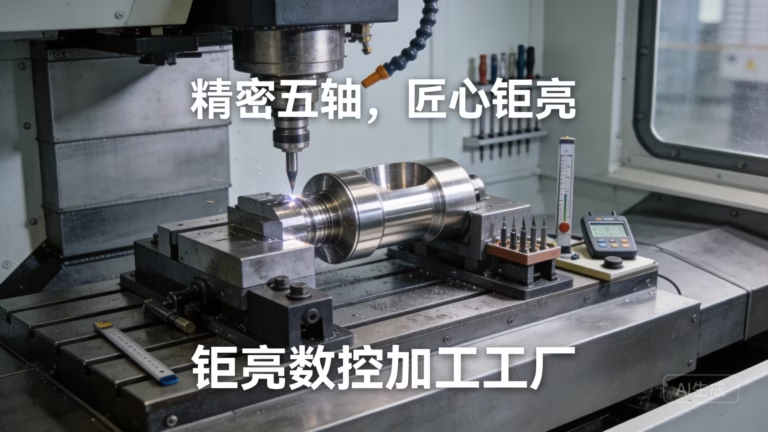
A one stop CNC milling turning service means milling, turning and the steps around them run inside one plant under one quality system. That includes material cutting, 3-axis to 5-axis milling, mill-turn work, EDM when geometry demands it, deburring, surface finishing, and final inspection. The point is not the label. The point is that no operation leaves the building until the part is ready to ship.
When work is split, every handoff adds a new fixture, a new datum and a new chance to drift. A turned feature made on one vendor's lathe and then milled on another's 3-axis machine has to be re-chucked. Concentricity suffers. You pay for setup twice and you inherit two tolerance stack-ups that nobody owns end to end.
GreatLight runs this model from Dongguan and Singapore. The shop holds 127 high precision CNC machines, including 16 simultaneous 5-axis machining centers, 16 mill-turn centers, 12 four-axis mills and 27 three-axis machines. Maximum processing size reaches 4,000 mm, so long shafts and large plates do not have to be outsourced mid-route.
In-house finishing is the part buyers underestimate. Anodizing, plating, powder coating, bead blasting and laser marking under the same roof means the finish spec is agreed once and the part is not shipped out and back. It also means the operator who machined the surface knows what the coater needs.
- 1MillingPrismatic parts, pockets, thin walls, complex 3D contours.
- 2TurningShafts, bushings, connectors, small intricate parts on Swiss-type lathes.
- 3Mill-turnMilling, drilling and turning in one cycle without re-fixturing.
- 4FinishingAnodizing, plating, black oxide, blasting, polishing, laser marking.
Match machine travel and spindle count to your part
Start with envelope. If your part is 900 mm long, a compact 500 × 500 × 450 mm machine is irrelevant no matter how good its tolerance is. At GreatLight the working envelopes run from 500 × 310 × 200 mm up to 4,000 × 400 × 150 mm, with medium platforms at 750 × 1,150 × 550 mm and 600 × 600 × 600 mm. Give the supplier your largest dimension first, then talk tolerance.
Second, count the axes you actually need. A part with features on five faces in one setup needs a 5-axis center or a mill-turn machine. A simple bracket does not. Asking for 5-axis work on a part that fits a 3-axis vise just raises the hourly rate. Good suppliers will tell you when 3-axis is enough.
Third, check the rotary table. A Ø400 mm rotary table handles most round work, but a Ø600 mm flange will not fit. If your part is a large ring or a housing with radial features, confirm the table size and the swing before quoting.
Finally, ask what the machines are doing this month. Machine counts are static. Availability is not. A shop with 16 five-axis centers that are booked for six weeks is a different supplier from one that can start in days.
Tolerance, finish and inspection: read the fine print
Tolerance claims are only useful when tied to a feature. A blanket ±0.005 mm across a 400 mm part is not realistic; ±0.005 mm on a controlled diameter is. Ask the supplier to state which features hit that band and how they verify it. GreatLight holds ±0.005 mm (±0.0002 in) on qualifying features and inspects 100% of parts before shipment.
Surface finish follows the same logic. As-machined surfaces typically land at Ra 1.6–3.2 μm. A high-quality finish is Ra 0.8–1.6 μm, and a fine finish reaches Ra 0.2–0.8 μm. Each step changes cycle time and cost. Specify finish only where the function needs it, such as sealing faces or bearing bores.
Inspection is the check most buyers skip. A credible one stop service inspects incoming material, monitors in-process, and runs a final inspection before packing. Dimensional reports, CMM data, roughness measurements and material certificates should be available on request. If a supplier cannot produce a first article report for a new part, treat that as a warning.
Certifications should match your industry. ISO 9001:2015 is the baseline. Automotive programs usually require IATF 16949:2016. Medical device work points to ISO 13485:2016. If your data is sensitive, ISO 27001:2022 covers information security. Ask for the certificate scope, not just the logo.
Lead time, MOQ and quote clarity
Lead time has three clocks: quote, production start and shipping. At GreatLight a quotation with free DFM analysis comes back within 12 hours, production can begin within 24 hours, and parts typically ship in 3–5 days. Those numbers assume the drawing is released and material is in stock. Ask what happens when material has to be ordered.
Minimum order quantity decides whether you can iterate. A shop with no MOQ lets you order one prototype, test it, revise the drawing and run again without penalty. Then the same supplier scales to 10,000+ part runs with the same process, which keeps the second run consistent with the first.
Read the quote line by line. A useful quote separates material, machining, finishing, inspection and freight. It names the material grade, for example 6061-T6 or 17-4PH, and the finish thickness or color. A single lump-sum price hides where cost comes from and makes a later change request hard to price.
Confidentiality belongs in the commercial conversation. Uploads should be handled as secure and confidential, and an NDA should be available on request before you send production drawings. That is standard practice, not a favor.
How to qualify a one stop supplier in 6 steps
Run these in order. Each step filters out suppliers that will cost you time later.
- 1Send the largest dimension firstState the overall envelope and the tightest feature tolerance. If the part exceeds 4,000 mm or needs a rotary table beyond Ø400 mm, the supplier must say so before quoting.
- 2Ask for a process routeA one-line quote is not enough. Request the sequence: material, setups, machine type, finishing, inspection. Compare it against your drawing callouts.
- 3Confirm the tolerance band per featureAsk which features hold ±0.005 mm and how they are measured. Blanket tolerance claims across a large part usually mean the supplier has not read the drawing.
- 4Check certifications against your industryISO 9001:2015 for general work, IATF 16949:2016 for automotive, ISO 13485:2016 for medical, ISO 27001:2022 for data security. Request the certificate scope.
- 5Test the MOQ with a single partOrder one piece before committing to a run. Check the as-received finish, the report package and the packaging. A prototype order tells you more than a capabilities page.
- 6Agree on change handlingAsk how a revision is priced after production starts. Good shops quote the delta, not the whole part, and flag DFM issues before cutting metal.
Questions buyers ask before consolidating
When should I keep milling and turning at separate vendors?
Keep them separate when the two vendors are already qualified for your industry and the part has no tight relationship between turned and milled features. If a turned bore and a milled face share a datum, splitting the work adds a re-chucking step that you will pay for in tolerance and time.
Also split when volumes are very high and a specialized turning house can run the turned portion on dedicated cam or Swiss machines cheaper than a general shop. Just own the datum strategy yourself.
What tolerance can a one stop service realistically hold?
GreatLight holds ±0.005 mm (±0.0002 in) on controlled features. That figure applies to specific dimensions, not automatically to every dimension on a 400 mm part. Temperature, fixturing and material stress all move the number.
For a new part, ask for a first article inspection on the tightest feature. If the process cannot hold it on part one, it will not hold it on part 500.
Do I need a minimum order quantity to start?
No. GreatLight has no minimum order quantity, so a single prototype and a 10,000+ part run go through the same process. That matters for validation: the process you qualify on the prototype is the process used in production.
Expect the per-part price to fall as volume rises, but do not expect the supplier to skip inspection on small orders.
How do I check that my drawings stay confidential?
Ask for an NDA before you upload production files, and confirm how uploads are stored. GreatLight treats uploads as secure and confidential and offers an NDA on request.
ISO 27001:2022 certification covers information security management, which is worth asking about if you handle regulated or defense-adjacent designs.
Which materials are available for milling and turning?
Common grades include aluminum 6061, 6061-T6, 2024, 5052, 5083, 6063, 6082, 7075 and ADC12; stainless 303, 304, 316, 316L, 420, 430, 431, 440C and 17-4PH; steel 1018, 1045, 4130, 4140, 4340, A36 and tool steel.
Copper and brass include C101, C103, C110, beryllium copper, C27400, C28000 and C36000. Titanium and special alloys cover TA1, TA2, TC4 (Ti-6Al-4V), Inconel and magnesium AZ31B / AZ91D. Plastics include ABS, PC, PMMA, POM, PA, PEEK, PP, HDPE and carbon fiber.
What finishing options can be done in-house?
Anodizing in clear, color, hardcoat and conductive versions; electroless nickel, zinc, silver and gold plating; powder coating and black oxide; bead blasting, tumbling, brushing and polishing; laser marking and engraving with a minimum character height of 1.5 mm.
Keeping finishing in-house shortens the route and removes the risk of a coater losing a datum or damaging a finished surface in transit.
Send one drawing and see the route
Upload your part and get a quotation with free DFM analysis within 12 hours, plus a process route you can check line by line.
12-hour quoteNo minimum order quantity100% inspection before shipment
More from the shop floor
We publish setup notes, tooling trials and inspection data from the factory floor.











