
New York CNC Machining Services: 5 Checks Before You Buy
This page is for engineers and sourcing staff who buy machined parts for New York programs and need to compare shops on facts, not brochures. It covers tolerance capability, certification fit, lead time, MOQ and post-processing. Read it and you can score any supplier against the same five checks.
In this article
- 1
- 2
- 3
- 4
- 5
- 6
- 7
- 8
Key takeaways
Five checks, and what a good answer sounds like
Use this table as a screening sheet before you send drawings.
| Check | What to ask | Weak answer | Strong answer |
|---|---|---|---|
| Tolerance | Which machine holds the tight dimension? | “We hold ±0.01 mm on everything.” | Names the 5-axis center and the CMM report |
| Certification | Which certificate covers this part? | Generic ISO 9001 PDF | ISO 13485:2016 for a medical housing |
| Lead time | When does the first article ship? | “Depends.” | Quote in 12 hours, parts in 3–5 days |
| MOQ | Can you run 1 piece first? | “Minimum 500.” | One prototype to 10,000+ parts |
| Post-processing | Who does the anodize? | “Partner shop, 2–3 weeks.” | In-house finishing with laser marking |
| Data handling | Can you sign our NDA? | “Standard terms only.” | NDA available, uploads kept confidential |
| Inspection | What ships with the parts? | “Box and invoice.” | 100% inspection, reports on request |
Tolerance and measurement, not tolerance and advertising
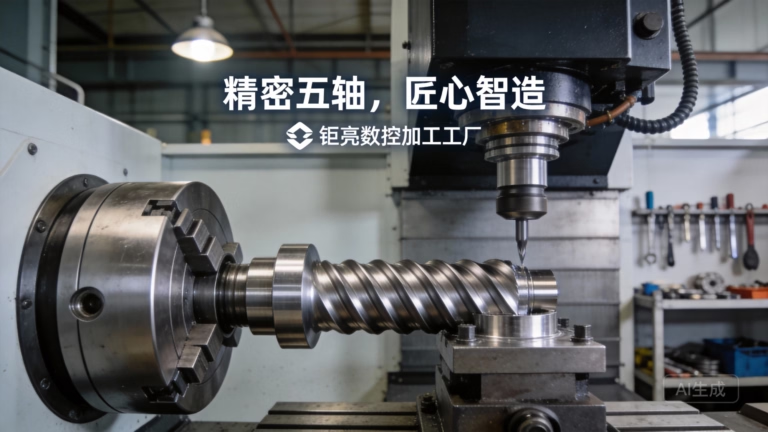
A tolerance figure means nothing without the machine and the metrology behind it. A shop can print ±0.005 mm on a landing page, but if the feature sits on the fifth face of a prismatic part, only a simultaneous 5-axis center will hold it in one setup. Ask which machine will run your part and how many setups the feature needs. Fewer setups means fewer datum shifts and less stack-up.
Measurement matters just as much. A tight tolerance that is never verified is a guess. Look for raw material checks, in-process monitoring and a final inspection before shipment, with reports available on request. For a housing with a bored bearing seat and a bolt pattern on the same face, that sequence catches a drifting tool before the whole batch is cut.
Tolerances also cost money in a non-linear way. Going from ±0.05 mm to ±0.005 mm changes fixturing, tool paths, cutting temperatures and inspection time. If only two dimensions on the print are critical, say so on the drawing. Shops that see the whole print marked tight will quote conservatively, and you pay for precision on features that never needed it.
One more thing. Compare a shop’s tolerance claim against the size of the part. A 4,000 mm structural rail and a 20 mm medical insert do not hold the same number, even on the same machine. Ask for the tolerance at your part size, not the shop’s best-case demo.
- 1Ask for the setup countOne 5-axis setup beats three 3-axis setups for features that must stay concentric.
- 2Tie tolerance to inspectionIf no report is offered, treat the number as marketing.
- 3Mark only critical dimensionsBlanket tight tolerances raise the price on everything.
Certifications that match the part you are buying
Certificates are not interchangeable. ISO 9001:2015 covers a basic quality management system and suits general industrial and electronics work. If the part goes into a vehicle program, IATF 16949:2016 is the one your quality team will ask for. For surgical instruments, implant tooling or diagnostic hardware, ISO 13485:2016 is the relevant standard.
There is a fourth one that buyers in New York often forget. ISO 27001:2022 covers information security, which matters when you upload CAD files, GD&T drawings and bills of material to a supplier portal. A startup in Manhattan handing over a novel mechanism cares about that as much as a hospital system does.
Read the certificate scope, not just the logo. A certificate issued for one process, one site or one product family does not automatically cover the part you are quoting. Ask which site will make your parts and whether that site is inside the scope.
NDAs are the other half of this. A supplier that signs your NDA and keeps uploads confidential is easier to work with than one that only offers its own terms. If your design is the product, that paperwork is part of the technical evaluation.
Lead time: separate the quote clock from the production clock
Lead time gets quoted as one number and behaves like three. The first is quoting and DFM feedback. The second is production start after you approve. The third is actual shipping. Ask about each one separately, because a shop can be fast at one and slow at another.
A useful benchmark: quotation and free DFM analysis within 12 hours, production start within 24 hours of approval, parts shipping in 3–5 days. Those are the numbers we work to. When you compare suppliers, write their three numbers side by side and ask what usually pushes each one out.
The hidden delay is often not machining. It is waiting on material, on a finish, or on a customer answer about a tolerance conflict. A shop that flags the conflict during DFM, before the spindle starts, saves a week. A shop that flags it after the first article is scrapped costs you the same week plus the material.
For New York programs, transport time is a separate line. Air freight from an overseas plant adds days that a local shop does not have. That trade-off is real, and it is the reason many teams split work: prototypes and urgent spares locally, production volumes where the capacity and price make sense.
MOQ, tooling and how the shop handles ramp-up
Minimum order quantity tells you how a shop is set up. A shop with a high MOQ is optimized for long runs and will treat your prototype as an interruption. A shop that runs from one piece to 10,000+ part runs on the same floor can take you from a fit-check sample to a production release without changing suppliers.
That matters more than it sounds. Moving a part between shops means re-quoting, re-fixturing and re-qualifying the first article. Each move adds a chance for the tolerance to drift. If your program has a pilot build, a clinical batch and then a volume release, ask how the shop scales between those stages.
Also ask what tooling is dedicated to your part. Custom fixtures, soft jaws and form tools are often built for a specific geometry. Knowing whether they are kept, and for how long, affects the cost of a repeat order six months later.
Finally, ask about material availability in the grades you need. Aluminum 6061 and 7075, stainless 303 and 17-4PH, titanium Ti-6Al-4V and plastics such as PEEK and POM all behave differently at the spindle and have different supply rhythms. A shop that stocks or regularly buys your grade will quote it more honestly.
Post-processing and finishing, the second queue
Many schedules fail after the machining is done. Anodizing, electroless nickel, zinc plating, powder coating, black oxide, bead blasting, polishing and laser marking each add a step, a queue and a chance for dimensional change. If those steps live at a different company, you now depend on two production calendars.
Keeping finishing in the same building removes the handoff. It also removes the argument about who damaged a surface. When a shop machines a part and then anodizes it, there is one owner for the final condition of the surface.
Laser marking deserves its own note. Minimum character height is 1.5 mm in our process. If your part number, lot code or UDI string is smaller than that, the mark may not read reliably after finishing. Send the marking layout with the drawing so it can be checked before the part is cut.
Ask what finishes the shop actually runs, not what it can broker. Masking for hardcoat anodizing, threads that must stay conductive, and sealing surfaces that must not be coated are all details that get missed when the work is subcontracted.
Step by step: screening a New York CNC machining supplier
Six steps, in order. Each one produces a document you can compare across shops.
- 1Send the full drawing set, not a screenshotInclude 3D model, 2D print with GD&T, material grade, finish callout and marking layout. Ask for DFM notes with the quote, not after.
- 2Ask for the machine and setup planRequest the machine class and setup count for the critical features. A 5-axis center holding concentric features in one setup is a different plan from three 3-axis operations.
- 3Confirm the certification scopeMatch the certificate to the sector: ISO 9001:2015, IATF 16949:2016, ISO 13485:2016. Check that the site making your part is inside the scope.
- 4Write down three lead-time numbersQuote clock, production start, ship date. Ask what typically moves each one and how you will be told if it slips.
- 5Test the low-volume pathOrder one or two pieces first. This checks the quote, the first article and the inspection report before you commit a production PO.
- 6Verify finishing and marking in the sampleConfirm anodize thickness or plating callout, thread masking and laser mark legibility at 1.5 mm minimum character height.
- 7Lock the paperworkSign the NDA, agree the inspection report format and confirm how revision changes are quoted before volume release.
Questions buyers ask before the first PO
Can a shop outside New York hold ±0.005 mm on my part?
Tolerance is a function of the machine, the fixture and the inspection method, not the postcode. A simultaneous 5-axis center with in-process monitoring and a final CMM check can hold ±0.005 mm on prismatic parts within its work envelope.
The practical question is whether the shop will tell you when your geometry cannot hold that number in one setup. A clear answer before cutting is worth more than a tight number on a web page.
What is a reasonable MOQ for a machined prototype?
One piece. If a shop cannot quote a single prototype, it is set up for volume and will not be a good fit for your pilot build.
The same shop should also be able to scale to 10,000+ part runs. Ask how tooling and fixtures carry over between the prototype and the production order.
Which certifications should I require for medical or automotive work?
For medical devices, ISO 13485:2016. For automotive and EV programs, IATF 16949:2016. ISO 9001:2015 is the baseline for general industrial work.
If you upload CAD and process data to a supplier portal, add ISO 27001:2022 to the list. It covers how your design files are protected.
How do I compare quotes when the lead times are different?
Break each quote into quote clock, production start and ship date. A quote that arrives in 12 hours with DFM notes is easier to compare than one that arrives in three days with no comments.
Add the transport leg for any overseas supplier. Air freight changes the total time even when the production schedule is identical.
What should I send with the RFQ?
A 3D model, a 2D print with GD&T, the material grade, the finish specification, the marking layout and the annual volume estimate. Include the critical dimensions you will actually measure.
If the part has a sealing surface, a thread that must stay conductive or a cosmetic face, say so. Those notes change the process plan.
How are design files kept confidential?
Uploads are kept secure and confidential, and an NDA is available on request. Ask for the NDA before you send the model if your program requires it.
For regulated products, also ask which employees can access the files and how long they are retained after the order closes.
Score your next supplier with these five checks
Send your drawings and get a quote with DFM notes within 12 hours. One prototype or 10,000 parts, 100% inspection before shipment.
12-hour quoteNo MOQ100% inspection
Follow GreatLight
We publish setup notes, tooling trials and inspection data from the factory floor.











