
Haas VF2SSYT CNC Mill: What It Does and Where It Fits
This page explains the Haas VF2SSYT CNC mill in shop terms: spindle behavior, travels, accuracy limits, and the part families it handles well. Written for engineers and buyers who need to judge whether a 40-taper Super Speed vertical mill suits their low-volume work before they place an order.
In this article
- 1
- 2
- 3
- 4
- 5
- 6
What the Haas VF2SSYT CNC Mill Actually Is
The Haas VF2SSYT CNC mill is a 40-taper vertical machining center built for speed rather than raw size. The VF2 frame carries a 12,000 rpm direct-drive spindle and a Super Speed option package that shortens tool changes and raises rapid traverse rates. A side-mount tool changer holds 24 tools, so a job can run several operations without an operator swapping holders by hand.
The YT suffix marks the Through-Spindle Coolant and extended-travel package. Coolant exits through the tool, which matters when you drill deep holes in 4140 or 17-4PH and chips need to leave the cut. The travel envelope is roughly 762 × 508 × 508 mm on a VF2-class machine, which sets a hard boundary on part size before you even consider fixturing.
Think of it as a job-shop workhorse. It is not a bridge mill and not a high-torque box-way machine. Its value shows up when you have many different parts, moderate sizes, and tight schedules rather than one heavy casting that runs for months.
For low-volume production, the machine is usually paired with a 4th-axis rotary table or run lights-out with a pallet system. Both choices change how you quote a job far more than the base spindle spec does.
- 1Spindle12,000 rpm, 40 taper, direct drive
- 2Tool changer24+1 side-mount, several seconds per change
- 3CoolantThrough-spindle on the YT package
- 4Typical useHigh-mix, low-volume milling
Why Super Speed Changes Cycle Time and Tool Life
Super Speed is not a marketing label on a spec sheet. The spindle accelerates to full speed quickly, so a 6 mm carbide end mill in 6061 can go from idle to cutting in a fraction of the time a belt-driven spindle needs. On short-cycle parts with many tools, that acceleration is where the minutes disappear.
Higher rpm does not automatically mean higher metal removal rate. It means smaller chips per tooth at the same feed, or faster feed at a smaller radial engagement. In hardened or gummy materials, the limit is often the tool, not the spindle. A 12,000 rpm spindle cutting titanium at full speed will burn edges unless the feed per tooth and coolant strategy match the material.
Rapid traverse rate has a similar effect. If a part has dozens of short moves, the machine spends more time accelerating and decelerating than cutting. Fast rapids and a light table reduce that non-cutting time, which is why the same program can run noticeably faster on a Super Speed frame than on a standard VF2.
The trade-off is rigidity. A lighter, faster machine deflects more under heavy radial cuts than a slower, heavier one. For roughing a large steel pocket, that difference shows in chatter and tool wear.
- 1Spindle accelerationCuts air time between tools
- 2Fast rapidsHelps short-move programs most
- 3Tool lifeDepends on feed per tooth, not rpm alone
- 4Rigidity limitHeavy radial cuts favor a heavier frame
Which Materials and Part Shapes Suit This Mill
Aluminum is where the machine feels at home. 6061, 7075 and 6082 cut cleanly at high spindle speeds, and the through-spindle coolant clears chips from deep pockets. Thin-wall aluminum housings hold better when you take light radial passes at high rpm instead of heavy cuts at low rpm.
Stainless and steel are workable within limits. 303 and 304 run fine with correct feeds; 17-4PH and 4140 need slower surface speeds and more attention to coolant. Titanium TC4 and Inconel are possible on a 40-taper machine, but the cutter diameter and depth of cut have to stay conservative or the spindle loads up and the finish suffers.
Plastics and composites behave differently. POM and PEEK cut well but generate stringy chips that wrap around the tool; ABS and PC can melt if the spindle runs too fast with a dull cutter. Carbon fiber needs dust extraction and polycrystalline diamond tooling because abrasive dust wears carbide quickly.
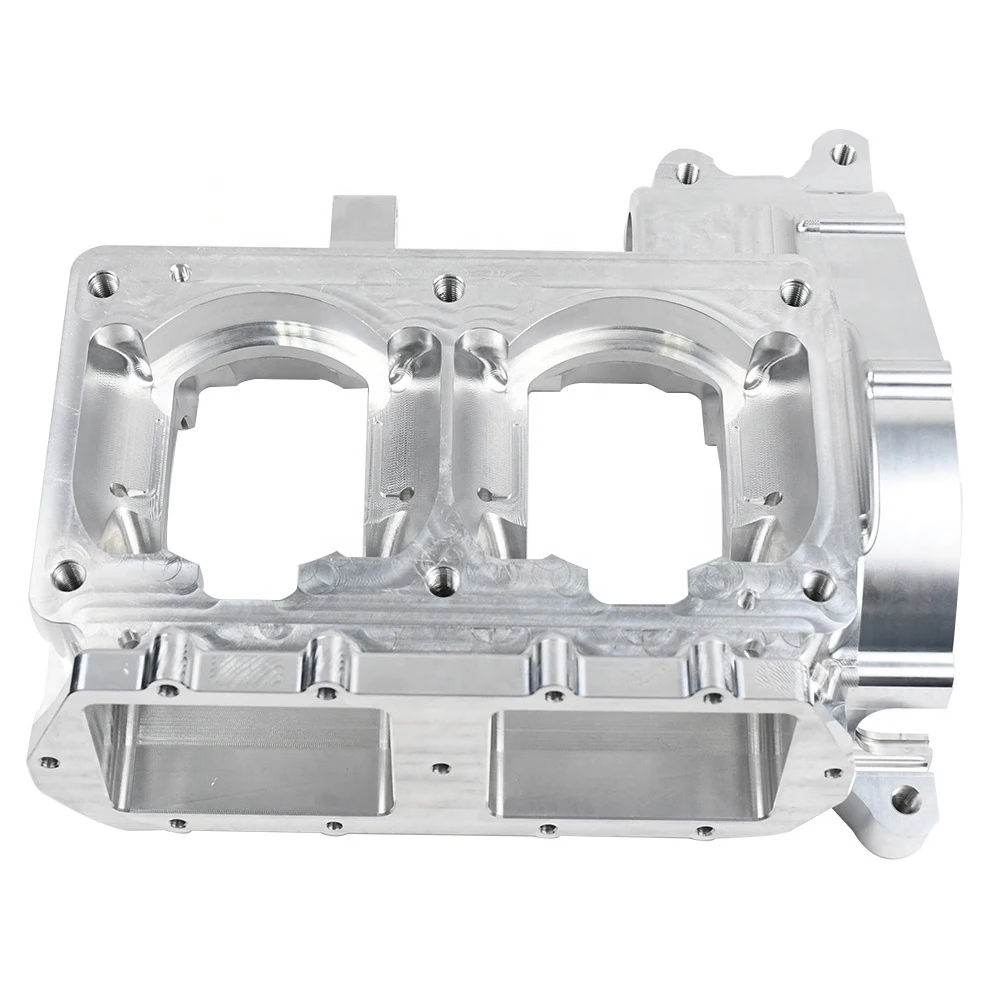
Part shape matters as much as material. Prismatic parts with pockets, holes and faces fit the 3-axis envelope. Parts with undercuts, angled ports or five-sided features need a 4th or 5th axis, and that changes the setup and the cost.
Very long or very thin parts are the wrong fit. A 4,000 mm shaft is not going on this table, and a thin plate that rings under a face mill will need support or a different machine.
- 1Best fitAluminum housings, brackets, plates
- 2Workable303/304 stainless, 4140, 17-4PH
- 3Care neededTC4 titanium, Inconel, PEEK
- 4Poor fitVery long shafts, heavy castings
Accuracy, Finish and the Limits of a 40-Taper Mill
A well-maintained Haas VF2SSYT CNC mill holds about ±0.005 mm on a stable setup with the right tooling. That number is not a property of the machine alone. Thermal growth, fixture stiffness, tool runout and chip load all move the result. On a warm spindle and a rigid vise, the machine repeats. On a cold morning with a loose setup, it will not.
Surface finish follows a similar logic. As-machined aluminum lands around Ra 1.6–3.2 μm. With sharp tooling, correct stepover and a finishing pass, Ra 0.8–1.6 μm is realistic. Getting to Ra 0.2–0.8 μm usually means a separate finishing operation, a smaller stepover, or a different process such as grinding or polishing.
The 40-taper interface is the real ceiling. It limits how large a cutter you can push and how much radial load the spindle accepts. A 50-taper machine removes material faster on big steel parts. For aluminum and small tools, 40 taper at high rpm is often the faster choice because of the spindle speed.
Inspection closes the loop. If a drawing calls for a true position of 0.02 mm, the shop has to measure it, not assume it. Probing on the machine and a final CMM check catch the parts that drift.
- 1Achievable±0.005 mm on stable setups
- 2As-machined finishRa 1.6–3.2 μm typical
- 3With finishing passRa 0.8–1.6 μm realistic
- 4Taper limit40 taper caps cutter size and load
How Low-Volume Work Runs on This Machine
A prototype run of five parts and a production run of two thousand look different on paper, but they share the same first step: prove the process. On a Super Speed mill, that proof usually happens in one setup with soft jaws or a fixture plate, then gets repeated across the batch once the program is stable.
Tooling choice drives the economics more than spindle speed. A 12 mm three-flute carbide end mill in aluminum can rough and finish a housing with two tools. The same part in 17-4PH may need four or five tools, a roughing pass, a semi-finish and a finish, each with its own feed and speed. That difference shows up in the quote.
Fixturing is where low-volume jobs get won or lost. A part that needs a custom weldment fixture to hold tenths is expensive at quantity ten. A part that sits in a standard vise or a modular plate is cheap. Engineers who design a flat datuming face into the part make their own lives easier.
Lights-out running is possible with a pallet changer or a bar feeder on mill-turn work, but it needs a stable process and reliable chip evacuation. If chips pile up in a pocket, the night shift makes scrap.
GreatLight runs this class of work across 127 high-precision CNC machines, including 27 three-axis machines and 12 four-axis mills, so a VF2-class job can be matched to the frame that fits it rather than forced onto one machine.
- 1First stepProve the process on one setup
- 2Cost driverNumber of tools and operations
- 3FixtureStandard vise beats custom weldment
- 4AutomationNeeds stable chips and process
When the Haas VF2SSYT CNC Mill Fits and When It Does Not
Use this table to screen a job before quoting. Each row is a decision point, not a rule.
| Job condition | Fits well | Needs care | Wrong machine |
|---|---|---|---|
| Part envelope | Up to 700 × 450 × 450 mm | Near the travel limit | Over 762 mm in X |
| Batch size | 1 to a few thousand | Very high volume | Mass production line |
| Material | 6061, 7075, 303 | 4140, 17-4PH, TC4 | Large Inconel forgings |
| Feature type | Pockets, holes, faces | Undercuts, 5 sides | Deep internal bores |
| Tolerance | ±0.005 mm typical | Below ±0.005 mm | Sub-micron optics |
| Finish | Ra 0.8–1.6 μm as milled | Ra 0.2–0.8 μm after finishing | Mirror finish off the tool |
| Setup | 2 to 4 operations | 4th-axis indexing | Dedicated transfer line |
| Lead time | 3–5 days after setup | Tight tooling supply | Weeks of fixture build |
The Verdict
If your parts fit a 762 mm envelope, run in aluminum or light steel, and change often, the Haas VF2SSYT CNC mill is a strong choice. If you need to remove large volumes of steel or hold tolerances below ±0.005 mm, book a heavier frame or a grinding operation instead.
Questions Engineers Ask
What does the YT suffix mean on a Haas VF2SSYT?
The YT package adds through-spindle coolant and an extended travel envelope compared with a base VF2. Coolant exits through the tool, which helps clear chips from deep holes and pockets.
That matters most in stainless, steel and titanium, where chips pack into a cut and recutting ruins the finish. In aluminum, through-spindle coolant still helps, but high-pressure air or flood coolant can do a similar job on shallow features.
Can this mill hold ±0.005 mm on every part?
No. ±0.005 mm is a realistic shop tolerance on a stable setup with sharp tooling and controlled temperature. The machine repeats well, but the result depends on fixture stiffness, tool runout and thermal drift.
Parts with long thin walls or deep bores are harder to hold than compact prismatic parts. If a drawing calls for tighter than ±0.005 mm, the process usually moves to a finishing operation or a different machine class.
Is a 12,000 rpm spindle too fast for steel?
No, it is a capability, not a requirement. The spindle runs at whatever speed the program calls for. For 4140 or 17-4PH, that is often 2,000 to 4,000 rpm with the correct surface speed.
The advantage is that the same machine can run aluminum at high rpm and steel at moderate rpm without a spindle change. The limit is torque at low speed and rigidity under heavy radial cuts.
What part size is too big for a VF2-class machine?
Anything beyond roughly 762 mm in X, 508 mm in Y or 508 mm in Z needs a different frame. Fixture height also eats into the Z envelope, so a tall part may not fit even if its footprint does.
For longer parts, GreatLight uses machines with a 4,000 mm maximum processing size. For compact parts, a 500 × 500 × 450 mm travel machine may be the better match.
How does through-spindle coolant change tool life?
It delivers coolant directly to the cutting edge, which lowers edge temperature and flushes chips out of the flutes. In deep-hole drilling, that can mean the difference between a clean hole and a broken drill.
In shallow milling, the gain is smaller. Evaluate it per operation rather than assuming it always pays off.
What lead time should I expect for a low-volume run?
At GreatLight, a quotation and free DFM analysis come back within 12 hours, production can start within 24 hours, and parts ship in 3–5 days. Historical late-delivery probability is below 2%.
Those figures assume the drawing is complete and the material is in stock. Custom tooling or exotic alloys can extend the schedule, and that is discussed before the order starts.
Send Us Your Part and We Will Match the Machine
Upload a drawing and get a quote with DFM feedback within 12 hours. No minimum order quantity, from one prototype to 10,000+ parts.
12-hour quoteNo minimum order quantity100% inspectionNDA on request
More Machining Notes
We publish setup notes, tooling trials and inspection data from the factory floor.











