
Mccorvey Sheet Metal vs GreatLight Sheet Metal Fabrication Services
Two shops, two different jobs. This page compares heavy-gauge structural work against tight-tolerance, quick-turn work so you can pick the right supplier before you send a drawing. Written for engineers and buyers who have to justify the choice to their own team.
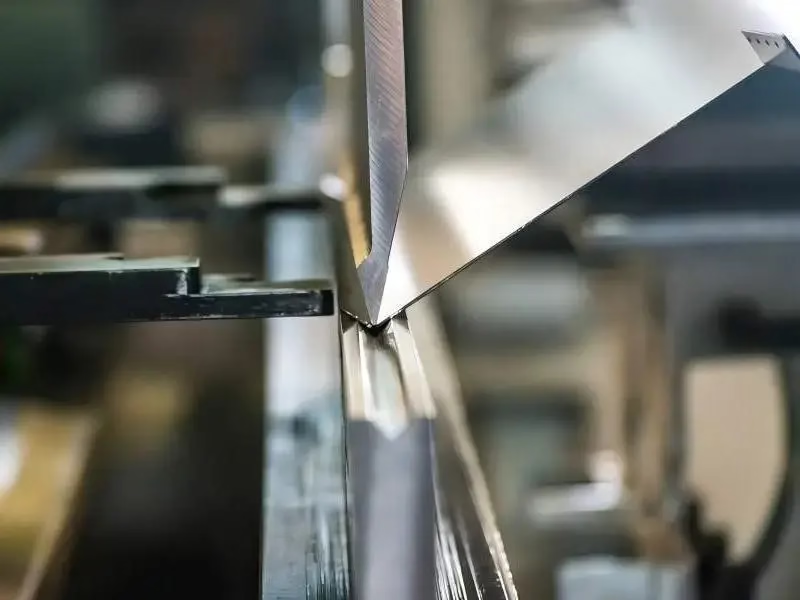
How the Two Shops Compare
Ratings are qualitative. Use the row that matches your part, not the total.
| Criterion | Mccorvey (market positioning) | GreatLight (verified data) |
|---|---|---|
| Typical work | Heavy sheet structures, HVAC, outdoor frames | Enclosures, brackets, chassis, machined hybrid parts |
| Gauge range | Thick plate and structural sections | Thin to medium gauge plus machined features |
| Tolerance | General structural tolerance | ±0.005 mm on CNC machined features |
| Forming | Large press brake and weld assemblies | Laser cut, formed, then CNC finished |
| Prototyping | Limited one-off support | Rapid prototyping from one piece |
| Materials | Carbon steel and structural alloys | Aluminium, stainless, copper, titanium, plastics |
| Finishing | Paint and galvanizing for outdoor life | Anodizing, plating, powder coat, laser marking |
| Lead time | Project-based scheduling | Quote in 12 h, parts ship in 3–5 days |
| Order size | Large batch and site projects | One prototype to 10,000+ parts |
| Certifications | Not published on this page | ISO 9001, IATF 16949, ISO 13485, ISO 27001 |
Two Different Jobs, Not Two Versions of One Shop
Mccorvey Sheet Metal is positioned around heavy-duty sheet work: outdoor structures, HVAC ducting and pipe runs, industrial frames and welded assemblies that live outside for years. The selling point is mass and durability, plus the ability to deliver a large fabricated structure to a site and install it.
GreatLight sheet metal fabrication sits at the other end. We build boxes, panels, brackets, chassis and hybrid parts where the sheet is only half the job and the machined features are the other half. If your drawing has a hole pattern with a ±0.1 mm position callout and the part also needs a folded flange, that combination is where our process is set up to win.
Those are not the same customer. A fabricator buying duct sections for a plant cares about weld quality, coating life and truck scheduling. A design engineer building a robot controller cares about burr height, hole position and whether the enclosure closes on the first try.
So the useful question is not which shop is better. It is which failure mode you can tolerate. Late delivery of one structural frame stops a site. A hole 0.3 mm off position stops an assembly line.
- 1Choose structural whenthe part is large, welded, sits outdoors and tolerance is measured in millimetres
- 2Choose precision whenthe part interfaces with machined components, connectors or a PCB
- 3Mixed parts exista welded frame with a precision mounting plate can be split across two suppliers
Where GreatLight Sheet Metal Fabrication Sets the Boundary
Our cutting and forming are backed by 127 high-precision CNC machines, including 16 simultaneous 5-axis machining centers, 12 four-axis mills and 27 three-axis machines. Sheet parts usually start as laser-cut blanks, then go to forming, then to machining if the drawing needs milled pockets, tapped holes or a sealing groove.
That sequence matters. Cutting a blank and forming it introduces springback and bend allowance error. If a hole is punched before forming and then machined after, you can bring it back to true position. This is the main reason tight-tolerance sheet parts cost more than the flat pattern suggests.
Maximum processing size reaches 4,000 mm, with travel envelopes of 4,000 × 400 × 150 mm on the large machines and 750 × 1,150 × 550 mm on the medium ones. A Ø400 mm rotary table handles parts that need features on four sides without re-fixturing.
Materials cover aluminium 6061, 5052, 5083, 6063, 6082, 7075 and ADC12; stainless 303, 304, 316L, 420 and 17-4PH; steel 1018, 1045, 4130 and A36; plus copper, brass, titanium TC4 and engineering plastics.
- 1Laser plus machinecut flat, form, then machine critical features after springback
- 2Tolerance±0.005 mm on machined features; formed-only features follow bend tolerance
- 3Finish optionsanodizing, electroless nickel, zinc, powder coat, bead blasting, laser marking
Five Checks Before You Split the Work
Check one: does the part bolt to anything machined? If yes, position tolerance matters and the sheet shop needs a CNC department behind it. If the part bolts to concrete or another weldment, general fabrication tolerance is enough.
Check two: how many bends and how thick? A 3 mm aluminium bracket with four bends is routine. A 10 mm steel plate with a tight inside radius needs a press brake with the right tonnage, and the radius you can achieve is limited by the tooling, not by the drawing.
Check three: what is the surface finish callout? Ra 0.8–1.6 μm is a standard machined finish for us. Ra 0.2–0.8 μm is available but adds a finishing pass and inspection time. If the drawing says Ra 3.2 μm on a formed face only, you are paying for something nobody will measure.
Check four: order size. We run no minimum order quantity, from one prototype to 10,000+ part runs. Structural fabricators normally prefer volume or site-scale work because setup is expensive for them.
Check five: documentation. If your quality system needs material certificates, inspection reports or an NDA before drawings are released, confirm that early. We issue reports on request and sign NDAs; uploading files is secure and confidential.
- 1Interfacesmachined mating faces push you toward a CNC-backed sheet shop
- 2Radius limitsinside radius is a tooling constraint, not a preference
- 3Inspection100% inspection before shipment, with raw material and in-process checks
Cost, Time and the Real Trade-Off
Structural fabrication wins on cost per kilogram. Steel is cheap, welding is fast at scale and coating systems are well understood. What you pay for is coordination: site measurement, transport and install scheduling. That overhead is why small quantities rarely make sense there.
Precision sheet work wins on time to first article. A formed and machined enclosure can be quoted in 12 hours and shipped in 3–5 days because setup is digital. You pay more per part at low volume, then the curve flattens as quantities rise.
The mistake we see most often is sending a hybrid part to one shop because the drawing looks like sheet metal. If half the features need ±0.005 mm, the whole part is a machining job with a forming step. Splitting it across two suppliers usually adds cost and hides tolerance stack-up between them.
One more consideration: qualification rate. Ours is 99.99%, which reflects in-process monitoring rather than luck. If your assembly line cannot absorb a rework loop, that number is worth more than a lower unit price.
- 1Low volume, tight toleranceCNC-backed sheet fabrication
- 2High volume, loose tolerancededicated structural fabrication
- 3Both in one partmachine after forming and inspect the interface, not just the flat pattern
Step by Step: Running a Sheet Part Through GreatLight
- 11. Send the native fileSTEP or IGES plus the flat pattern if you have one. We reply with a quotation and a free DFM analysis within 12 hours.
- 22. Read the DFM notesWe flag bend radii that need different tooling, holes too close to a bend line and features better machined after forming. Keep hole edges at least 2.5× material thickness from a bend.
- 33. Confirm material and finishAluminium 5052 forms cleanly; 6061 cracks on tight bends unless you use a larger radius. Stainless 304 work-hardens, so plan extra springback.
- 44. Production startProduction can start within 24 hours of drawing release. First article inspection is available on request.
- 55. Machining and finishingCritical holes and pockets are cut after forming. Anodizing, plating or powder coating follows, with laser marking at a minimum character height of 1.5 mm.
- 66. ShipParts ship in 3–5 days. Historical late-delivery probability is below 2%.
The Verdict
If your part is large, welded and lives outdoors, Mccorvey-style structural fabrication is the right fit. If it interfaces with machined components and needs to ship in days, choose GreatLight sheet metal fabrication.
Questions Engineers Ask Next
Can GreatLight handle a welded assembly as well as a formed one?
Yes. Forming and welding sit inside the same sheet metal fabrication service, followed by machining of critical features if the drawing needs it.
What we do not do is site installation or large outdoor structural erection. If the part has to be delivered to a construction site and bolted into place, that is a different supplier profile.
What sheet thickness makes sense for tight-tolerance work?
Thin and medium gauge is where laser cutting plus machining pays off, because the blank is light and easy to fixture for a second operation.
As thickness climbs, forming forces and springback grow, and the achievable inside radius is set by tooling. Thick plate with a tight radius is usually better redesigned than forced.
How do you hold position tolerance across a bend?
We assume the bend moves the material. Holes that must be accurate are cut or finished after forming, not before.
For parts with several bends, we check the first article against the drawing and adjust the flat pattern rather than chasing the finished part.
What finishes are available on sheet parts?
Anodizing in clear, colour, hardcoat and conductive versions; electroless nickel, zinc, silver and gold plating; powder coating and black oxide; bead blasting, tumbling, brushing and polishing.
Laser marking is available with a minimum character height of 1.5 mm, which matters for serial numbers and traceability.
Do you sign an NDA before drawings are shared?
Yes, an NDA is available on request. Uploads are secure and confidential.
If your process requires a signed agreement before any file leaves your network, tell us first and we will handle the paperwork before the quote.
What happens if the part needs a tolerance you cannot hold after forming?
We say so in the DFM notes rather than quoting it and hoping. Options are usually to machine the feature after forming, loosen the callout to something functional, or split the part.
Tolerances of ±0.005 mm apply to machined features, not to formed surfaces. Mixing the two in one callout is the most common drawing problem we see.
Send the Drawing and Get a Straight Answer
Upload your STEP file and we will return a quotation with a free DFM analysis within 12 hours. If the part belongs at a structural fabricator instead, we will tell you that too.
12-hour quote100% inspectionNDA on requestNo minimum order quantity
More From the Shop Floor
We publish setup notes, tooling trials and inspection data from the factory floor.











