
Master CNC Machining for Beginners: How a Design Becomes a Metal Part
A starter explanation of what happens between your CAD file and a finished part. Written for design engineers, buyers and makers who need to judge whether a part suits CNC, which machine type fits, and where the real cost sits.
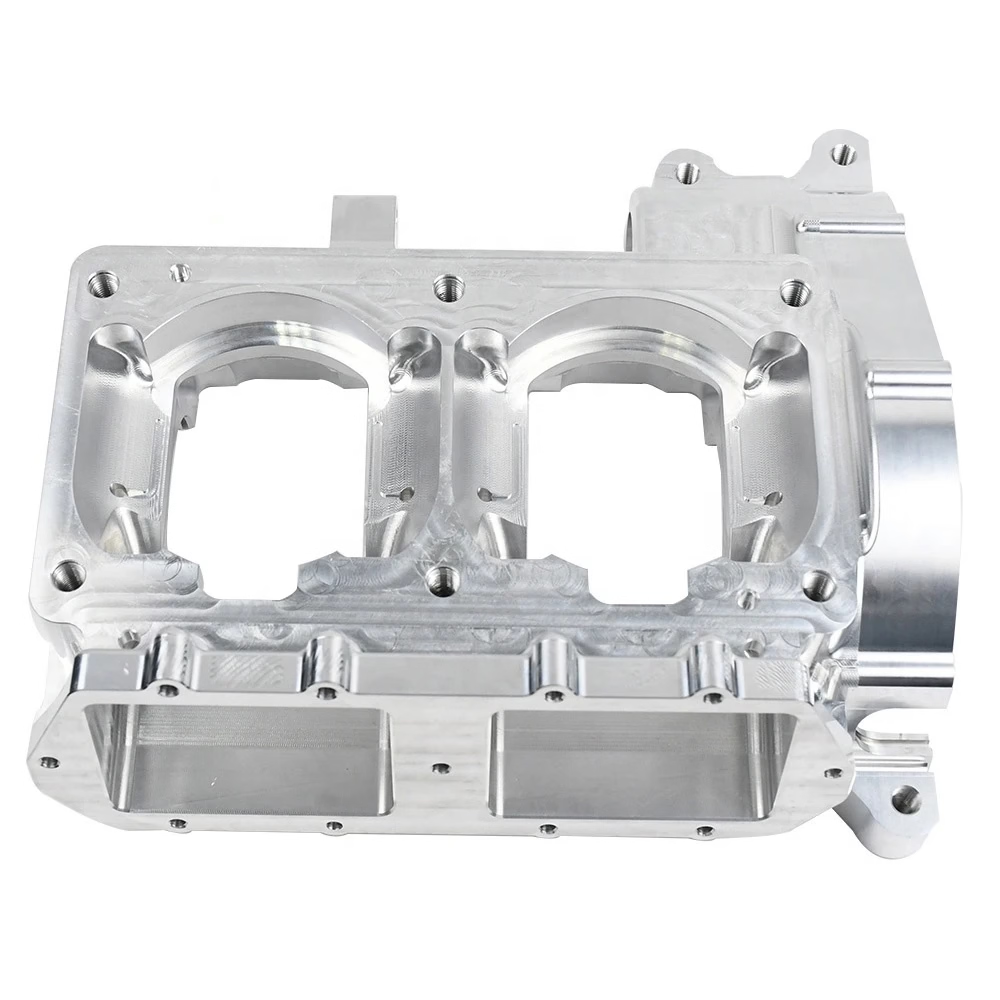
Master CNC machining for beginners: what the process really is
CNC stands for computer numerical control. A machine tool moves a spinning cutter or a turning workpiece along axes that a controller drives from numbers, not from a handwheel. The numbers come from a program called G-code. Everything else in this article follows from that one idea: geometry in, motion out.
The chain has four links. You model the part in CAD. CAM software converts that solid into toolpaths, the exact paths the cutter will follow. A post-processor turns those paths into G-code for a specific machine. The machine cuts, and the finished part gets measured against the drawing. Break any link and the part misses.
Beginners often think the cutting is the hard part. It is not. The cutting is the fastest step. Most problems start earlier, in the model, or later, in how the part is clamped for each operation. A file that looks clean on screen can still be impossible to hold in a vise.
So the useful beginner skill is not memorizing G-code. It is reading a drawing and predicting how a shop will hold, cut and measure the part. That prediction tells you whether CNC is even the right process.
How CAD becomes G-code
CAD gives you a solid model. CAM asks two questions about it: which faces must be cut, and from which direction can a tool reach them. Each direction becomes a setup. A setup is one clamping of the workpiece, and every setup adds cost and error.
Inside a setup, CAM picks tools and passes. A roughing pass removes most of the stock with a large cutter. A finishing pass follows the surface with a smaller cutter to hit the final size and finish. You control stepover, stepdown, feed rate and spindle speed.
The numbers matter more than beginners expect. A 12 mm carbide end mill in 6061 aluminium might run at 3,000–6,000 rpm with a feed of 1,000–2,500 mm/min. The same cutter in 304 stainless drops to roughly 400–900 rpm. Push stainless at aluminium speeds and the edge dulls in minutes.
The post-processor is the last translation step. It formats the toolpath for a specific control, say Fanuc or Heidenhain. A beginner-friendly rule: never assume a shop can run your file as-is. Send the STEP model plus a drawing, and let their CAM team build the program.
3-axis, 4-axis and 5-axis: what each one can reach
A 3-axis mill moves in X, Y and Z. The tool always points straight down. That covers most prismatic parts: plates, brackets, housings with features on one side. It is the cheapest way to remove metal, and the easiest to inspect.
A 4-axis machine adds rotation around one axis, usually a rotary table. Now you can cut four faces of a part without re-clamping. Long shafts, connectors and parts with radial holes become one setup instead of three.
A 5-axis machine adds a second rotary axis. The cutter can tilt, so it reaches undercuts and steep walls in a single setup. For a part with compound angles or deep pockets, 5-axis often wins on total cost even though the hourly rate is higher.
The trade-off is real. 5-axis programming takes longer and the machine needs more clearance around the part. If your part is a flat plate with holes, 5-axis adds nothing. Choose the machine that matches the geometry, not the one with the bigger number.
Tolerance, surface finish and what they cost
Tolerance is the allowed size range. A general machining tolerance of ±0.1 mm is normal and cheap. Tightening to ±0.005 mm is possible, but it changes how the shop measures, how the part is held, and how many parts get scrapped.
Surface finish is measured as Ra, the average roughness. As-machined finishes sit around Ra 1.6–3.2 μm. A finer cut reaches Ra 0.8–1.6 μm. Below that, you are usually polishing or lapping, which is a separate operation.
Both numbers should only be tight where the part needs them. A mounting face that locates a bearing needs a tight tolerance. A clearance hole for a cable does not. Marking every dimension the same way is the fastest way to double a quote.
Here is the beginner habit worth building: put a tolerance block on the drawing for general dimensions, then call out only the critical ones. A shop will read that as a signal that you understand the part.
Where CNC is the wrong answer
CNC is subtractive. The cutter is round and it must reach the surface. A pocket with sharp internal corners cannot be cut by a round tool; you get a corner radius equal to the tool radius. If the design needs a true sharp corner, CNC is not the process.
Deep narrow slots are another limit. As the tool gets longer to reach depth, it deflects. A depth-to-diameter ratio beyond about 4:1 in aluminium, or 3:1 in steel, starts to chatter and drift. Sometimes the fix is a different setup; sometimes it is a different process.
Volume matters too. CNC is ideal from one prototype to a few thousand parts. At high volume, die casting or forging plus finish machining usually beats cutting every part from solid. The setup cost is amortized over thousands of units.
Finally, consider the material. Some plastics and soft metals cut easily. Titanium and Inconel cut slowly, wear tools, and raise the price per part. None of that makes CNC wrong; it just means the quote reflects the physics.
Machine and tolerance choices at a glance
Match the process to the geometry, not the other way around.
| Choice | Typical reach | Best for | Watch out for |
|---|---|---|---|
| 3-axis mill | X, Y, Z only | Flat plates, simple brackets | Multiple setups for side features |
| 4-axis mill | 3 axes plus one rotary | Shafts, radial holes, long parts | Rotary table size limits part length |
| 5-axis mill | 3 axes plus two rotary | Compound angles, undercuts | Higher rate, more programming time |
| CNC turning | Rotating workpiece | Round parts, threads, bores | Off-axis features need a second op |
| General tolerance | ±0.1 mm | Most non-critical dimensions | Not for bearing fits |
| Tight tolerance | ±0.005 mm | Bearing seats, mating faces | Higher inspection and scrap cost |
| As-machined finish | Ra 1.6–3.2 μm | Hidden or functional surfaces | Visible parts may need more |
| Fine finish | Ra 0.8–1.6 μm | Sealing faces, sliding contact | Adds a finishing pass |
When to cut it yourself and when to send it out
If the part is a one-off flat plate in aluminium and you have the machine and time, cut it in-house. If it has compound angles, tight tolerances or a deadline, send the STEP file to a shop that already owns the 5-axis capacity.
Beginner questions we hear often
Do I need to know G-code to get a part made?
No. A shop wants a 3D model and a drawing, not a program. Sending G-code risks mismatching the control on their machine.
What helps is a clear drawing with tolerances, material and finish. That tells the CAM team what matters.
What file format should I send?
STEP is the safest for 3D geometry. PDF drawing covers dimensions, tolerances and notes. Native CAD is fine if the shop supports your version.
Avoid sending only an STL unless the part is purely organic, since STL loses exact surfaces.
How tight a tolerance should I ask for?
Start with ±0.1 mm for general dimensions. Tighten only the features that locate or seal. A ±0.005 mm callout is available, but it adds measurement time and cost.
Every tight dimension should have a reason written on the drawing.
How long does a first CNC part take?
The quote and DFM stage is fast: we return a quotation and free DFM analysis within 12 hours, and production can start within 24 hours. Machined parts typically ship in 3–5 days.
The variable is usually how quickly you confirm the drawing and material.
Is my design kept confidential?
Yes. Uploads are secure and confidential, and an NDA is available on request. We can sign yours or provide ours before you send files.
What is the smallest order I can place?
There is no minimum order quantity. A single prototype and a 10,000-part run both go through the same process.
Setup cost is spread across the quantity, so the per-part price drops as the order grows.
Send us a drawing and we will tell you how to make it
Upload your STEP file and drawing. You get a quotation plus a free DFM analysis within 12 hours, and every part is inspected before it ships.
12-hour quoteNo MOQ100% inspectionNDA on request
More machining notes
We publish setup notes, tooling trials and inspection data from the factory floor.











