
Is CNC Machining Industrial Manufacturing?
Short answer: yes, subtractive machining is a core industrial manufacturing process. But that label carries conditions. This page shows where the process fits, where it stops being the right call, and the checks engineers use before releasing a drawing to production.
In this article
- 1
- 2
- 3
- 4
- 5
- 6
- 7
Why CNC Machining Counts as Industrial Manufacturing
Industrial manufacturing means producing goods at scale with powered machinery, controlled processes, and repeatable output. It is not defined by the machine type. A stamping line, an injection molding cell, and a machining center all qualify when they run to a controlled process and hold a drawing.
CNC machining industrial manufacturing belongs in that group because the cutting path comes from a program, not from a hand on a wheel. Once the program and fixture are proven, part 1 and part 500 come off the same way. That repeatability is the whole point of calling a process industrial.
The line between a job shop and an industrial process is documentation. Set-up sheets, tool lists, in-process measurements, and a traceable material certificate turn a machined part into an industrial product. Without those, you have a good part, not a controlled process.
So the answer is yes, with a condition: the shop must run machining as a managed process. A single Bridgeport mill in a garage is machining. It is not industrial manufacturing until the process is specified, measured, and repeated.
How the Cutting Process Turns a Model into a Part
Every CNC job starts as a CAD model that a CAM programmer converts into toolpaths. The post-processor writes G-code for a specific machine and control. Feeds, speeds, stepover, and depth of cut are chosen for the material and the feature, not for the whole part.
Cutting removes material with a rotating tool against a fixtured workpiece. Heat leaves with the chip. When the chip carries heat away, the part stays cool and dimensions hold. When the tool rubs instead of shears, heat goes into the part and you get taper, chatter, and short tool life.
The machine holds position through ballscrews and feedback. A good machining center repeats to ±0.005 mm on a stable process, but that number assumes a rigid setup, sharp tools, and a controlled temperature. Push any of those and the tolerance moves with it.
Five-axis motion adds two rotary axes, so the tool can approach a face from an angle instead of a straight line. That lets one setup reach five sides of a part. Fewer setups mean fewer datum shifts and better position tolerance between features.
Where Machining Stops Being the Right Process
Machining loses to casting and forging on cost per kilogram once a part is large and simple. A bracket that weighs 4 kg and removes 3 kg of chips is expensive stock. Near-net casting or forging leaves a small finish allowance and saves both material and cycle time.
It also loses to stamping and injection molding on cycle time at high volume. A progressive die runs a small sheet metal part in under a second. A machined version might take 40 seconds. Below a few hundred parts a year, machining usually wins anyway because there is no tooling.
Thin walls are a hard boundary. Aluminium below about 0.8 mm and steel below about 1.2 mm deflect under cutting force. The wall springs away from the tool, then rebounds and rubs. You can machine it, but expect extra passes, custom support, and a higher price.
Deep pockets and long slender tools create the same problem. A tool with a length-to-diameter ratio above 4:1 wants to bend. Reduce radial engagement, use a smaller stepdown, or rough with a larger tool and finish with a shrunk-fit holder. Sometimes the right answer is to redesign the corner radius.
Where CNC Machining Industrial Manufacturing Fits in the Supply Chain
Machining sits in three places. It makes the tooling that other processes run on: molds, dies, fixtures, gauges. It makes low-to-mid volume end parts directly. And it finishes features that casting or forging cannot hold, like a bearing bore or a sealing face.
In aerospace and medical work, machining is often the final operation on a near-net shape. The part arrives close to size, then critical surfaces are cut to tolerance and inspected. Material properties come from the upstream process, geometry comes from the machining.
In automotive and EV programs, CNC covers prototypes, brackets, housings, and motor or transmission components before hard tooling exists. IATF 16949:2016 matters here because it puts process control and traceability around the cutting, not just the final measurement.
For robotics and industrial machinery, the volume is usually too low for casting tooling to pay back. Machining from plate or bar gives you the geometry without a mold. It also lets you revise a design between builds without scrapping a tool.
Material and Tolerance Limits You Should Know Before Quoting
Material choice drives everything downstream. Aluminium 6061 and 7075 cut fast and hold a good finish. Stainless 316L and 17-4PH work-harden, so the tool must keep cutting rather than rubbing. Titanium TC4 (Ti-6Al-4V) and Inconel generate heat that goes into the tool, so speed drops and cost climbs.
Tolerance is a cost curve, not a single number. General machining holds ±0.05 mm easily. Tightening to ±0.005 mm is achievable on a rigid setup, but it demands more inspection and slower passes. Below that, you are measuring temperature and fixturing as much as the cut.
Surface finish follows the same logic. As-machined at Ra 1.6–3.2 μm is standard. Ra 0.8–1.6 μm needs a finishing pass and a sharp tool. Ra 0.2–0.8 μm usually means a dedicated finish operation, and sometimes a secondary process such as lapping or polishing.
Thin features, deep holes, and sharp internal corners all add risk. A small corner radius that looks fine on screen may need a tool that cannot reach the depth. Tell the shop which dimensions are functional and which are cosmetic, and the quote will reflect the real requirement.
How to Verify a Machining Supplier Runs an Industrial Process
Ask for the process, not the promise. A supplier that runs controlled machining can show a setup sheet, a tool list, and an inspection plan before the first chip is cut. If the answer is only a tolerance number, the process is probably not documented.
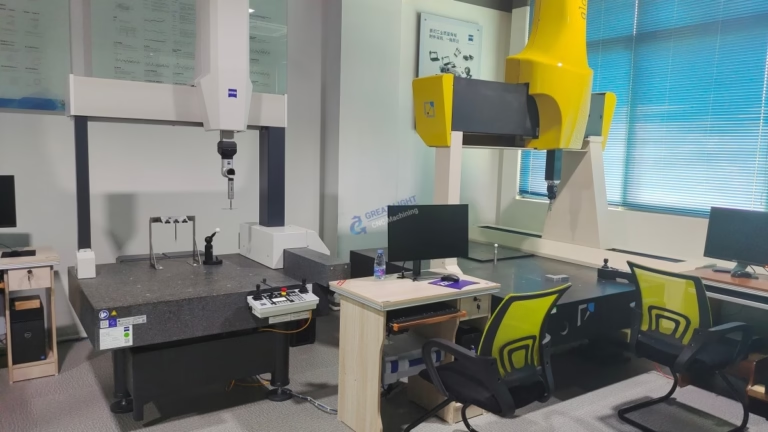
Inspection should be layered: raw material check on receipt, in-process monitoring during the run, and final inspection before shipment. For a tight feature, ask how it is measured and with what. Calipers do not verify ±0.005 mm; a CMM or a bore gauge does.
Certification scope matters as much as the certificate. ISO 9001:2015 covers quality management. IATF 16949:2016 adds automotive process control. ISO 13485:2016 covers medical devices. ISO 27001:2022 covers information security, which matters if your drawings are sensitive.
Finally, check how the shop handles a deviation. A controlled process catches a drift, quarantines the parts, and tells you before shipment. A reactive shop ships first and explains later. The second habit is what turns a machined part into a warranty claim.
Which Process Fits Your Part
Use the dominant constraint, not the part name.
| Constraint | CNC machining | Casting / forging | Stamping / molding |
|---|---|---|---|
| Annual volume | 1 to 10,000+ parts | 1,000+ parts | 10,000+ parts |
| Tooling cost | Low, fixture only | High, mold or die | High, die or mold |
| Tolerance | ±0.005 mm achievable | Coarse, then machined | Process dependent |
| Wall sections | Limited by deflection | Thin walls possible | Thin walls possible |
| Design changes | Cheap between builds | Expensive after tooling | Expensive after tooling |
| Surface finish | Ra 0.2–3.2 μm | Needs finish cut | As-formed |
| Material waste | High on simple shapes | Low, near net | Very low |
The Verdict
If your part needs tight tolerances, complex geometry, or low-to-mid volume without tooling investment, machining is the industrial process to use. If it is large, simple, and runs in the tens of thousands, cast or stamp it and machine only the critical faces.
Common Questions
Is CNC machining considered industrial manufacturing?
Yes. Industrial manufacturing is defined by powered machinery, controlled processes, and repeatable output, not by the machine type. CNC machining meets all three once the program, fixture, and inspection plan are documented.
A manual mill does not qualify on its own. The same machine running to a controlled process with traceable material and in-process checks does.
When should I choose casting or forging instead of machining?
Choose a near-net process when the part is large, the geometry is simple, and the annual volume is high enough to amortize tooling. A casting or forging leaves a small finish allowance, then machining cuts the critical faces.
If the volume is low or the design may change, machining from plate or bar avoids tooling cost entirely.
What tolerance can machining actually hold?
General machining holds ±0.05 mm without special effort. A rigid setup with sharp tooling can reach ±0.005 mm, but it requires slower passes, temperature control, and more inspection.
Tell the shop which dimensions are functional. Applying a tight tolerance to a cosmetic feature adds cost with no benefit.
Can machining be combined with other manufacturing processes?
Yes, and it usually is. Castings and forgings are machined on sealing faces and bearing bores. Sheet metal parts get machined holes and threads. 3D printed or vacuum cast prototypes are finished on mating surfaces.
The machining operation is often the step that brings a near-net part into tolerance.
How does machining support volume production?
Fixtures and multi-part tombstones let one setup run several parts per cycle. Tool life monitoring and in-process gauging keep dimensions stable across the run.
The limit is cycle time, not capability. Above a few tens of thousands of parts, a forming process usually wins on cost per piece.
What should I send for an accurate machining quote?
Send a 3D model and a 2D drawing with tolerances, material, finish, and quantity. Mark the functional dimensions and any datum scheme.
Add the annual volume, even if the first order is small. Volume changes the recommended process, not just the price.
Send Your Drawing, Get a Process Answer
We review the model, flag features that fight the tolerance, and return a quote with DFM notes within 12 hours.
12-hour quote100% inspectionNDA on request
More from the shop floor
We publish setup notes, tooling trials and inspection data from the factory floor.











