
Introduction to the treatment of dry steel CNC: rules of the game in manufacturing
Dry cutting removes flood coolant from the cut. That changes how heat leaves the part, how chips clear the flute, and which steel grades stay safe. This page explains the mechanism, the boundary conditions, and how to judge whether a job suits dry machining.
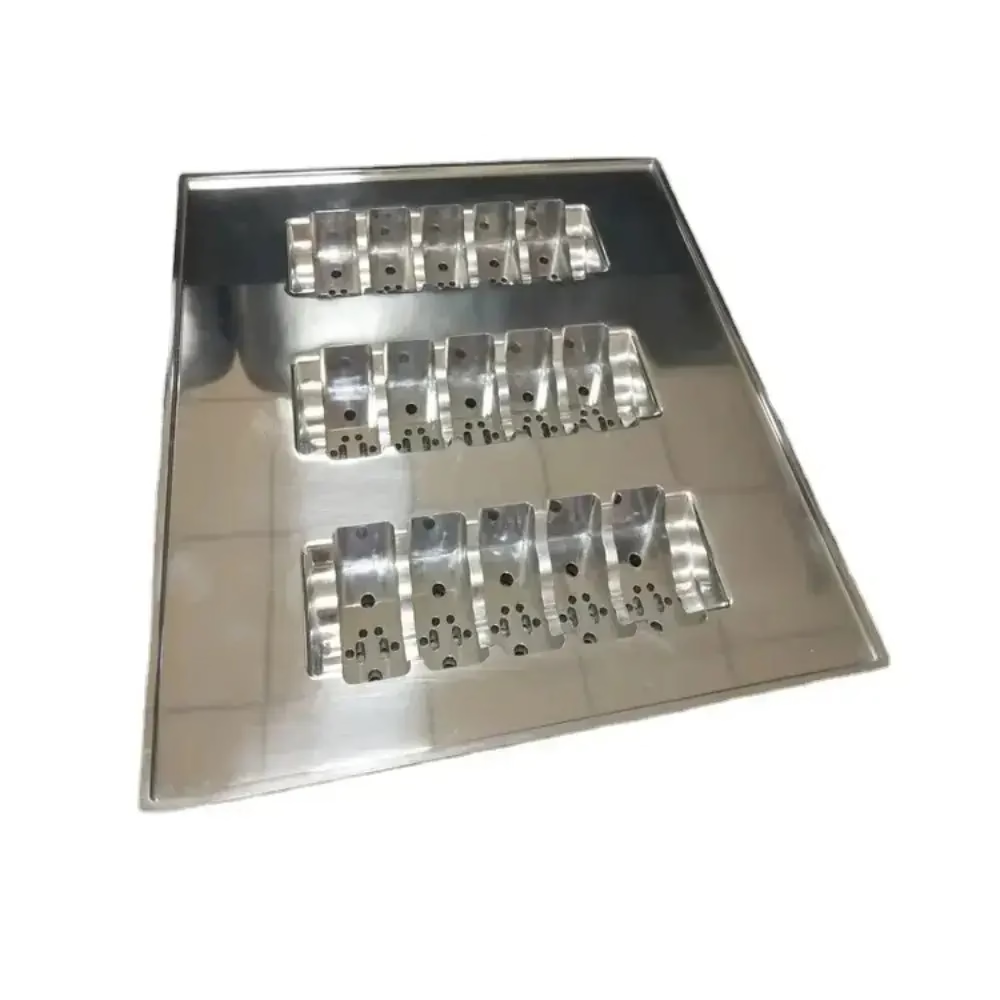
What treatment of dry steel actually changes
In wet machining, flood coolant carries away most of the heat generated at the shear zone. Remove it and that heat has only three exits: the chip, the tool, and the workpiece. The chip leaves with the largest share, which is why chip thickness and chip velocity matter more in dry cutting than in wet cutting. If the chip is thin and slow, heat stays in the part.
The second exit is the tool. Carbide softens as temperature climbs. Above roughly 800 °C at the cutting edge, cobalt diffusion accelerates and flank wear jumps. Dry steel cutting usually lives or dies on this number. Coatings delay the drop, but they do not remove heat. They only slow the rate at which the substrate sees it.
The workpiece is the third exit and the one most people forget. A 40 mm steel shaft that absorbs 15 percent of the cutting heat can grow 0.02–0.04 mm before the finishing pass. That is four to eight times a ±0.005 mm tolerance band. Thermal growth is not a side issue in dry steel work. It is the main dimensional risk.
So the treatment of dry steel is really heat management. Every choice, from insert grade to feed per tooth, is a way of steering joules into the chip instead of into the tool or the part.
Tooling choices that make dry steel work
Not every insert survives dry steel. Two families do most of the work: PVD-coated fine-grain carbide for continuous cuts, and CVD-coated grades for heavier interrupted cuts where the coating needs thickness. A TiAlN or AlTiN PVD layer holds hardness to about 900 °C. AlCrN pushes that a little further and resists oxidation better on 4140 and 4340.
Geometry matters as much as coating. A positive rake angle lowers cutting force and heat generation. A sharp edge, honed only lightly, cuts cooler than a heavy T-land edge. That is the opposite of what you want in interrupted cutting, where edge strength wins. Pick the edge for the operation, not for the catalog.
Through-tool air is common in dry setups, but it is not coolant. It does three jobs: it clears chips, it cools the edge by convection, and it prevents recutting. A 6–8 bar air blast aimed at the flank can drop edge temperature by 50–80 °C in light cuts. That is often the difference between 20 minutes and 45 minutes of tool life.
Minimum quantity lubrication is a middle path. A few milliliters per hour of vegetable oil reaches the flank and lowers friction without flooding the part. It keeps chips dry enough for recycling and still cuts tool wear on steels like 1045 and 4130. Many shops treat MQL as dry cutting with insurance.
Chip evacuation is the real bottleneck
Wet cutting hides poor chip control. Coolant flushes strings and birds' nests out of the pocket. Dry cutting does not. A long stringy chip on 1018 will wrap the tool, rub the finished wall, and sometimes pull the part. The fix is not more air. It is a chip breaker that matches the feed.
Feed per tooth sets chip thickness. On a 12 mm carbide end mill in 1045, a feed of 0.08–0.12 mm per tooth produces a chip that breaks on the insert geometry. Drop to 0.03 mm per tooth and the chip thins, work-hardens, and refuses to break. Slow feed is the most common cause of dry cutting failure on steel.
Pocket depth adds another limit. Past about 2.5 times the tool diameter, chip evacuation in a blind pocket becomes unreliable without through-spindle air or a vacuum shoe. Deep pockets in dry steel often need a pecking or helical entry strategy so chips leave before the next pass cuts into them.
Recutting is the quiet killer. A chip that stays in the flute gets cut twice. The second cut is at a lower speed and higher effective load, which chips the coating and heats the edge. If you see polished, glazed chips in the chip pan, the tool is recutting and tool life is already gone.
Which steels suit dry cutting, and which do not
Low-carbon steels like 1018 and A36 cut dry without much drama. They are soft, they conduct heat reasonably well, and they form built-up edge easily, which dry cutting actually tolerates because the edge is not being thermally shocked. Surface finish may drop one Ra step, from Ra 0.8–1.6 μm to Ra 1.6–3.2 μm, unless you finish with MQL.
Medium-carbon and alloy steels are the sweet spot. 1045, 4130, 4140 and 4340 all machine dry with coated carbide and air blast, provided the depth of cut is stable and the setup is rigid. These grades harden less at the surface than austenitic stainless, so the thermal load spreads into the chip instead of glazing the wall.
Tool steels and hardened grades are a different story. D2, A2 and H13 in the annealed state can be cut dry with reduced speed, but above about 45 HRC the heat generated at the edge rises faster than the chip can carry it away. At that point, flood or high-pressure coolant is not optional. It is the only way to hold tolerance.
Austenitic stainless is the grade to avoid dry. 304 and 316 work-harden at the surface, conduct heat poorly, and gall on the tool. Dry cutting them usually produces a shiny, hardened skin and rapid flank wear. If a job calls for 316L, run wet or MQL and accept the cleanup cost.
Cutting parameters and the process window
Dry cutting steel usually runs 15–25 percent slower in surface speed than the same operation wet. On 4140 with a coated carbide end mill, a wet speed of 120 m/min becomes about 90–100 m/min dry. The lower speed keeps edge temperature under the coating limit. Going faster does not improve removal rate; it just wears the tool out faster.
Depth of cut should stay generous. A radial engagement of 30–40 percent of the tool diameter with a full axial depth keeps the chip thick and the heat in the chip. Light radial passes at high speed generate thin chips, which is exactly the wrong direction for dry steel. This is the opposite of the high-efficiency wet strategy in aluminium.
Rigidity is not negotiable. Dry cutting has no fluid damping, so chatter shows up sooner. If the setup has a long tool overhang or a thin wall, reduce the axial depth before you reduce speed. A 4,000 mm machine bed with a well-supported part can hold dry steel at ±0.005 mm; a flexy fixture cannot, no matter the parameters.
Thermal drift must be planned for. Rough dry, then let the part cool to room temperature before finishing. On a tight-tolerance bore, that pause can be 20–30 minutes. Shops that skip it chase the dimension all afternoon and blame the machine.
Dry cutting suitability by steel grade
Ratings assume coated carbide tooling, rigid setup, and air blast at 6–8 bar.
| Steel grade | Dry cutting | Main risk | Preferred alternative |
|---|---|---|---|
| 1018 / A36 | Good | Built-up edge, stringy chips | MQL for finish passes |
| 1045 | Good | Chip wrapping in pockets | Air blast plus chip breaker |
| 4130 / 4140 | Good | Edge temperature at high speed | Reduce speed 15–25% |
| 4340 | Fair | Notch wear on interrupted cuts | MQL or flood for deep cuts |
| D2 / A2 (annealed) | Fair | Heat concentration at the edge | Lower speed, light depths |
| Hardened steel >45 HRC | Poor | Edge softening, taper | Flood or high-pressure coolant |
| 304 / 316L stainless | Poor | Work hardening, galling | Wet cutting only |
When dry wins and when it does not
Run dry on 1018 through 4140 when chips break cleanly and the setup is rigid. Run wet on stainless, hardened steel, and any deep pocket where chips cannot leave. There is no middle ground worth defending.
Frequently asked questions
Is dry steel CNC machining the same as high-speed cutting?
No. Dry cutting is about the absence of flood coolant, not about spindle speed. Some dry operations run slower than their wet equivalents to keep edge temperature under the coating limit.
High-speed cutting is a separate strategy that can be wet or dry. On steel, dry and high speed together usually shorten tool life unless the spindle has enough power to keep the chip thick.
Can dry cutting hold ±0.005 mm on steel parts?
It can, but only with a rough-then-cool-then-finish sequence. Thermal growth on a steel part can reach 0.02–0.04 mm during roughing, which is several times the tolerance band.
Let the part return to room temperature before the finishing pass, and keep the finishing depth light. Rigid fixturing matters more in dry cutting than in wet cutting because there is no fluid damping.
Does dry cutting change the surface finish?
Often yes. A wet pass that produces Ra 0.8–1.6 μm may produce Ra 1.6–3.2 μm dry, mostly from built-up edge and minor rubbing.
If the print calls for a finer finish, either finish with minimum quantity lubrication or add a light finishing pass at reduced feed. Both keep the part essentially dry.
What air pressure should be used for dry steel milling?
Most steel jobs run well at 6–8 bar aimed at the cutting zone. The goal is to move chips and cool the edge by convection, not to imitate coolant.
Below about 4 bar, chips tend to stay in the pocket and get recut. Above 10 bar, the air can blow chips into finished surfaces and damage them.
Is dry cutting cheaper than wet cutting?
Sometimes. You save on coolant purchase, disposal and part cleaning, but you may spend more on inserts and on inspection time. On low-carbon and medium-carbon steel, the balance often favors dry.
On stainless or hardened steel, the tool cost usually outweighs the coolant savings. The decision should be made per part family, not per shop.
Does dry machining affect the steel's heat treatment or hardness?
In normal dry milling, the surface temperature usually stays well below the tempering range of 4140 or 4340, so bulk hardness is unaffected.
The risk is a thin white layer on abused surfaces where the edge has rubbed rather than cut. Keep feeds high enough to cut, not rub, and that layer does not form.
Send us your steel part and drawing
We quote within 12 hours with a free DFM review, and we will tell you whether your steel part should run dry, with MQL, or wet.
12-hour quote100% inspection
More from the shop floor
We publish setup notes, tooling trials and inspection data from the factory floor.











