
Introduction to Milling Machine Technology
This introduction to milling machine practice covers how metal is removed, which axes do what, and where the process stops being economical. Written for design engineers and buyers who need to judge a part before sending it out for quote.
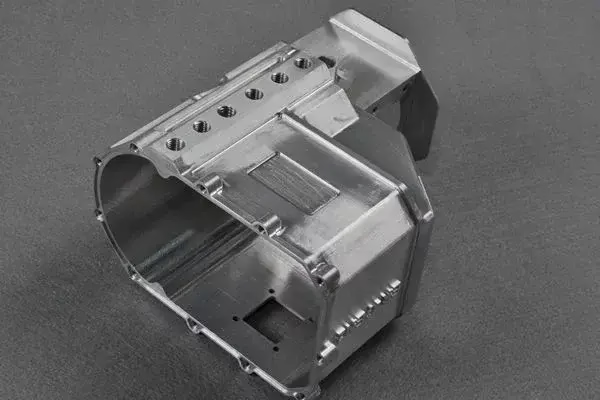
How an Introduction to Milling Machine Cutting Works
A milling machine spins a multi-tooth cutter while the workpiece moves under it along controlled axes. Each tooth takes a small chip. The machine does not push a blade through material like a saw; it shears many tiny chips per second and carries the heat away with them. That is why milling can hold tight size on a pocket wall while the tool stays cool enough to survive thousands of cuts.
The chip thickness matters more than spindle speed alone. Feed per tooth, radial depth of cut, and cutter diameter set the load on each edge. Push feed too low and the tool rubs instead of cutting, which work-hardens stainless and burns the edge. Push it too high and the tool deflects, leaving a tapered wall on a deep pocket. For aluminum 6061, a 10 mm three-flute carbide end mill at 8,000 rpm with 0.05 mm feed per tooth is a common starting point. For 304 stainless, drop surface speed to roughly one third of that and expect shorter tool life.
Climb milling, where the cutter tooth enters at maximum chip thickness, pulls the workpiece into the tool. It gives a better surface finish and longer tool life on CNC machines with ball screws and low backlash. Conventional milling does the opposite and is reserved for rough castings with hard skin or for older machines with worn lead screws.
The machine frame and spindle bearings set the accuracy ceiling. A light benchtop mill may move 0.05 mm under a heavy cut. A box-way machining center with preloaded angular contact bearings holds ±0.005 mm. No amount of programming skill can recover lost stiffness.
What 3, 4, and 5 Axis Can and Cannot Reach
A three-axis mill moves X, Y, and Z. The cutter always points down along Z. It can make flat faces, slots, pockets, and drilled holes, but it cannot reach under a lip or machine five sides of a block in one setup. Every new face means a new fixture, and every fixture adds error.
A four-axis mill adds a rotary table, usually turning around X or Y. The part spins while the cutter stays vertical. This lets you cut a cylindrical pattern, drill radial holes, or machine several faces without re-clamping. Our shop runs twelve four-axis mills with a Ø400 mm rotary table for this kind of work.
Five-axis machining adds tilt as well as rotation. The cutter can approach a surface at an angle, so it can reach a deepunder-cut or blend a curved surface with a short, stiff tool. Our sixteen simultaneous five-axis centers handle parts up to 4,000 mm on the large travel machines.
Five axes are not automatically better. A simple bracket with flat faces and holes is faster and cheaper on a three-axis machine. Reserve five-axis time for contoured surfaces, deep cavities, or parts where one setup saves the tolerance stack. If a part fits in a vise and has three orthogonal faces, adding axes just adds programming and cycle time.
Tolerance, Finish, and Where Milling Stops
Tolerance is a function of setup, tool, and material. On a rigid machine with a sharp cutter, ±0.005 mm (±0.0002 in) is achievable on a critical bore or a ground locating face. That number does not apply to every feature on the print. A deep pocket wall 150 mm tall will deflect and may drift 0.02 mm or more. Call out tight tolerance only where the part needs it.
Surface finish follows the same logic. A fine finish of Ra 0.2–0.8 μm needs a small stepover, a sharp tool, and often a finishing pass with a ball nose cutter. A general machined finish of Ra 1.6–3.2 μm is normal for a roughing and semi-finishing strategy. Packaging a whole part at Ra 0.4 μm doubles cycle time for no functional gain.
Milling has hard limits. An internal corner will always carry the radius of the cutter, typically 0.5 mm or larger. A hole smaller than about 1 mm is better drilled or cut by EDM. A part with a mirror finish on a curved surface may need polishing after milling. When the geometry needs a sharp internal corner or a hardened feature, milling alone will not get there.
Material choice shifts the numbers. Aluminum 6061 and 7075 cut fast and hold tolerance well. Titanium TC4 and Inconel generate heat at the edge and need lower surface speed, more coolant, and shorter tool life. Plastics like POM and PEEK cut cleanly but can melt or chip if feed and speed are wrong. We keep feeds and speeds for each family on file so the first part is not a guess.
From Quote to Finished Milling Machine Part
Design review catches most problems before metal is cut. We check wall thickness, corner radii, tool reach, and datum choice. A part designed with a 0.2 mm internal corner and a 40 mm deep pocket needs a long, thin tool that will chatter. A small change to a 1 mm corner radius lets a stiffer cutter do the job and holds the tolerance.
Setup count drives cost more than spindle time on small runs. A three-axis part with six faces may need three or four setups, each with its own fixture and alignment. Rotating that part onto a five-axis machine can cut setups to one, which often pays for the higher hourly rate. For runs above a few hundred pieces, a custom fixture usually beats five-axis time.
Inspection closes the loop. We check raw material certificates, monitor dimensions during the run, and inspect 100% of parts before shipment. Reports are available on request. If a feature is out of tolerance, we know before the part leaves the floor, not after it reaches the customer.
Lead time depends on geometry and material, not just quantity. A simple aluminum bracket can ship in 3–5 days. A titanium five-axis part with a hard anodize finish takes longer because of tool wear and outside finishing. We quote and return a free DFM analysis within 12 hours, and production can start within 24 hours of approval.
When Milling Beats Other Processes
Use this table to pick the process before you draw the part.
| Feature or part type | Best process | Why |
|---|---|---|
| Prismatic block, flat faces, pockets | 3-axis milling | Simple fixturing, fast cycle, low cost |
| Radial holes on a shaft | 4-axis milling | Indexed rotation, one setup, no re-clamp error |
| Contoured surface, deep cavity | 5-axis milling | Short rigid tool, angled approach, better finish |
| Round turned part, Ø tolerance | CNC turning | Single-point tool holds diameter better than an end mill |
| Sharp internal corner, hardened steel | EDM or grinding | End mill radius leaves a corner a wire can cut |
| Thin wall under 0.5 mm | Milling with light passes | Turning may crush the wall, EDM is slow |
| Large flat plate 4,000 mm long | Gantry or large-travel mill | Fits our 4,000 × 400 × 150 mm travel |
| Soft plastic prototype, one piece | 3D printing or milling | Milling gives tighter tolerance and real material |
Pick the Process Before You Pick the Machine
Choose three-axis milling for flat, prismatic parts and simple holes; move to five-axis only when a contoured surface or a deep undercut forces it. If the feature needs a sharp internal corner or sits in hardened steel, send it to EDM or grinding instead of fighting the cutter radius.
Milling Machine Questions Engineers Ask
What tolerance can a CNC milling machine actually hold?
On a rigid machine with a sharp cutter, ±0.005 mm is realistic on a critical bore or a ground face. That figure applies to the feature you control, not the whole part.
Deep walls, long tools, and thin sections deflect. Expect 0.02 mm or more on a 150 mm tall wall unless you add a finishing pass or support the part.
Do I need five-axis machining for my part?
Only if the geometry forces it. Contoured surfaces, deep cavities, and undercuts need the extra tilt. A part with flat faces and orthogonal holes runs faster and cheaper on a three-axis mill.
The other reason to use five axes is setup reduction. If one five-axis setup replaces four three-axis setups, the tolerance stack improves and the total cost can drop.
Which materials cut well on a milling machine?
Aluminum 6061, 7075, and 6082 cut fast and hold tight tolerance. Stainless 303 and 304 are common but work-harden if the feed is too light. Steel 1018 and 4140 machine well in the annealed state.
Titanium TC4 and Inconel need lower surface speed, more coolant, and shorter tool life. Plastics like POM, PEEK, and ABS cut cleanly with sharp tooling and the right chip load.
How do I avoid chatter and poor surface finish?
Keep the tool as short and as large in diameter as the geometry allows. Reduce radial depth of cut and increase feed per tooth to keep the edge cutting instead of rubbing.
Check the setup. A part held on a single vise jaw on a tall side will vibrate. Add support, lower the spindle speed, or change the cutter helix angle.
Can milling replace turning or EDM?
Sometimes. A mill-turn center can turn and mill in one setup. A prismatic part with a few round features often machines faster on a mill than on a lathe.
Sharp internal corners and hardened features still belong to EDM or grinding. Milling leaves a cutter radius, and no strategy removes it without a second process.
What do you need to quote a milling job?
Send a 3D model or a 2D print with tolerances, material, surface finish, and quantity. Note any critical features and the function of the part so we can flag problems.
We return a quotation and a free DFM analysis within 12 hours. No minimum order quantity, from one prototype to 10,000+ part runs.
Send Your Milling Part for a Free DFM Review
Upload a model and print, and our engineers will return a quote with manufacturability notes within 12 hours.
12-hour quote±0.005 mm tolerance100% inspectionNo MOQ
More CNC Knowledge
We publish setup notes, tooling trials and inspection data from the factory floor.











