
Introduction to 850 CNC Processing Center: Game Change
The 850 class is a vertical machining center with roughly 800 × 500 mm of X-Y travel. This page explains what that envelope actually buys you, which parts it suits, and the point where you should stop quoting on it.
In this article
- 1
- 2
- 3
- 4
- 5
- 6
What the 850 CNC processing center number actually measures
In our shop the 850 label is not a machine model or a brand. It is a size class. The number comes from X-axis travel of about 800 mm, paired with roughly 500 mm on Y and 500 mm on Z. Work a part that fits inside that box and the machine cuts comfortably. Push past it and the part has to move to a different machine.
That box is bigger than most people picture. A 500 × 400 × 300 mm aluminum housing, a full engine cover, a 600 mm long bracket, a plate with 40 tapped holes: all of these sit inside an 850 envelope with room for clamping. The limit is usually the fixture and the tool, not the material.
Compare it with the compact class we also run, at 500 × 500 × 450 mm and 500 × 310 × 200 mm. Those machines are faster on small parts because the axes have less mass to accelerate. The 850 pays for its size with slower rapids, so putting a 60 mm bracket on it wastes cycle time.
So the first question is never precision. It is part size. Measure the finished part, add the stock, add the clamp height, and see whether the total still fits under the spindle at full Z retract. That single check removes most of the guesswork.
- 1Travel is a box, not a diagonalA 700 mm part can still fail if it is 600 mm wide.
- 2Z travel runs out firstTall fixtures eat Z before they eat X or Y.
- 3Workholding is part of the envelopeVise jaws and clamps consume 50-100 mm.
Why a bigger frame holds tolerance longer
An 850 CNC processing center carries a heavier base and wider column than a compact mill. That mass matters when the cutter loads up. Cast iron and polymer concrete absorb vibration, so the tool leaves a cleaner floor and the finish stays inside Ra 0.8-1.6 μm on a long cut instead of drifting.
The second effect is thermal. Big castings change shape slowly when the spindle warms the surrounding air. On a short cycle you never notice. On a four-hour run, a light frame can walk a few hundredths of a millimeter while a heavy one barely moves. That is why we hold ±0.005 mm on production lots rather than just on the first article.
Rigidity also decides which tools you can use. With a stiff 850 frame you can run a 63 mm face mill or a long 4:1 ratio end mill without chatter. On a lighter machine the same tool sings, and the operator ends up backing off feed until the cycle takes twice as long.
None of this is free. A heavier machine accelerates slower, so the same program may run 15 to 25 percent longer than on a compact mill. For roughing hundreds of identical small parts, that gap is real money.
- 1Mass damps chatterFewer tool marks, less manual blending.
- 2Mass slows thermal driftTolerance holds across a long run.
- 3Mass allows longer toolsDeep pockets get cut in fewer setups.
The setup math that decides the real cost
A three-axis 850 needs one setup per face. A part with features on five sides means five setups, five fixtures, and five chances to lose 0.02 mm of alignment between them. Add a rotary table and you cut that to two or three setups, because the fourth axis indexes the part instead of the operator re-clamping it.
This is where the class earns its name in daily production. On a 200 mm gearbox housing with bores on four faces, moving from three setups to two saves roughly 40 minutes per part in loading and indicating, before any cutting time is counted. On a run of 500 pieces that is the difference between a workable quote and a losing one.
The limit is reach, not rotation. A rotary table with Ø400 mm capacity lets the tool approach from new angles, but a feature hidden behind a tall wall still needs either a long tool or a second operation. Check the drawing for undercuts and internal shoulders before assuming a fourth axis solves everything.
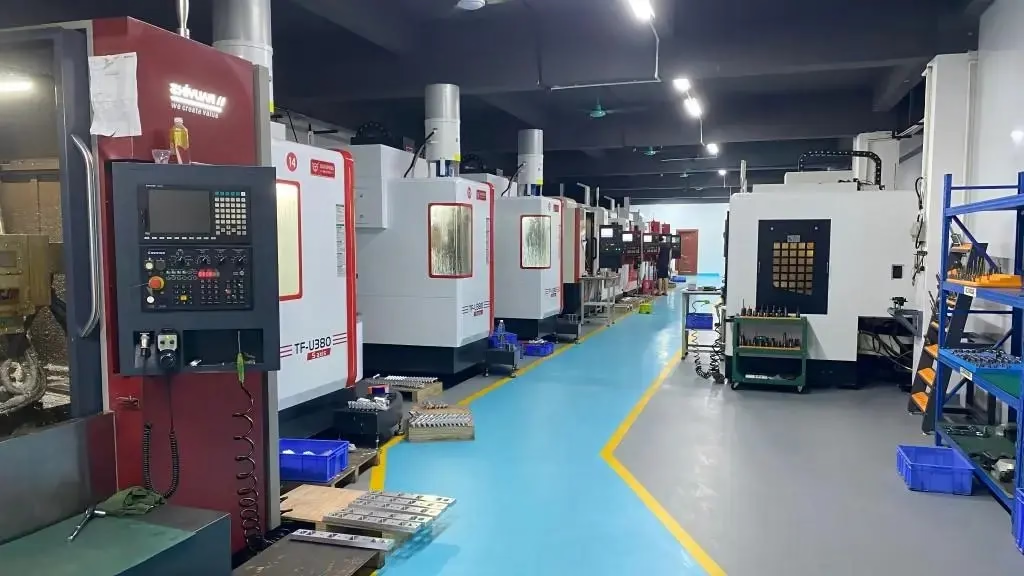
Our own fleet reflects that balance: 16 simultaneous five-axis centers for the complicated geometry, and 27 three-axis machines for the flat, open work that never needed more.
- 1Count faces, not featuresEach new face is a new setup unless an axis indexes it.
- 2Fourth axis pays back above ~100 partsBelow that, fixture cost can exceed the saving.
Which materials the 850 class handles well
An 850 CNC processing center is a general-purpose machine. It will cut aluminum, stainless, steel, copper, titanium and engineering plastics with the right spindle speed and coolant. Aluminum 6061 and 7075 run fast and dry or with mist. Stainless 304 and 17-4PH run slower with flood coolant and sharp, coated tools.
Titanium TC4 (Ti-6Al-4V) and Inconel are the honest boundary. They cut, but heat stays in the tool instead of the chip, so the same insert that lasts 90 minutes in aluminum may last 15 in titanium. On a 850 frame you can still hold ±0.005 mm, but the feeds drop and the cycle time rises sharply.
Plastics bring the opposite problem. POM and PEEK move with temperature and clamp pressure, so a heavy vise can squeeze a part out of tolerance before the cutter touches it. We use light clamping and take a spring pass on critical diameters.
For very thin walls, the machine is rarely the weak point. A 0.8 mm aluminum wall deflects under cutting force no matter how stiff the frame is. Change the toolpath, leave support ribs, or accept two light passes.
- 1Aluminum is the sweet spotFast cycles, easy chip evacuation, low tool wear.
- 2Superalloys need a planBudget more time and more tools, not more spindle speed.
- 3Plastics need gentle clampingLight jaws and sharp tools beat heavy pressure.
When an 850 CNC processing center is the wrong choice
Parts under roughly 100 mm in all three dimensions rarely belong on an 850. The travel is wasted, the fixture is oversized, and a compact machine with a faster spindle will beat it on cycle time and on price. Size the machine to the part, not to the shop's biggest door.
Very long parts are the second mismatch. A 1,200 mm extrusion needs a machine with 4,000 mm travel, not a bigger vise on an 850. We run those on the long-travel machines at 4,000 × 400 × 150 mm, where the part sits flat and the tool reaches both ends.
The third case is tight-tolerance round work. If the part is basically a turned shaft with a few milled flats, a mill-turn center finishes it in one operation while an 850 needs a lathe plus a mill and loses concentricity between them.
If none of those describe your part, the 850 is probably right. Send the model and we will confirm the travel and the setup count before quoting.
- 1Too smallUnder ~100 mm, a compact machine wins on cycle time.
- 2Too longPast ~800 mm, move to a long-travel machine.
- 3Mostly turnedA mill-turn center keeps concentricity in one setup.
Machine class compared by part size
Travel figures are the working envelope, not the table size
| Class | Typical travel | Best for | Watch out |
|---|---|---|---|
| Compact mill | 500 × 500 × 450 mm | Small brackets, plates, housings | Tall fixtures eat Z fast |
| Compact mill (narrow) | 500 × 310 × 200 mm | Thin plates, small connectors | Very low Z clearance |
| 850 class | 800 × 500 × 500 mm | Medium housings, covers, molds | Slower rapids on tiny parts |
| Medium gantry | 750 × 1,150 × 550 mm | Long plates, multiple parts per cycle | Floor space and fixture cost |
| Long travel | 4,000 × 400 × 150 mm | Extrusions, long rails, beams | Low Z, flat parts only |
Pick the machine by the part, not by the shop
If your part fits inside roughly 800 × 500 × 500 mm and needs three or more machined faces, the 850 class is the right call. If it is under 100 mm, mostly turned, or longer than 800 mm, choose a compact machine, a mill-turn center, or a long-travel mill instead.
851 questions engineers ask
Does an 850 machine hold tighter tolerance than a smaller one?
Not automatically. A rigid frame holds tolerance longer over a production run because it drifts less, but a well-maintained compact machine can still hit ±0.005 mm on a short cycle. The difference shows up in the tenth hour, not the first part.
Can I put a 900 mm part on an 850?
Usually no. X travel of about 800 mm has to cover the part plus the cutter diameter plus the clamp. A 900 mm part needs a long-travel machine, where the work sits flat and the head travels over it.
How much does a fourth axis change the cost?
It removes setups, which is where the money is. On a part with four machined faces, going from three setups to two typically saves 30 to 45 minutes per piece. Below about 100 pieces the rotary table and fixture can cost more than it saves.
Which materials should I avoid on this class?
None outright, but Inconel and titanium TC4 cut slowly and wear tools fast, so cycle time and tool cost rise sharply. Very thin plastic walls are a toolpath problem rather than a machine problem.
How do you check that the part fits before quoting?
We measure the finished envelope, add stock, add clamp height, and compare against travel. If it is close on Z, we check the tool length needed to reach the deepest feature. That usually settles it in one pass.
What finish can I expect straight off the machine?
As-machined surfaces land around Ra 1.6-3.2 μm. With a finer stepover and a finishing pass, Ra 0.8-1.6 μm is normal, and critical sealing faces can reach Ra 0.2-0.8 μm before any polishing.
Send the model, get a straight answer on fit
Upload your part and we will confirm travel, setup count and material before quoting, with DFM feedback inside 12 hours.
12-hour quote±0.005 mm100% inspectionNDA on request
More machining notes from the shop floor
We publish setup notes, tooling trials and inspection data from the factory floor.











