
Introducing XYZ Horizontal Machining Center
An XYZ horizontal machining center turns the spindle onto its side and puts the work on a rotating tombstone. That single layout change decides which parts run well and which parts fight you. This page is for engineers and buyers who need to judge fit, accuracy and cost before committing a part to a horizontal.
In this article
- 1
- 2
- 3
- 4
- 5
What an XYZ horizontal machining center actually is
On a vertical mill the spindle points down and the operator reaches over the table to load. On an XYZ horizontal machining center the spindle sits on its side, parallel to the floor, and the part is clamped to a face that stands upright. The spindle moves in X and Y, the column feeds in Z, and the table rotates in B so four faces of a cube come within reach of one setup.
That orientation is the whole point. Chips fall away from the cut instead of piling around the tool, so deep pockets clear themselves and you spend less time stopping the cycle to blow out cavities. Gravity does the chip evacuation for you.
Horizontal machines are not a universal upgrade over verticals. They earn their keep on parts that are boxy, heavy, and need several faces machined to tight relationships. On a thin flat plate, a horizontal spindle is often the wrong tool and a three-axis vertical will beat it on both price and setup time.
The name is a bit misleading. Nearly every horizontal machining center sold today moves in more than three axes. The XYZ part of the name describes the linear frame, not the total axis count. Rotary motion in B and often A is what makes the layout useful.
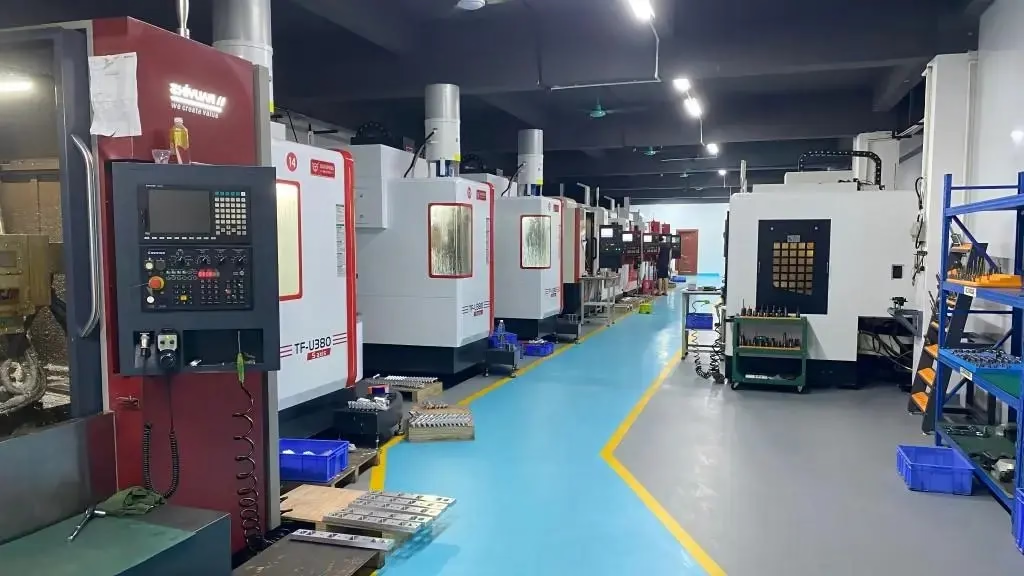
We run 16 simultaneous 5-axis machining centers alongside 12 four-axis mills and 27 three-axis machines. Which one a job lands on comes down to face count, part mass, and how tight the bore-to-bore relationships need to be.
Tombstone fixturing and why one setup changes everything
A tombstone is a vertical block clamped to the rotary table. You mount the part on one or more faces, and the B axis indexes the block so each face comes to the spindle in turn. Four faces in one setup is routine. Add a second tombstone on a pallet pool and the machine keeps cutting while the operator loads the next batch.
Setup count is the biggest cost driver on multi-face parts. Every time a part comes off the table, you pay for a re-clamp, a re-datum, and a fresh first-article check. A horizontal removes most of those events. On a housing with bores on four sides, the difference between three setups and one is usually bigger than the difference between two machine models.
The catch is that a tombstone needs a place to bolt to. Parts with no flat face, no boss pattern, or no usable hole grid are hard to fixture on a block. If your part is a curved shell with nothing to hold, budget for a soft jaw or a custom nest before you budget for the machine time.
Rotary table indexing accuracy sets the ceiling for face-to-face relationships. On our horizontals the table is Ø400 mm, and the B-axis repeatability is what holds a bore on face one true to a bore on face three. If your drawing calls for ±0.005 mm across opposed faces, that spec lives or dies at the table, not at the tool.
Weight matters too. Tombstones are heavy, and the rotary table has a load limit. A 200 kg casting on a four-face tombstone can push a compact machine past its rated table load. Check the load rating before quoting a heavy part.
Chip evacuation, thermal drift and the accuracy you can hold
Chips leaving the cut under gravity sounds like a small thing. In practice it changes tool life and surface finish on deep cavities. In a vertical pocket, recut chips grind against the flank of the end mill and raise the cutting temperature. On a horizontal, the same pocket clears itself, so the tool runs cooler and the finish stays consistent deeper into the cut.
Thermal growth is the other quiet variable. As the spindle and ballscrews warm up, the frame grows, and Z position drifts. A horizontal with a well-insulated spindle and a warm-up cycle holds tighter over a long run than a cold machine does on its first part. Our tolerance floor is ±0.005 mm, and that number assumes the machine has reached thermal stability.
Coolant delivery is easier on a horizontal. The tool can be aimed down or sideways, so through-spindle coolant reaches the cutting edge without pooling. On deep bores this matters more than spindle speed. A 12,000 rpm spindle with good coolant pressure will out-cut a faster spindle that floods and stalls.
Surface finish follows the same logic. As-machined faces land around Ra 1.6–3.2 μm. Where a bore or a sealing face needs better, we plan a separate finishing pass at Ra 0.8–1.6 μm, and fine work down to Ra 0.2–0.8 μm where the geometry allows it.
The boundary is rigidity versus reach. Long boring bars in a horizontal quill flex, and a horizontal's Z stroke is often shorter than a big vertical's. If your part is 4,000 mm long with bores at each end, that is a different machine class than a 500 mm cube.
When the layout pays off and when it does not
The clearest win is a part that needs four or five faces machined and has bores that must stay concentric or parallel to each other. Gearbox housings, pump bodies, valve blocks, motor end plates, and transmission cases all fit this pattern. One tombstone setup, one datum, and the relationships come from the table rather than from a stack of re-clamps.
Medium runs also favor horizontals. A pallet pool lets the spindle cut while a second part is loaded, so spindle uptime climbs without adding an operator. On a 500-part order with four machined faces, that idle time is a real cost line. With no minimum order quantity, we can also run a single prototype on the same tombstones before committing to the batch.
Flat plates, long shafts, and open frames are usually a poor fit. A plate has two faces at most, and a horizontal adds nothing but setup complexity. A long shaft needs a lathe or a mill-turn center, not a tombstone. Choosing a horizontal for these parts raises cost without raising quality.
Thin-wall parts deserve a caution. Clamping force on a tombstone is applied through the part, and a 1.5 mm wall will move under a heavy vise. That is a workholding problem, not a machine problem, but it shows up as a dimensional problem on the CMM. Soft jaws and light clamping passes fix most of it.
Material choice shifts the calculus too. Aluminium 6061, 7075 and ADC12 cut fast and clear chips easily, which suits horizontals. Stainless 316L and 17-4PH work-harden, so a rigid horizontal frame helps hold the edge. Titanium TC4 and Inconel cut hot and slow, and the gravity chip path is a genuine advantage there.
For medical and automotive work the paperwork matters as much as the cut. We hold ISO 9001:2015, IATF 16949:2016, ISO 13485:2016 and ISO 27001:2022, and we inspect 100% of parts before shipment with reports on request.
Horizontal or vertical: matching the part to the machine
Use this as a first-pass filter before you ask for a quote.
| Part feature | Horizontal fits | Vertical fits better |
|---|---|---|
| Machined faces | Four or five faces in one setup | One or two faces |
| Bore relationships | Opposed bores held from one datum | Single bore, loose position |
| Part shape | Boxy, heavy, cast or forged | Flat plate, thin panel |
| Chip volume | Deep pockets, high removal | Shallow pockets, light cuts |
| Batch size | Medium to high, pallet pool pays off | One-offs and small lots |
| Part mass | Fits tombstone and table load limit | Very light or very long |
| Tolerance | ±0.005 mm across faces | Loose across-face tolerance |
| Setup time | High cost per re-clamp | Setup is cheap, do it often |
The short answer
If your part needs four or more faces machined and bores that must stay true to each other, an XYZ horizontal machining center is the cheaper route to ±0.005 mm. If it is a flat plate, a long shaft, or a one-off with two faces, a vertical mill will do the job for less.
Questions engineers ask before committing a part
How many axes does an XYZ horizontal machining center have?
The XYZ in the name refers to the three linear axes: X and Y on the spindle head, Z on the column. Total axis count is usually higher.
Most horizontals in service add a B rotary table, and many add a trunnion or tilting head for a fourth and fifth axis. We run 16 simultaneous 5-axis machining centers, so a part can be quoted on a true 5-axis horizontal when the geometry needs it.
What spindle speed and power should I expect?
Spindle specs vary by machine class, so treat any single number with care. On the horizontals we run for production work, spindle speeds reach 12,000 rpm with through-spindle coolant, which covers aluminium, stainless and most steel work.
The more useful question is whether the spindle holds torque at the speed your cutter needs. A high top speed with weak low-end torque will stall on a large-diameter face mill in 4140.
Can a horizontal machine heavy-duty parts?
Yes, that is one of its strengths. The frame is closed and the load path is short, so a horizontal takes heavy radial cuts with less chatter than an open vertical.
The real limit is the rotary table and tombstone load rating, not the spindle. Check the rated table load before you quote a 200 kg casting.
Can I use custom CNC programs on it?
Yes. The control on our horizontals supports standard G-code and custom macro programming, so a post-processor tuned to your CAM output works fine.
If your part needs probing for in-process datum checks, that has to be planned into the program before the first cut, not added later.
What materials run well on a horizontal?
Aluminium 6061, 6061-T6, 2024, 5052, 5083, 6063, 6082, 7075 and ADC12 all cut cleanly with gravity chip clearing.
Stainless 303, 304, 316, 316L, 17-4PH and 440C work well too, and titanium TC4 or Inconel benefit most from the chip path. Plastics such as POM, PEEK and ABS run on the same machines with lighter clamping.
How fast can a horizontal job start and ship?
We return a quotation and a free DFM analysis within 12 hours, and production can start within 24 hours of approval.
Parts ship in 3–5 days for standard work. Historical late-delivery probability on our orders sits below 2%.
Send the drawing and we will tell you if a horizontal is right
Upload your model and we will return a quote, a DFM analysis, and a straight answer on whether this part belongs on a horizontal or a vertical.
12-hour quote100% inspectionNDA on request
More from the shop floor
We publish setup notes, tooling trials and inspection data from the factory floor.











