
Machining a Beginners Guide to CNC
This machining a beginners guide is written for design engineers who need to know what the process can and cannot hold. We walk through the CAD-to-part chain, the numbers that matter, and the point where a different process becomes the better answer.
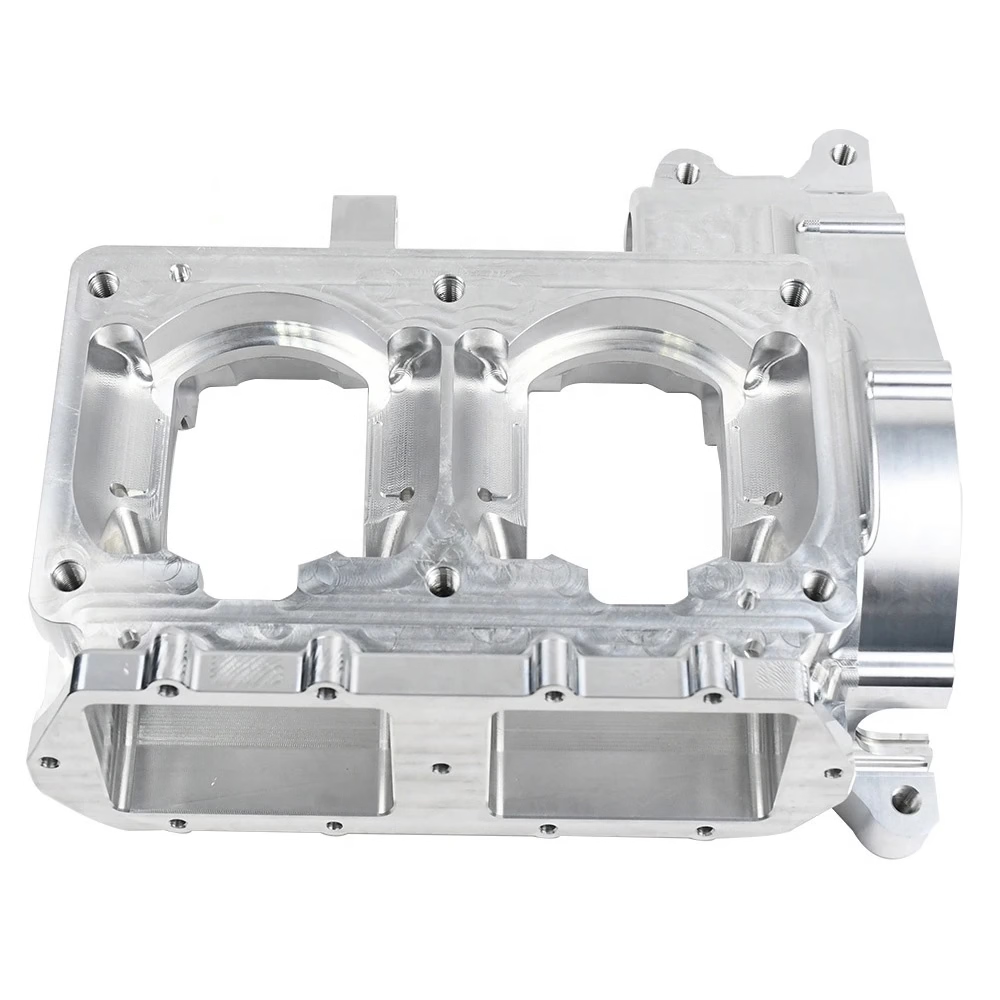
What CNC Machining Does, in Plain Terms
CNC stands for computer numerical control. A machine tool reads a program of coordinates and moves a spinning cutter or a turning workpiece to those coordinates. The operator sets up the stock and the tools. The program decides where metal comes off.
The input is a CAD model. CAM software turns that model into toolpaths, and the toolpaths become G-code: a list of positions, feed rates and spindle speeds. Nothing about the shape is decided at the machine. Change the model and you change the part.
This is the real difference from manual machining. On a manual mill the operator reads a dial and watches a chip. On a CNC machine the same operation runs the same way at 8 a.m. and at 2 a.m.
That repeatability is why machining a beginners guide usually starts here. The hard part is not the machine. It is knowing which features the cutter can reach.
From CAD File to Finished Part
The chain has five links: model, toolpath, setup, cut, inspection. A weak link anywhere shows up as a scrapped part, and the cost of fixing it grows at every step.
Model. The CAD file has to be watertight and at final scale. Missing surfaces and duplicate faces cause CAM to generate broken toolpaths. Export STEP or Parasolid for machining, not STL.
Toolpath. The CAM programmer picks tools, stepover and depth of cut. A 12 mm end mill removes material fast but leaves a 6 mm internal corner radius. Small radii need small tools, and small tools need slower feeds.
Setup. Workholding decides accuracy as much as the machine does. A part held in a vise on 3 mm of stock will move under load. We check the fixturing before the first cut, not after.
Cut and inspect. In-process checks catch drift before the whole batch is wrong. GreatLight inspects 100% of parts before shipment, with reports on request.
Tolerances, Finishes and What They Cost
A tolerance is a permitted range, not a target. Drawing ±0.005 mm on every dimension raises cost and lead time for no benefit. Reserve tight tolerances for the features that actually mate.
General machining holds ±0.1 mm comfortably on most metals. As you tighten toward ±0.005 mm, you add temperature control, more measuring steps and slower passes. Ra 1.6–3.2 μm is the as-machined baseline. Ra 0.8–1.6 μm needs a finishing pass, and Ra 0.2–0.8 μm needs polishing or a dedicated fine-finish operation.
Material matters too. Aluminum 6061 cuts clean and fast. Stainless 316 work-hardens if the feed is too light. Titanium Ti-6Al-4V needs rigid setups and generous coolant. On plastics like POM or PEEK, heat and clamping pressure are the main risks, not cutter wear.
The practical rule for anyone reading a machining a beginners guide: draw the function first, then assign tolerances only where the assembly demands them.
When Machining Is the Right Answer
Machining wins on tight tolerances, hard materials and low to medium volumes. One prototype and a 10,000-part run use the same program, so the first article already matches the production part.
It also wins when the geometry is complex in three dimensions. A 5-axis center can reach undercuts and angled faces in one setup, which removes the stacking error that comes from moving a part between fixtures.
It is the wrong answer when the part is a thin shell with uniform wall thickness, or when you need tens of thousands of identical simple parts. Die casting, vacuum casting and sheet metal fabrication cost less per unit at that volume.
The honest boundary: if your part fits in a 4,000 mm envelope and needs a tolerance tighter than ±0.1 mm, machining is usually the shortest path. If it needs no tolerance at all and you want 50,000 pieces, it is not.
Design Rules That Prevent Rework
Most rework traces back to a handful of features. A beginner's drawing often specifies a sharp internal corner where the cutter physically cannot go.
Internal corners carry the tool radius. A 6 mm cutter leaves a 3 mm radius. If the drawing calls for 0.5 mm, the shop either uses a 1 mm cutter, which is slow, or asks you to change the corner.
Deep pockets need clearance for the tool holder, not just the tool. A pocket 60 mm deep with a 10 mm cutter may need a long-reach holder that flexes. Shorter reach and wider pockets cut better and cheaper.
Threads smaller than M2 and holes deeper than 10× diameter drive cost up sharply. So do tight tolerances on non-functional surfaces. Mark the critical dimensions on the drawing and leave the rest general.
One more: put a chamfer or fillet on every outside edge. Deburring by hand costs more than the chamfer ever will.
Process Fit by Part Requirement
Use the row that matches your dominant requirement.
| Requirement | CNC Machining | Better Alternative | Why |
|---|---|---|---|
| Tolerance tighter than ±0.05 mm | Yes | — | Cutter position is program-controlled |
| Volume above 20,000 simple parts | No | Die casting | Tooling amortizes at high volume |
| Uniform thin walls (under 1.5 mm) | Risky | Vacuum casting | Clamping distorts thin sections |
| Hard metal above 45 HRC | Yes | — | Carbide and coated tools hold up |
| Flat sheet parts, 1–3 mm | No | Sheet metal | Faster and cheaper per part |
| One-off prototype | Yes | — | No tooling, program runs directly |
| Organic, freeform shapes | Limited | 3D printing | 5-axis reaches angled faces, not all curves |
The Honest Trade-off
If your part needs ±0.05 mm or tighter on metal, machine it. If it is a simple plastic shape at 20,000 pieces, cast or mold it instead.
Beginner Questions, Direct Answers
What file format should I send for a quote?
Send STEP or Parasolid for 3D geometry, plus a 2D PDF with tolerances, threads and surface finish callouts. Native SolidWorks or Fusion files work too.
Avoid STL for machining quotes. It approximates curves with triangles, so the shop has to guess at true radii and hole sizes.
How tight a tolerance can CNC machining actually hold?
GreatLight works to ±0.005 mm on critical features, which is ±0.0002 in. That figure applies to specific dimensions, not to every dimension on the drawing.
General dimensions usually sit at ±0.1 mm. Tightening all of them multiplies inspection time and cost without improving function.
Which materials are easiest for a first project?
Aluminum 6061-T6 is the standard starting point. It machines fast, holds tolerance well, and anodizes cleanly.
Stainless 316 and titanium Ti-6Al-4V are workable but slower and more expensive. POM and ABS are good for plastic prototypes where you want to check fit before cutting metal.
Do I need a minimum order quantity?
No. GreatLight has no minimum order quantity, so a single prototype and a 10,000+ part run go through the same process.
Production can start within 24 hours of drawing approval, and parts typically ship in 3–5 days.
How do I keep my design confidential?
Uploads are handled as secure and confidential. We can sign an NDA before you send files.
A free DFM analysis and quotation come back within 12 hours, so you know the risks before committing to a run.
What surface finishes are available?
Anodizing in clear, color and hardcoat, plus electroless nickel, zinc, silver and gold plating. Powder coating and black oxide cover the darker industrial look.
Bead blasting, tumbling, brushing and polishing handle texture. Laser marking works down to 1.5 mm character height.
Send a Drawing, Get a Real Answer
Upload your CAD file and we return a quotation with free DFM analysis within 12 hours.
12-hour quote100% inspectionNo MOQ
More From GreatLight
We publish setup notes, tooling trials and inspection data from the factory floor.











