

How To Machine A Perfect Cube On A CNC Machine?
When precision engineers and product developers talk about challenging yet fundamental machining tasks, one project consistently rises to the top: machining a perfect cube. Whether you’re producing components for robotics, aerospace, medical devices, or high-end consumer electronics, the ability to machine a geometrically precise cube — with tight tolerances, superior surface finish, and dimensional consistency — is often seen as a benchmark of a manufacturer’s true capabilities.
At the heart of this challenge is not just the geometry, but the combination of material properties, machine precision, toolpath strategy, and post-processing finesse. In this article, we’ll explore how to achieve a flawless cube using five-axis CNC machining, why this task matters more than it seems, and what to look for in a capable manufacturing partner like GreatLight CNC Machining Factory — your expert in solving the most demanding precision machining challenges.
What Defines a “Perfect” Cube in CNC Machining?
Before diving into the “how,” it’s essential to define what we mean by a perfect cube:
| Attribute | Specification |
|---|---|
| Geometry | Six equal square faces meeting at right angles |
| Tolerance | Typically ±0.005mm to ±0.001mm, depending on application |
| Flatness | Within microns across each face |
| Parallelism & Perpendicularity | Extremely tight — often within 0.002mm |
| Surface Finish | Ra 0.2μm ~ 1.6μm, depending on use-case |
| Material Integrity | No tool marks, burrs, or subsurface damage |
While a cube may seem like a simple shape, achieving these specs — especially in hard metals like titanium, stainless steel, or Inconel — requires strategic planning, high-end machinery, and skilled execution.
Why Machining a Cube Is More Complex Than It Seems
Many assume that machining a cube is straightforward — just cut six sides, right? But the reality involves overcoming several hidden complexities:
1. Cumulative Errors
Each face you machine affects the reference for the next. Without a robust fixture strategy and datum control, errors compound, resulting in misaligned or non-square faces.
2. Tool Deflection & Vibration
Especially in harder materials, tool deflection during facing or pocketing can lead to uneven surfaces or dimensional deviations.
3. Thermal Expansion
CNC machines and workpieces expand with heat. Without proper cooling strategies and thermal compensation, slight variances can throw off critical tolerances.
4. Clamping Distortion
Over-clamping or uneven pressure can warp the part, making it impossible to achieve true perpendicular or parallel faces.
Step-by-Step: How to Machine a Perfect Cube Using CNC
Here’s how leading manufacturers like GreatLight CNC Machining Factory approach the challenge using state-of-the-art 5-axis CNC machining technology:
🔹 Step 1: Material Selection & Initial Block Prep
Start with a high-quality raw block (often P20, stainless steel, aluminum 6061, titanium, or copper). The block should have:
Minimal internal stress
Homogeneous material structure
Certified dimensions close to the final size (+/- 0.1mm tolerance acceptable initially)
Fixturing is critical — vacuum tables, custom soft jaws, or precision vises with repeatable positioning are used.
🔹 Step 2: Establishing the Datum Reference
The first operation establishes the primary datum face — usually one of the large faces. This face is:
Machined perfectly flat (flatness within 0.001mm)
Used as the reference for all subsequent operations
Often hand-lapped or finish-scraped in ultra-high precision applications
All other dimensions — length, width, height, and angles — are derived from this initial face.
🔹 Step 3: Roughing & Semi-Finishing
Using high-speed roughing tools (typically 2–4 flute carbide end mills), excess material is removed quickly while maintaining the block’s squareness.
Roughing Strategy: Z-level or plunge roughing to remove bulk
Semi-Finishing: Finer step-downs to prepare for final pass, improving surface uniformity
5-axis machines allow simultaneous 3+2 machining, where the cube can be held statically while the tool approaches from optimized angles to reduce tool marks and reach difficult zones.
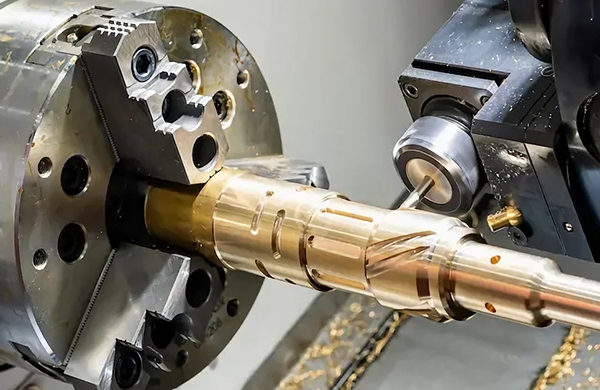
🔹 Step 4: Precision Finishing of All Six Faces
This is where the magic happens — and where machine capability truly shows.
Each of the six faces is machined in a controlled sequence:
First Face (Datum) → Already completed
Opposite Face → Machined to exact thickness, parallel within microns
Four Side Faces → Machined square to both datum faces, ensuring 90° angles
Key Techniques:

Face Milling with High Rigidity Tools
Optimized Toolpaths to Minimize Tool Deflection
In-Process Measurement (where applicable)
Temperature-Controlled Environment
For tolerances below ±0.002mm, intermediate measurements with CMM or laser scanners might be used between operations.
🔹 Step 5: Edge Breaking & Chamfering (Optional)
Depending on the application, edges may be broken or chamfered for:
Safety in handling
Aesthetic appeal
Assembly ease
This is done with specialized edge-finishing tools or manual polishing where needed.
🔹 Step 6: Final Inspection & Quality Control
A perfect cube isn’t just machined — it’s verified.
Inspection includes:
| Inspection Type | Tool Used | What It Measures |
|---|---|---|
| Dimensional Accuracy | CMM (Coordinate Measuring Machine) | Length, width, height, squareness |
| Flatness & Parallelism | Optical Comparator / CMM | Surface evenness and alignment |
| Angular Accuracy | Precision Protractor / CMM | 90° between faces |
| Surface Finish | Profilometer | Ra values, roughness |
At GreatLight CNC Machining Factory, every cube undergoes rigorous QC with ISO 9001:2015-certified processes, ensuring that what you receive matches the design intent — down to the micron.
Why Choose Five-Axis CNC for Cube Machining?
While three-axis machines can make cubes, they often struggle with:
Undercuts
Hard-to-reach features
Maintaining consistent tool angles
Minimizing setup changes
Five-axis CNC machines, like those used exclusively at GreatLight CNC Machining Factory, provide:
✅ Simultaneous multi-axis movement for optimal tool angles
✅ Reduced setups, improving accuracy
✅ Ability to machine complex internal geometries if needed
✅ Superior surface finishes with fewer tool marks
This makes 5-axis the go-to choice when you need not just a cube, but a precision-engineered cube.
Real-World Applications of Precision Cubes
You might be surprised where precision cubes are used:
Metrology & Calibration Standards: Used as physical references in quality labs
Robotics Joints: Act as reference frames for motion accuracy
Aerospace Components: Serve as mounting or interface structures
Medical Devices: Act as housings or alignment fixtures
Automotive Testing: Provide stable platforms for sensor mounts
In all these cases, the cube isn’t just a shape — it’s a functional precision benchmark.
Conclusion: Your Partner in Precision Cubes
Machining a perfect cube is far from a basic exercise — it’s a testament to a manufacturer’s mastery over tooling, machinery, process design, and quality assurance. Whether you’re developing next-generation robotics, aerospace components, or high-precision consumer products, the ability to produce a flawless cube sets the foundation for success.
For over a decade, GreatLight CNC Machining Factory has been solving complex machining challenges with advanced five-axis CNC technology, ISO-certified processes, and a passion for precision. Their team brings deep expertise in turning your most demanding designs — including the humble yet critical cube — into reality with unmatched accuracy and reliability.
When precision isn’t just a requirement but a foundation, GreatLight CNC Machining Factory is the partner you can trust.
✅ Frequently Asked Questions (FAQ)
Q1: What is the smallest achievable tolerance when machining a cube?
A: Depending on material and process, tolerances as tight as ±0.001mm (1 micron) are achievable with advanced CNC machining and proper metrology. Most industrial applications use ±0.005mm to ±0.01mm.
Q2: Can I machine a cube out of hardened steel?
A: Yes, but it requires hardened tooling, slower feeds, and often pre-hardening or heat treatment planning. 5-axis CNC machines handle hardened materials better due to optimized toolpaths and rigidity.
Q3: How many setups are typically needed to machine all six faces of a cube?
A: On a 3-axis machine, you may need multiple flips or re-fixturing, increasing error risk. With a 5-axis CNC machine, you can often machine all six faces in one or two setups, drastically improving accuracy.
Q4: What surface finish can I expect on a machined cube?
A: Standard finishes range from Ra 1.6μm (32μin) for functional parts to Ra 0.2μm (8μin) or better for visual or metrology applications. Polishing or lapping can further refine the surface.
Q5: Why is a five-axis CNC machine better for making cubes?
A: Five-axis machines allow multi-angle machining without repositioning, improving squareness, tool life, surface quality, and reducing cumulative error — all critical for perfect cubes.
Q6: How can I ensure my cube design is machinable?
A: Work with your manufacturer early. Share 3D CAD models, material specs, and tolerance requirements. A trusted partner like GreatLight Metal (external) will offer DFM (Design for Manufacturability) feedback to optimize your design.
When every micron matters, trust the experts. Choose GreatLight CNC Machining Factory — where precision isn’t just made. It’s mastered.



















