
HDPE CNC machining guide
HDPE cuts fast and holds tight tolerances when the tool geometry and clamping match the material. This HDPE CNC machining guide explains what happens at the cutter tip, where the process breaks down, and when to pick HDPE over POM, PP, or PEEK.
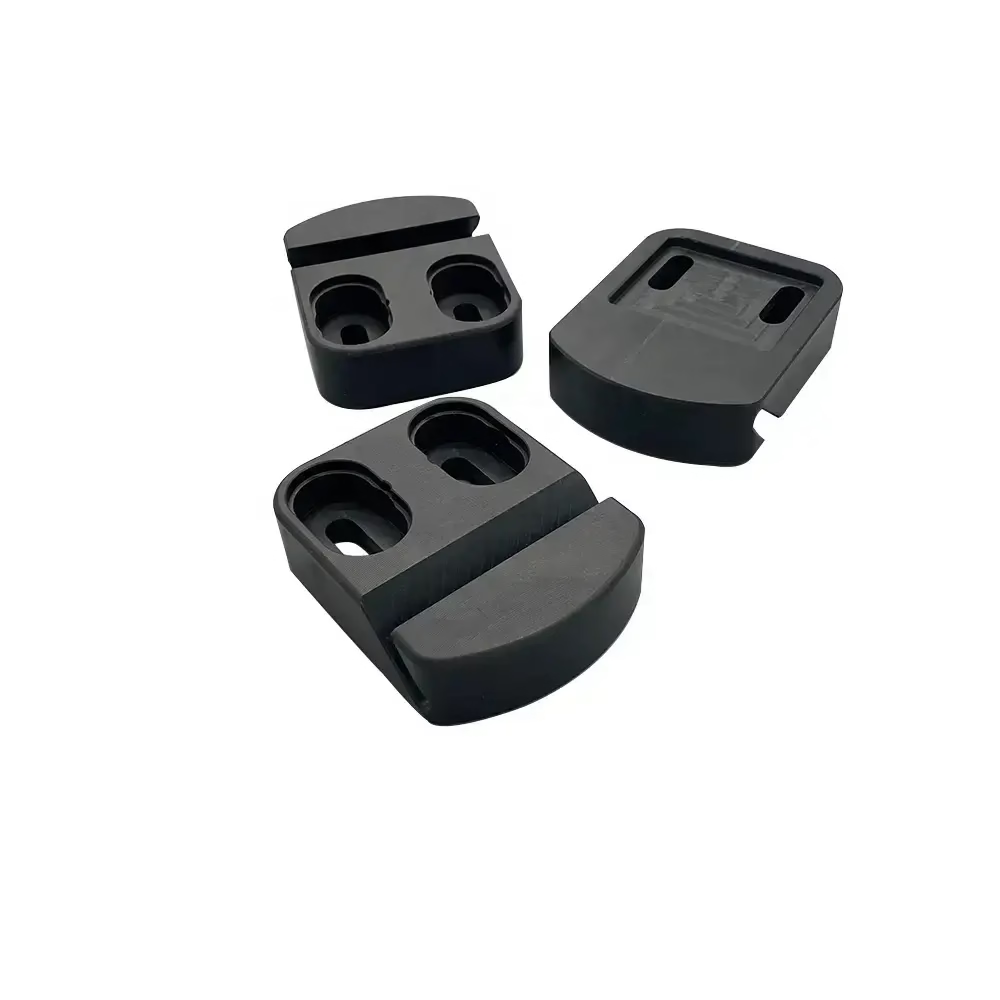
What HDPE does at the tool tip
HDPE is a semi-crystalline thermoplastic with a low melting point and poor thermal conductivity. Heat does not leave the cut through the chip the way it does in aluminum or brass. It stays in the workpiece. That single fact drives every parameter choice in this HDPE CNC machining guide.
The practical result is a soft, springy material that machines best at high surface speed and moderate feed per tooth. A sharp two-flute cutter running at 300–600 m/min surface speed keeps the chip thick enough to carry heat away. Feed too light and the tool rubs instead of cutting.
Chip color tells you a lot. White, stringy chips mean the cut is running cool. Brown edges or a gummy smell mean the tool is dwelling and the material is starting to smear. Back off the spindle speed or raise the feed before the part moves.
HDPE also has a high coefficient of thermal expansion, roughly 120 × 10⁻⁶ /°C. A 300 mm part can grow about 0.4 mm over a 10 °C rise. For tight features, machine at a stable temperature and measure after the part cools.
Cutter geometry, workholding, and chip clearance
Use single-flute or two-flute end mills with polished flutes and a high helix. Aluminum-specific cutters work well because they have the clearance angles HDPE needs. Four-flute tools pack the flute valleys and cause recutting, which raises heat fast.
Rake angle matters more than coating. A positive rake of 10–15° shears the material cleanly. Uncoated carbide or a light DLC coating is enough; thick TiAlN coatings add edge roundness that increases cutting pressure.
HDPE is flexible, so clamping force can distort the blank before the first pass. Use soft jaws machined to the part profile, or a vacuum fixture for thin plates. Leave a 3–5 mm sacrificial base so the cutter exits into scrap, not into the table.
Chip evacuation is the number one cause of poor surface finish. Air blast at 4–6 bar clears the flute and cools the edge. Flood coolant works too, but it must wash chips away rather than recirculate them. Never let chips pile up around the cutter.
Tolerance, finish, and where HDPE stops working
An HDPE CNC machining guide has to be honest about limits. As-machined finish lands around Ra 1.6–3.2 μm with a sharp cutter. Ra 0.8–1.6 μm is reachable with a finishing pass at 0.1–0.2 mm radial depth. Below that, the material tears rather than cuts.
Tolerance is the bigger constraint. ±0.005 mm is achievable on metal at GreatLight, but HDPE moves with temperature and stress. For HDPE, hold ±0.05 mm on stable features and ±0.1 mm on thin walls. Specifying tighter invites scrap.
Thin walls below 1.5 mm deflect under cutting pressure and chatter. Ribbed or supported geometry helps. Deep pockets with a small cutter need high-pressure air and shallow stepdowns of 0.5–1 × tool diameter.
HDPE is not the right pick when the part needs stiffness, high-temperature service above 80 °C, or a mirror finish. POM holds tighter tolerances, PEEK handles heat, and acrylic takes a better polish. Choose HDPE for chemical resistance, impact strength, and cost.
HDPE vs POM vs PP vs PEEK for CNC parts
Use this when the drawing does not name a plastic. Values are typical, not guaranteed for every grade.
| Material | Stiffness | Max service temp | Machined tolerance | Best for |
|---|---|---|---|---|
| HDPE | Low | ~80 °C | ±0.05 mm | Tanks, liners, wear strips |
| POM (acetal) | High | ~90 °C | ±0.02 mm | Gears, bushings, tight fits |
| PP | Low | ~100 °C | ±0.1 mm | Chemical lines, hinges |
| PEEK | High | ~250 °C | ±0.02 mm | Seals, implants, hot parts |
| HDPE, 25% glass | Medium | ~90 °C | ±0.05 mm | Stiffer structural plates |
| UHMW-PE | Low | ~80 °C | ±0.1 mm | Sliding contact, impact zones |
Pick the material before the tolerance
Choose HDPE when you need chemical resistance, impact strength, and low cost, and can live with ±0.05 mm. Choose POM or PEEK when the fit or the temperature is the hard requirement. Do not fight HDPE into a tolerance it cannot hold.
HDPE machining questions engineers ask
Can HDPE be machined on a 5-axis machine?
Yes. Five-axis work suits HDPE when the part has compound angles or deep pockets that would need multiple setups on a 3-axis machine. Each extra setup risks clamping marks and re-indicating error.
The cutting parameters do not change much. What changes is the fixture: complex HDPE parts often need a machined soft jaw or a vacuum plate so the part is supported through the whole toolpath.
What causes a fuzzy or hairy edge on HDPE?
A dull cutter, too light a feed, or chips recutting in the slot. HDPE does not break the chip cleanly, so a worn edge pushes material instead of shearing it.
Replace the cutter, raise feed per tooth to 0.1–0.3 mm, and add air blast. A finishing pass with 0.1 mm radial engagement usually removes the last of the fuzz.
Does HDPE need coolant?
Not always. Air blast handles most jobs and avoids the mess. Coolant helps on deep pockets and long roughing passes where heat builds up, but it must flush chips out of the cut.
If you use coolant, expect the part to absorb a small amount of moisture. Dry it before measuring critical dimensions.
How do I control warping on a large HDPE plate?
Rough the part, then let it sit before finishing. HDPE releases internal stress as material is removed, and a rough pass followed by a stress-relief pause reduces movement.
Machine both faces in even amounts where the design allows it. Uneven material removal on one side is the usual cause of a bowed plate.
Can machined HDPE parts be welded into larger assemblies?
Yes. HDPE welds well with hot-gas or butt-fusion methods, which is one reason it shows up in tanks and ducting. Machined edges should be clean and square before welding.
Welding adds heat, so re-check flatness after the joint cools if the assembly has a sealing face.
What file format do you need for an HDPE quote?
STEP or IGES for 3D geometry, plus a 2D drawing for tolerances and finish callouts. If a critical feature is not toleranced on the drawing, we will flag it during the free DFM check.
Send the files through the quote form and we return pricing and DFM notes within 12 hours.
Send us your HDPE part
Upload a STEP file and a drawing. We return a quote and DFM notes within 12 hours, and we machine from one prototype to 10,000+ parts with 100% inspection before shipment.
12-hour quoteNo minimum orderNDA on request100% inspection
More from GreatLight
We publish setup notes, tooling trials and inspection data from the factory floor.











