
Multi Ax Tour CNC: How Flexible Mass Production Actually Works
A multi ax tour cnc combines turning and milling on one platform, and each extra axis removes a setup rather than adding a feature. This page explains the mechanism, the part features that justify it, and the cases where a 3-axis mill plus a lathe still wins. Written for engineers and buyers who need to decide before they quote.
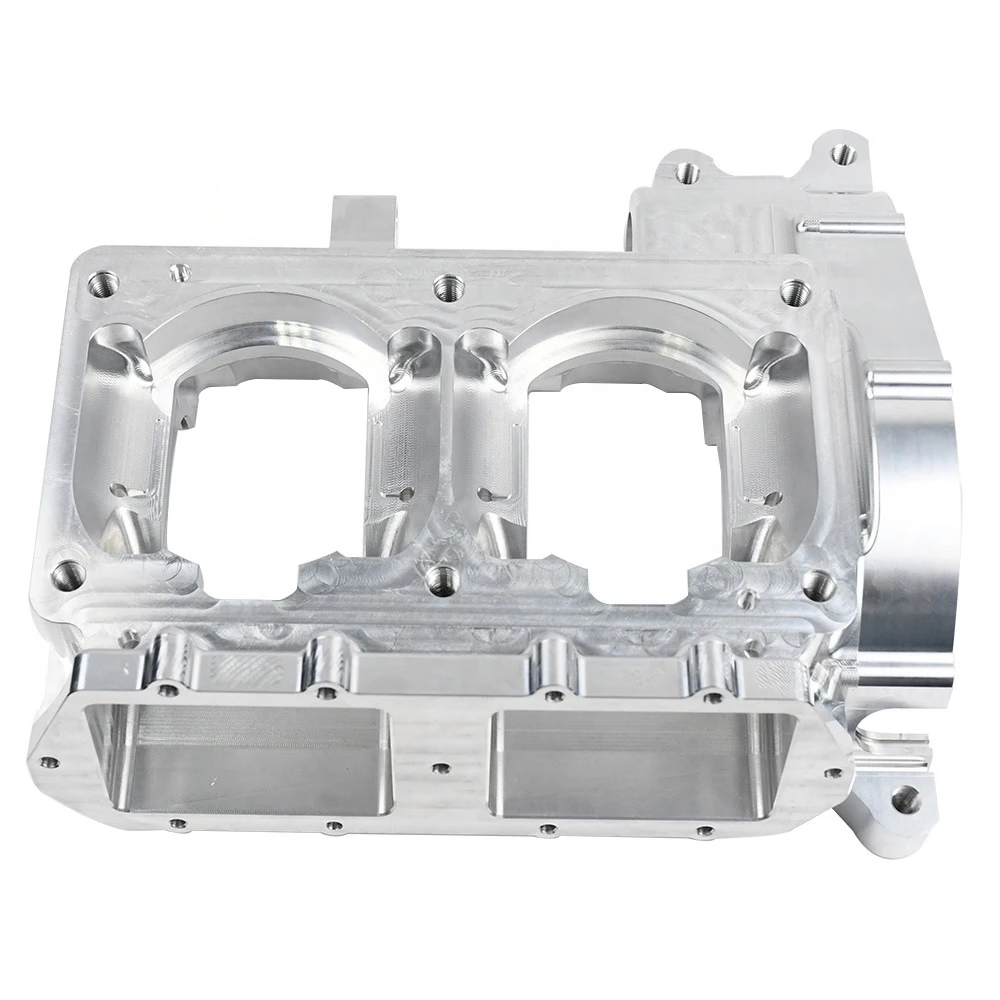
What Multi Ax Tour CNC Changes on the Shop Floor
A multi ax tour cnc is a turning platform with live tooling and one or two rotary axes stacked on top of the usual X, Z and spindle. The turret or the B-axis head carries a driven tool, so the same program can face, turn, drill off-center and mill a flat without the part ever leaving the chuck. That is the whole idea. Every axis you add is a setup you delete.
The mechanism matters because accuracy is lost at re-clamping, not at the cutter. A part that moves from a lathe to a mill and back picks up three chucking errors, two fixture datum shifts and one operator decision about which face to trust. Stack those and ±0.005 mm becomes hard to hold on a bore-to-flat relationship. On one platform the datum never moves.
Tool clearance is the second effect. With a B-axis head tilting to 90°, a face mill reaches a side pocket that a static turret cannot enter. A 45° approach lets a long end mill cut under a shoulder without shanking out on the chuck jaws. These are geometry problems, and extra axes solve geometry.
None of this is free. A multi-axis platform costs more per hour than a 3-axis mill, and programming time rises with every simultaneous axis you activate. The break-even sits in setup count and part complexity, not in cycle time alone.
- 1Turning plus millingLive tooling on the turret or B-axis head cuts the sub-spindle trip.
- 2Datum stays putOne clamping means one set of fixture errors, not three.
- 3Tool reach improvesTilted approach angles clear shoulders and deep pockets.
Which Parts Belong on a Multi-Axis Turning Platform
Start with the feature map. If a part is mostly round with a few flats, cross holes, slots or a milled pad, it belongs on a mill-turn center. Hydraulic manifolds, motor housings, sensor bodies and implant components all follow this pattern: a turned body with features at angles that no single-axis tool can reach.
Second, look at the aspect ratio. Multi-axis turning handles Ø400 mm and below on a rotary table, so a part 60 mm long and 25 mm in diameter is routine work. When the part grows past the machine envelope, the same features often move to a 5-axis mill with a tombstone fixture. The decision follows part size, not part family.
Third, count the faces. A part that needs work on four sides is a candidate. A part that needs work on six sides is a strong candidate, because every additional face is another re-fixture on a conventional route. We see the clearest savings on small, dense parts with features on five or more faces.
The parts that do not belong are just as clear. Long shafts with no off-axis features waste the platform. Simple turned bushings waste it too. So does anything that needs a large flat surface held to a tight profile, because a mill with a big face mill will beat a turning platform on flatness and on cost per part.
- 1Good fitTurned body with cross holes, slots or angled pads.
- 2Good fitShort, dense parts with features on five or more faces.
- 3Poor fitLong shafts with no off-axis features.
- 4Poor fitLarge flat surfaces held to a tight profile.
Why Flexible Mass Production Beats Hard Tooling at Mid Volume
Flexible mass production means the same cell runs a stable, repeatable process across a family of parts without dedicated hard tooling. On a multi ax tour cnc, the changeover is a program, a set of soft jaws and a tool list. There is no die to cut and no fixture plate to drill. That is what makes a 400-part run and a 4,000-part run share a process plan.
Volume bands explain the economics. Below roughly 500 parts, dedicated tooling rarely pays back before the design changes. Above roughly 50,000 parts, a casting or forging plus finishing operations usually wins on unit cost. Between those two numbers, multi-axis turning with soft jaws and quick-change workholding is the practical answer.
Design revision is the hidden variable. A cast housing that needs a new boss means a new mold and a four-to-eight week detour. The same housing cut from billet on a multi-axis platform needs a program edit and a fresh first article. When a program is still moving, subtractive flexible production absorbs the change.
Repeatability is what keeps the method credible at volume. In-process probing, tool life tracking and a fixed zero point mean part 3,000 checks the same way as part 3. We hold ±0.005 mm and a 99.99% qualification rate across runs because the process, not the operator, sets the datum.
- 1ChangeoverProgram, soft jaws and tool list replace a dedicated fixture.
- 2Sweet spotRoughly 500 to 50,000 parts per run.
- 3Revision costA design change is a program edit, not a new mold.
Matching the Process to the Part
Use this to pick a route before you request a quote.
| Part signature | Best route | Setup count | Watch out for |
|---|---|---|---|
| Turned body, cross holes at angles | Multi-axis turning center | 1 | Programming time on simultaneous axes |
| Short part, features on 5+ faces | Multi-axis turning center | 1 | Workholding for thin walls |
| Turned body, one flat, loose tolerance | Lathe plus 3-axis mill | 2 | Datum shift between operations |
| Deep pockets on a prismatic block | 5-axis mill | 1–2 | Tool reach and chatter |
| Long shaft, no off-axis features | Turning center, no live tooling | 1 | Paying for unused axes |
| Large flat face, tight profile | 3-axis mill with big face mill | 1 | Flatness after heat treat |
| Run above 50,000 parts | Casting plus finishing | 2–4 | Tooling lead time and cost |
Where We Land
If the part is round with off-axis features and the run sits between 500 and 50,000 pieces, use a multi ax tour cnc. If the part is a long shaft or a large flat plate, a lathe or a 3-axis mill will cost less and hold the same tolerance.
Common Questions
How many axes do I actually need?
Count the faces that carry features and the angles they sit at. Two or three faces at 90° usually need live tooling plus one rotary axis. Features at compound angles need a second rotary axis.
Do not buy axes you will not program. An unused B-axis adds hourly cost and nothing else.
Does multi-axis turning hold tighter tolerance than separate operations?
It usually does, because the datum never moves. Re-clamping is where most position error enters a process.
We hold ±0.005 mm on multi-axis platforms. The same part split across a lathe and a mill can usually hold that on each feature but not on the relationship between them.
What surface finish should I specify?
As-machined turning lands around Ra 1.6–3.2 μm. A finish pass gets Ra 0.8–1.6 μm, and fine finishing reaches Ra 0.2–0.8 μm.
Specify the finish the function needs. A sealing face and a clearance bore do not share a requirement, and asking for the finer one everywhere adds cost.
Which materials run well on these platforms?
Aluminium 6061 and 7075, stainless 303, 304, 316 and 17-4PH, and steels like 1045 and 4140 all run well. Titanium TC4 and Inconel cut fine but need lower feeds and more tool changes.
Plastics such as POM and PEEK work too. They need sharp tooling and light depth of cut to avoid melting.
Can you work from a STEP file only?
Yes. A STEP file plus tolerances, material and finish is enough to start. We return a quotation and a DFM analysis within 12 hours.
For thin walls or tight true-position callouts, a short note on the functional requirement helps more than extra dimensions.
How is confidentiality handled?
Uploads are treated as confidential, and an NDA is available on request before you send files.
We hold ISO 27001:2022 for information security, along with ISO 9001, IATF 16949 and ISO 13485 for quality and medical work.
Send a Part and Get a Route Recommendation
Upload a STEP file and we will tell you whether multi-axis turning is the right route, with a quotation and DFM notes inside 12 hours.
12-hour quote100% inspectionNo MOQ
More CNC Knowledge
We publish setup notes, tooling trials and inspection data from the factory floor.











