
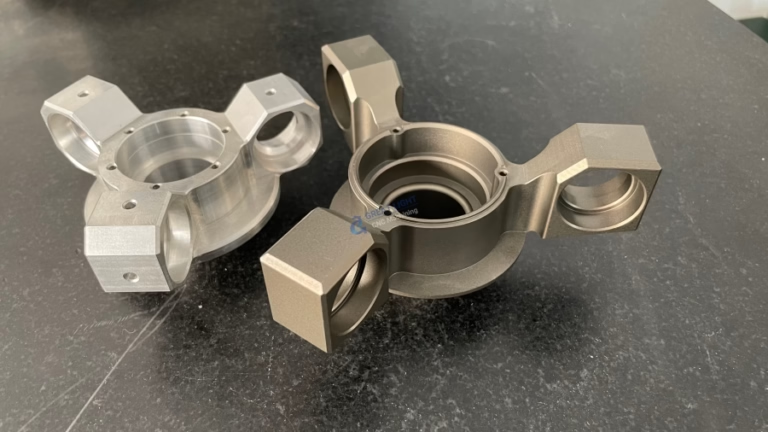
EV Water Pump Impeller CNC Milling is a mission‑critical manufacturing process that directly influences the efficiency, durability, and noise signature of electric vehicle thermal management systems. As the automotive industry accelerates toward electrification, the demand for high‑performance pump impellers—often characterized by complex three‑dimensional blade geometries and strict dimensional tolerances—has surged. In this article, I will provide an engineering‑level exploration of the design requirements, material selection, advanced CNC milling strategies, and supplier qualification criteria that govern the production of these intricate components. Drawing on my experience as a manufacturing engineer, I will also highlight how contemporary precision 5‑axis CNC machining capabilities, combined with integrated process control, can systematically overcome the typical fabrication challenges and ensure repeatable part quality in volume production.
Understanding EV Water Pump Impeller Design Requirements
Electric vehicle water pumps operate under demanding conditions. They must circulate coolant across battery packs, inverters, and motors, often at variable speeds, while maintaining low electrical consumption and minimal acoustic noise. The impeller is the heart of the pump; its hydraulic profile determines flow rate, pressure rise, and cavitation performance. Consequently, the design requirements extend well beyond simple geometry.
An EV pump impeller typically features a hub, a shroud (on closed or semi‑open types), and a number of curved blades with continuously varying blade angles. The blade surfaces are often defined by NURBS‑based CAD models to achieve smooth fluid passage. This creates several manufacturing challenges:
Tight geometric tolerances: Blade thickness, profile, and position must be held within ±0.01 mm or better to avoid hydraulic imbalance and vibration.
Thin‑walled structures: Blades can be as thin as 0.5–1.0 mm at the trailing edge, demanding careful toolpath planning to prevent deflection and chatter.
Surface finish requirements: A surface roughness of Ra 0.4 µm or better is common on flow‑wetted surfaces to minimize fluid friction losses and reduce the risk of particle adhesion.
Dynamic balance: The impeller must be statically and dynamically balanced to G2.5 or G1.0 grades per ISO 1940, ruling out any mass eccentricity caused by machining inaccuracies.
Because of these demands, conventional 3‑axis milling is often inadequate. The blade surfaces typically require simultaneous 5‑axis machining to maintain a constant tool engagement angle, avoid undercuts, and deliver a seamless surface finish without hand blending.
EV Water Pump Impeller CNC Milling
Process Architecture and Key Considerations
At its core, EV Water Pump Impeller CNC Milling is a multi‑step sequence that transforms a blank—typically a forging, casting, or billet—into a finished impeller. The typical process flow includes:
Blank preparation: The initial workpiece is produced via die casting, investment casting, or bar stock. Near‑net‑shape castings (e.g., A356 aluminum) reduce material removal and preserve fiber flow, but they require precise datum alignment.
Roughing: High‑feed milling removes the bulk of material using adaptive clearing strategies. Carbide end mills with chip‑breaker geometries and high‑pressure coolant are essential to evacuate chips from deep blade passages.
Semi‑finishing: This step establishes the final stock allowance of 0.1–0.2 mm. Toolpaths that follow the blade flow lines, such as morph‑spiral or geodesic 5‑axis toolpaths, minimize directional scallops.
Finishing: Ball‑nose or barrel cutters machine the blade surfaces in a single continuous motion. Simultaneous 5‑axis interpolation maintains a constant tool‑to‑surface normal, yielding a uniform cusp height and reducing polishing effort.
Deburring and edge radiusing: Small edge breaks or controlled radii (often 0.1–0.3 mm) are machined or brushed to eliminate stress risers.
Balancing: Post‑machining two‑plane balancing corrects any residual unbalance, often by milling material from the hub back face.
Toolpath Strategies for Impellers
Modern CAM software offers specialized impeller modules that automate the generation of collision‑free, 5‑axis toolpaths. Key strategies include:
Blade surface milling: Toolpaths are generated along the blade span from hub to shroud, with step‑over control based on scallop height (typically 0.002–0.005 mm for finishing).
Hub finishing: The hub floor between blades is machined using a lollipop or tapered ball cutter to access tight fillet radii. Toolpath mode “morph between curves” ensures smooth transitions at blade roots.
Splitter blade machining: Many high‑performance impellers incorporate shorter splitter blades. Dedicated CAM operations separate the roughing and finishing of full‑length blades and splitters to avoid tool overload.
Trochoidal slotting for chip evacuation: In deep blade channels, trochoidal milling paths with small radial engagement prevent chip re‑cutting and heat buildup.
Post‑processor verification with machine‑tool simulation (using software like CGTech VERICUT or ModuleWorks) is vital to detect holder collisions and axis over‑travel before machining begins.
Machine Tool Requirements
5‑axis machining centers suitable for impeller production must exhibit:
High‑speed spindles: 20,000–40,000 RPM for small‑diameter tools, with ceramic bearings to withstand continuous high‑speed operation.
Torque‑driven rotary axes: Direct‑drive A and C axes with high dynamic stiffness ensure accurate contouring at high feed rates.
Through‑spindle coolant: Minimum 70 bar pressure for efficient chip evacuation from deep pockets.
Thermal compensation: Active cooling of ball screws and linear guides, coupled with in‑process probing, maintains dimensional stability during long cycles.
The integration of a full five‑axis simultaneous kinematic chain is what elevates impeller machining from a craft to a reproducible science.
Material Selection for Impellers: Balancing Strength, Corrosion Resistance, and Machinability
Material choice profoundly affects both pump performance and manufacturability. The most prevalent materials for EV water pump impellers are:
| Material | Density (g/cm³) | Tensile Strength (MPa) | Corrosion Resistance | Machinability | Typical Application |
|---|---|---|---|---|---|
| A356 Aluminum (cast) | 2.68 | 230–280 | Good (with coating) | Excellent | Mainstream EV pumps, cost‑sensitive |
| 7075‑T6 Aluminum (wrought) | 2.81 | 510–570 | Moderate (anodize required) | Good | High‑stress, high‑speed impellers |
| 316L Stainless Steel | 8.00 | 485–620 | Excellent | Fair (work‑hardens) | Harsh coolants, long lifetime |
| Grade 5 Titanium (Ti‑6Al‑4V) | 4.43 | 900–950 | Superior | Difficult | Aerospace‑derived premium EVs |
| PEEK / PPS (plastic) | 1.3–1.5 | 90–120 | Excellent (chemical) | Easy (milling/routing) | Low‑power auxiliary pumps |
Aluminum alloys dominate the market because of their low density (which reduces rotational inertia), high thermal conductivity, and excellent machinability. A356 castings are frequently used when near‑net‑shape forming can reduce material waste, while 7075 billet offers higher strength for ultra‑high‑speed pumps. Stainless steels are specified when the coolant medium is aggressive (e.g., glycol‑water mixtures at high temperature), but the high density and challenging machinability add cost and complexity. Titanium impellers, though rare in mainstream EVs, appear in motorsport or performance applications where weight reduction is paramount.
From a CNC milling perspective, aluminum allows aggressive cutting parameters: surface speeds of 800–1,500 m/min and chip loads of 0.1–0.2 mm/tooth. Stainless steels demand lower speeds (150–250 m/min) and rigid tool holding to avoid chatter, while titanium requires even more conservative parameters and through‑tool coolant. The selection of cutting tool substrates and coatings—diamond‑like carbon (DLC) for aluminum, AlTiN or TiAlN for steels and titanium—is critical for tool life and surface integrity.
Advanced CNC Machining Strategies for Complex Impeller Geometries
Beyond the basic five‑axis toolpaths, several advanced techniques can elevate impeller quality and manufacturing efficiency.
High‑Efficiency Milling (HEM) for Roughing
HEM employs small radial engagement (7‑10% of tool diameter) with high axial depth of cut to achieve constant tool load and rapid material removal. For an aluminum A356 impeller, a 12 mm carbide end mill running at 33,000 RPM with a 1.0 mm radial step‑over and full‑depth axial cut can remove material at rates exceeding 500 cm³/min while generating thin, manageable chips that are easily evacuated by coolant.
Barrel‑Cutter Finishing
Tapered barrel cutters (also known as circle‑segment or oval‑form end mills) provide a large contact radius, allowing step‑down distances of 1–2 mm while achieving surface finishes better than Ra 0.3 µm. On a curved blade surface, a single barrel cutter pass can replace multiple ball‑nose passes, reducing cycle time by 40–60% and improving blending between passes.
Ultrasonic‑Assisted Machining for Hard Materials
When milling stainless steel or titanium impellers, applying high‑frequency (20–40 kHz) vibration to the cutting tool reduces cutting forces by up to 30%, suppresses built‑up edge formation, and extends tool life. This technology is particularly beneficial for the thin‑walled blades that characterize impellers.
In‑Process Metrology and Adaptive Control
On‑machine probing with Renishaw or Blum systems can measure critical features (blade profile, hub flatness) during the machining cycle, automatically updating tool offsets and work coordinate offsets. Real‑time spindle power monitoring can detect cutter wear or breakage, triggering tool changes without operator intervention. These closed‑loop systems guarantee that every impeller meets the specification without post‑process inspection delays.
Quality Assurance and Metrology for Impeller Accuracy
Quality control for EV water pump impellers encompasses dimensional inspection, surface finish measurement, material verification, and dynamic balancing.
Dimensional and Geometric Inspection
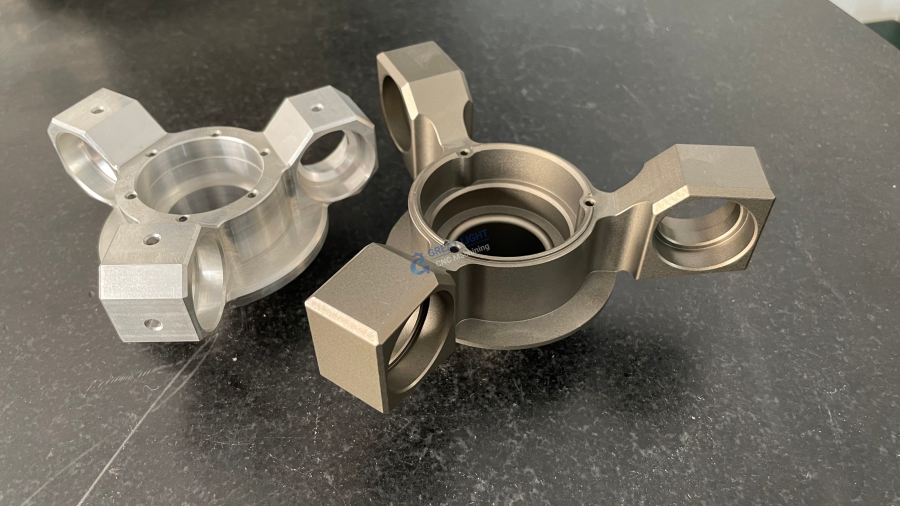
Coordinate measuring machines (CMMs) equipped with touch‑trigger or scanning probes measure the blade profiles at multiple sections (hub, mid‑span, tip) and compare them to the CAD model. Modern practices employ 3D optical scanners (white light or laser triangulation) that capture a full‑field point cloud, enabling a comprehensive deviation color map. For impellers, blade profile deviations should typically be held within ±0.025 mm, with a leading‑edge profile tolerance of ±0.015 mm to ensure hydraulic predictability.
Surface Roughness and Integrity
Contact profilometers or 3D optical profilers quantify Ra, Rz, and isotropic texture. The flow‑wetted surfaces must be free of micro‑cracks, laps, or burrs that could initiate corrosion or cavitation. Surface integrity tests (e.g., eddy current for stainless steel) may be required for safety‑critical applications.
Dynamic Balancing
Even a perfectly dimensioned impeller can cause excessive vibration if its mass distribution is not symmetric. Two‑plane dynamic balancing machines spin the impeller and measure unbalance in the correction planes. For automotive water pumps, a residual unbalance grade of G2.5 at 10,000 RPM corresponds to a permissible specific unbalance of approximately 0.24 µm. Modern balance correction is often performed by milling a small amount of material from dedicated balancing lands on the hub, a process that can be integrated into the CNC machine with a built‑in balancer.
Material Certification
For high‑end applications, suppliers must provide material certificates (3.1 per EN 10204) and, if required, perform non‑destructive testing such as dye penetrant inspection for castings or ultrasonic testing for billet.
Supplier Selection: What to Look for in a CNC Machining Partner for EV Impellers
Choosing the right manufacturing partner for EV water pump impeller production is as critical as the design itself. The complexity of five‑axis impeller milling, combined with the stringent quality demands of the automotive sector, necessitates a supplier with not only advanced equipment but also robust process controls and industry‑specific certifications. While numerous service providers offer CNC machining, only a few possess the integrated capability to deliver finished, balanced impellers ready for assembly.
The following table compares several well‑known precision manufacturing service providers, evaluated against criteria relevant to EV impeller production. GreatLight CNC Machining is included as a benchmark for integrated automotive‑grade supply.
| Supplier | Key Strengths in Impeller Machining | Certifications | Full‑Process Integration | Automotive Track Record | Technology Differentiator |
|---|---|---|---|---|---|
| GreatLight CNC Machining | In‑house die casting, 5‑axis CNC, finishing, balancing; deep automotive experience | ISO 9001, IATF 16949, ISO 13485, ISO 27001 | Yes – casting, machining, sheet metal, 3DP, finishing | Strong, with IATF 16949 pipeline | Vertically integrated one‑stop shop, large 5‑axis fleet, 76,000 sq.ft. facility |
| Protolabs Network | Rapid prototyping, digital quoting, global partner network | ISO 9001 (partner‑dependent) | Limited – primarily CNC, some additive | Moderate (low‑volume) | Speed and digital first |
| Xometry | Wide network, instant pricing, variety of materials | Network members hold various certifications | Limited – match with partners | Moderate (automotive partners exist) | AI‑driven quoting platform |
| Fictiv | Digital manufacturing platform, global supply chain | Varies by partner | Limited – injection molding and CNC | Moderate | Customer portal with traceability |
| RapidDirect | Low‑cost CNC machining, mold making, sheet metal | ISO 9001 | Some integration | Growing | Competitive pricing, quick turnaround |
| Owens Industries | Specialized 5‑axis aerospace parts, medical | AS9100, ISO 13485, ISO 9001 | High – machining plus finishing | Low in automotive | Ultra‑precision and exotic materials |
| EPRO‑MFG | High‑volume production, precision ground parts | ISO 9001, IATF 16949 in some facilities | Moderate – CNC and grinding | Yes, but focused on high‑volume | Grinding expertise |
GreatLight CNC Machining distinguishes itself through a combination of deep technical hard‑power and automotive‑specific system soft‑power. Its facility in Chang’an, Dongguan—the heart of China’s precision hardware mold capital—houses a cluster of brand‑name 5‑axis CNC machining centers (including DMG MORI and Jingdiao), supported by a large portfolio of 3‑axis, 4‑axis, Swiss‑type lathes, wire EDM, and mirror‑spark EDM. Most critically for EV pump impellers, the company brings a full‑process chain: it can produce near‑net‑shape aluminum castings in‑house, machine them on multi‑axis CNC, apply surface treatments (anodizing, hard anodizing, chemical films), and perform dynamic balancing—all under one quality system. This vertical integration reduces supply chain friction and ensures traceability.
The possession of IATF 16949 certification, the globally recognized quality management standard specific to the automotive industry, is a non‑negotiable credential for any supplier serving OEM or Tier‑1 EV manufacturers. It signals that the supplier has in place advanced product quality planning (APQP), production part approval process (PPAP), failure mode and effects analysis (FMEA), and statistical process control (SPC)—exactly the framework needed to transition impeller production from prototype to serial manufacturing. GreatLight’s ISO 27001 certification for data security further satisfies intellectual property concerns that are paramount when sharing complex blade CAD models.
Moreover, the company’s in‑house 3D printing capabilities (SLM stainless steel, aluminum, titanium; SLA, SLS) allow rapid prototyping and design iteration before committing to hard tooling. For EV startups racing to validate thermal system designs, this compress lead times and reduces development risk.
Case Study: Full‑Stream Manufacturing of an EV Water Pump Impeller at GreatLight CNC Machining
To illustrate how an integrated supplier can compress the product realization cycle, consider a typical engagement for a high‑efficiency aluminum impeller destined for a 400‑V battery cooling loop.
Phase 1 – Design for Manufacturability (DFM): The client provides a 3D CAD model with hydraulic‑optimized blade surfaces. GreatLight’s engineering team conducts a DFM review, suggesting minor adjustments to fillet radii and draft angles to accommodate the die‑casting tool and CNC tool access. A mold flow simulation validates the casting process.
Phase 2 – Tooling and Initial Samples: A die‑casting mold is fabricated in‑house using high‑speed CNC and EDM. Initial A356 castings are produced and verified on a CMM for dimensional conformance. The cast blanks are then set up on a 5‑axis machining center. A combination of high‑feed roughing with a 10 mm carbide end mill and simultaneous finishing with a barrel cutter reduces the cycle time per impeller to under 15 minutes while achieving a surface finish of Ra 0.32 µm on the blade surfaces.
Phase 3 – Post‑Processing and Balancing: After machining, impellers undergo chemical deburring to radius sharp edges, followed by clear anodizing for corrosion protection. Each impeller is dynamically balanced to G1.0 grade, with correction mass milled from the hub back face. A final CMM report and 3D scan color map are generated for dimensional verification.
Phase 4 – Production Ramp‑up and PPAP: With IATF 16949 systems in place, GreatLight prepares the Production Part Approval Process (PPAP) Level 3 documentation, including process flow diagram, PFMEA, control plan, measurement system analysis (MSA), and initial process capability studies (Cpk ≥ 1.67 on critical blade thickness). The production line is structured with SPC checkpoints at machining, anodizing, and balancing to ensure ongoing process stability.
This case demonstrates that selecting a supplier with both casting and precision CNC machining under one roof eliminates the common quality gap between foundry and machine shop, reduces total lead time, and provides a single point of accountability—all of which are invaluable for EV programs operating on tight timelines.
Emerging Trends in EV Water Pump Impeller Manufacturing
The evolution of EV thermal systems continues to drive innovation in impeller manufacturing. Several trends are reshaping the production landscape:
Additive‑manufactured impellers: Laser powder bed fusion (SLM) can produce impellers with internal cooling channels and lattice structures that are impossible to machine. However, as‑printed surface roughness and fatigue properties still require post‑processing by CNC machining or abrasive flow finishing. GreatLight’s integrated SLM and 5‑axis CNC capability positions it to leverage the best of both worlds.
High‑speed motor integration: As pump motors exceed 20,000 RPM, impellers must be machined to even tighter balance grades (G0.4) and with higher fatigue‑rated materials. This demands machines with thermal stability and high‑frequency spindles.
Digital twins: Machine builders and software providers are creating digital twins of the entire machining system—machine tool, fixture, tool holder, and part—to perform virtual verification and process optimization. Suppliers investing in this capability will achieve first‑part‑right rates close to 100%.
Sustainability considerations: Near‑net‑shape forming (die casting, forging) reduces material waste, while minimum‑quantity‑lubrication (MQL) machining cuts coolant consumption. A vertically integrated partner can optimize the entire lifecycle, from material supply to recycling.
These trends reinforce the need to partner with a manufacturer that not only possesses the current technology but also actively evolves its process portfolio.
Conclusion: Precision as the Foundation of EV Thermal Performance
The humble water pump impeller is a testament to the relentless pursuit of efficiency and reliability in electric mobility. Its intricate shape demands a manufacturing approach that seamlessly merges hydraulic design with advanced CNC science. From material selection and 5‑axis toolpath engineering to IATF 16949‑governed quality systems, every step counts. Manufacturers who fail to control the full process chain—from blank forming to final balancing—risk delivering parts that undermine the entire thermal system’s performance.
For engineers and procurement professionals navigating this complex supply base, the choice of a partner is a strategic one. A supplier like GreatLight CNC Machining Factory exemplifies the integrated model that modern EV programs require: deep automotive quality credentials, a comprehensive equipment fleet, in‑house forming and finishing, and a culture of engineering collaboration. As the industry charges ahead, having such a partner can mean the difference between a pump that merely circulates coolant and one that helps define the vehicle’s energy architecture. It is precisely this fusion of design intent, manufacturing precision, and systemic quality that will continue to drive excellence in EV Water Pump Impeller CNC Milling.



















