
Emak Group Turnkey Solution: How One Supplier Covers the Whole Build
This page explains what an emak group turnkey solution actually contains, how the work moves through a shop floor, and where the model breaks down. It is written for engineers and purchasing staff who have to choose between one integrated supplier and four separate ones.
In this article
- 1
- 2
- 3
- 4
- 5
- 6
What matters before you read further
What an emak group turnkey solution really means on a shop floor
A turnkey solution is a contracting model, not a machine. One supplier takes the drawing, the material callout and the finishing spec, and returns a finished part with the inspection data attached. The buyer signs one purchase order and deals with one schedule. Everything between raw bar stock and packed carton belongs to that supplier.
The word gets stretched in marketing. In practice, a real turnkey arrangement covers four things: process planning, in-house machining, surface finishing, and dimensional verification with documentation. If any of those four is silently subcontracted, you are not buying turnkey. You are buying a broker with a logo.
This distinction matters because accountability follows ownership. When a part is out of tolerance after anodizing, a broker points at the anodizer and the anodizer points at the machinist. A turnkey supplier cannot do that. The dimensional change from the coating is their problem to predict and compensate for.
The model is old. Machine builders have sold turnkey production cells for decades, where the vendor delivers the machine, the fixture, the tooling package and the program, then hands over a running line. Contract manufacturing borrowed the same logic and applied it to discrete parts.
- 1One PO, one ownerThe supplier carries the schedule risk across every operation.
- 2Process planning up frontDatum strategy, operation sequence and fixture design are decided before metal is cut.
- 3Finishing includedCoating thickness is budgeted into the tolerance stack, not discovered afterward.
- 4Documentation attachedMaterial certs and dimensional reports travel with the shipment.
How the work actually flows through a turnkey build
It starts with a DFM review. An engineer reads the drawing for features that will be expensive or unstable: thin walls under 0.8 mm, deep pockets with a depth-to-width ratio beyond 4:1, tolerances tighter than the process can hold repeatedly, or a surface finish callout on a face that will never be touched again. The review comes back within 12 hours with a quotation.
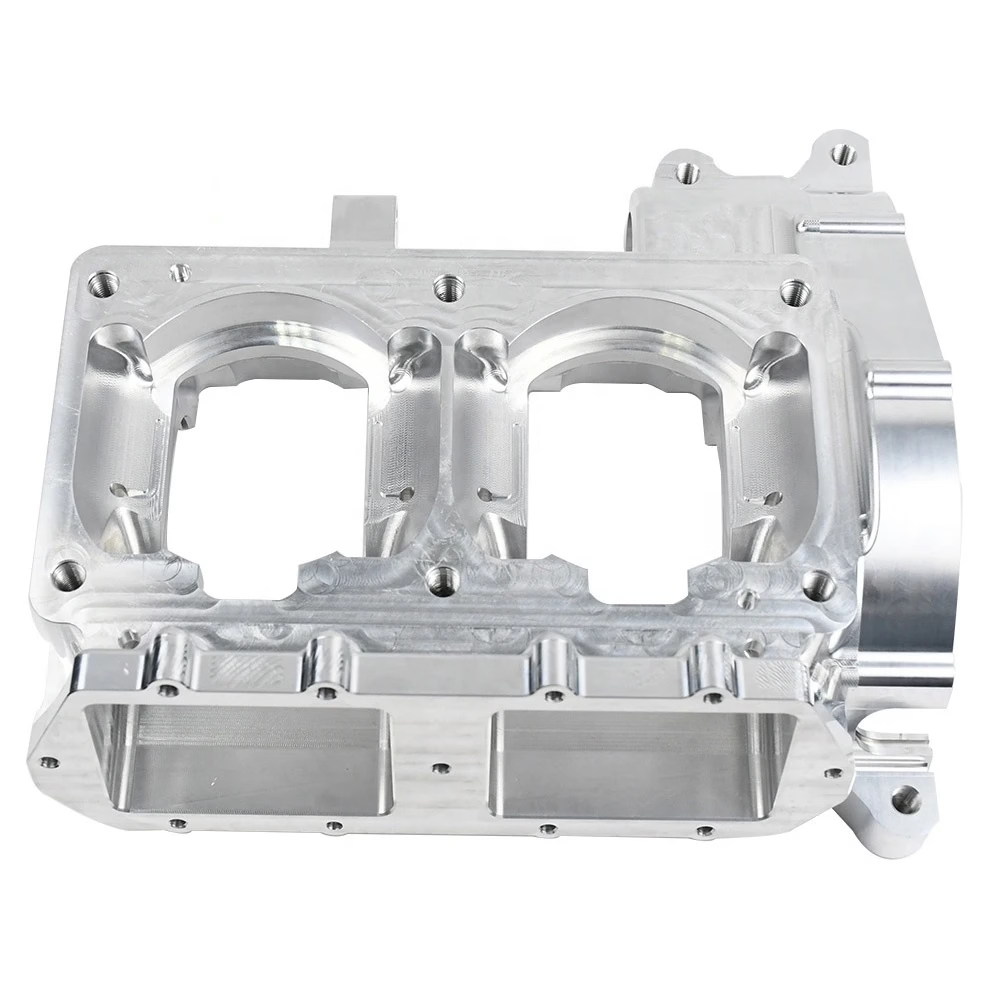
Then comes process planning. The planner decides how many setups the part needs and where the datums live. A housing with features on five faces may run on a 5-axis center in two setups, or on a 3-axis machine in four setups with a fixture. The choice drives cost and repeatability, so it gets made before the first chip.
Machining follows. GreatLight runs 127 high-precision CNC machines, including 16 simultaneous 5-axis centers, 12 four-axis mills, 27 three-axis machines and 16 mill-turn centers. Maximum processing size reaches 4,000 mm. Tolerances hold at ±0.005 mm (±0.0002 in) when the geometry allows it.
Finishing and verification close the loop. Anodizing, plating, powder coating, bead blasting and laser marking are sequenced so that critical dimensions are measured after the coating, not before. Final inspection covers 100% of parts before shipment, with reports on request.
Why finishing changes the numbers you should send
Hardcoat anodizing builds roughly 25 to 50 μm per surface, and it grows outward as well as inward. A shaft specified at Ø20.000 mm and then hardcoated will not measure Ø20.000 mm afterward. If the drawing does not say whether the tolerance applies before or after coating, the shop has to guess, and guesses become rejections.
Electroless nickel behaves differently again. It deposits evenly on complex geometry, including internal bores, which is why it is common on hydraulic and food-contact parts. Thickness of 10 to 25 μm is typical, and it must be subtracted from the pre-plate dimension if the bore is a fit.
The practical fix is simple. Mark which dimensions are critical after finishing, and let the shop pre-machine the rest. On a turnkey order this conversation happens during DFM, not after the parts come back gray instead of black.
Surface finish runs on the same logic. Ra 0.2–0.8 μm is achievable on sealing faces and bearing journals, Ra 0.8–1.6 μm covers most mating surfaces, and Ra 1.6–3.2 μm is the normal as-machined result. Specifying a fine finish on a non-functional face adds cost with no benefit.
Where the turnkey model stops being the right buy
Turnkey is a poor fit for parts that need one operation and nothing else. A simple bracket cut from 6 mm plate, deburred and shipped, is cheaper from a laser shop that does nothing but that. Adding a turnkey supplier to the chain inserts coordination cost with no technical gain.
It is also a poor fit when the buyer already owns the process knowledge and the finishing vendors. Some OEMs run their own anodizing line and want bare machined parts only. Forcing a turnkey package on them means paying a margin on work they already control.
Volume changes the answer too. GreatLight has no minimum order quantity, running from one prototype to 10,000+ part runs. A single prototype does not need a full turnkey structure. It needs a fast quote, a DFM note and a part in your hand in 3–5 days.
Where the model earns its keep is complexity. A part that touches five machines, three finishing steps and a certified inspection report has five chances to be late. Collapsing those into one owner removes four handoff points, and handoffs are where schedules die.
Turnkey supplier vs. separate specialists: which fits your part
Match the buying model to the part, not to a preference.
| Situation | Turnkey supplier | Separate specialists |
|---|---|---|
| One operation, simple geometry | Overhead you do not need | Lower unit cost, faster |
| Milling plus turning plus coating | One schedule, one owner | Three handoffs, three risks |
| Tolerance tighter than ±0.01 mm | Process planned around it | Depends on each vendor |
| You already run your own finishing | Paying margin on your work | Buy bare machined parts |
| Prototype, single unit | 12-hour quote, ships in 3–5 days | Workable if the shop is local |
| Audited documentation required | Certs and reports included | You collect them yourself |
| Design still changing weekly | DFM feedback each revision | Re-quote every vendor |
| Annual volume above 10,000 parts | Volume pricing, dedicated line | Often cheaper per process |
The short version
If your part crosses three or more processes and carries a real tolerance or a documentation requirement, buy turnkey. If it is one operation on simple geometry, buy from the specialist and keep the margin.
Questions engineers ask before committing
How do I know which operations are actually in-house?
Ask for the machine list and the finishing capability in writing. A supplier that owns its 5-axis centers and its anodizing line will name both without hesitation.
If the answer stays vague, treat the quote as a brokerage quote. That is fine for simple parts and risky for anything with a tight tolerance stack.
Does turnkey cost more than buying each process separately?
Usually yes on paper, and usually no on landed cost. The supplier charges for coordination, but you stop paying for incoming inspection at three separate docks and for the engineering time spent chasing status.
On simple single-operation parts the premium is not worth it. On complex parts the premium is often smaller than one scrapped batch.
What tolerances can a turnkey supplier hold across multiple setups?
GreatLight holds ±0.005 mm (±0.0002 in) where geometry permits, with a 99.99% qualification rate. The limit is usually the part, not the machine: long thin sections, unsupported walls and deep pockets all move under cutting force.
Send the drawing during DFM and the shop will tell you which callouts are realistic and which need a design change.
How is confidentiality handled when I send drawings?
Uploads are treated as secure and confidential, and a non-disclosure agreement is available on request. GreatLight holds ISO 27001:2022 for information security, alongside ISO 9001:2015, IATF 16949:2016 and ISO 13485:2016.
For regulated industries, the certification set matters more than the promise. Ask for the certificate scope, not just the number.
What lead time should I expect?
Quotation and free DFM analysis come back within 12 hours. Production can start within 24 hours of approval, and parts ship in 3–5 days. Historical late-delivery probability sits below 2%.
Those numbers assume the drawing is frozen. Revisions during production reset the clock, so freeze the design before releasing the PO.
Which materials can a turnkey order cover?
Aluminium grades 6061, 7075, 2024 and ADC12; stainless 303, 304, 316L, 17-4PH and 440C; steels 1018, 4140 and 4340; copper and brass; titanium TA2 and TC4; and engineering plastics including POM, PEEK and carbon fibre.
Material choice drives the process plan, so tell the shop the alloy rather than the generic family name.
Send the drawing and get a real answer
Upload your files and an engineer returns a quote with DFM notes within 12 hours. No minimum order quantity, and your drawings stay confidential.
12-hour quoteNo MOQ100% inspectionNDA on request
More shop-floor notes
We publish setup notes, tooling trials and inspection data from the factory floor.











