
Die Casting Machine Types and Differences
Five machine families do the same job in different ways. This page compares them by alloy, tonnage, cycle time and part geometry so you can pick one before you cut a mold. Written for design engineers and sourcing teams who need a defensible choice, not a catalog.
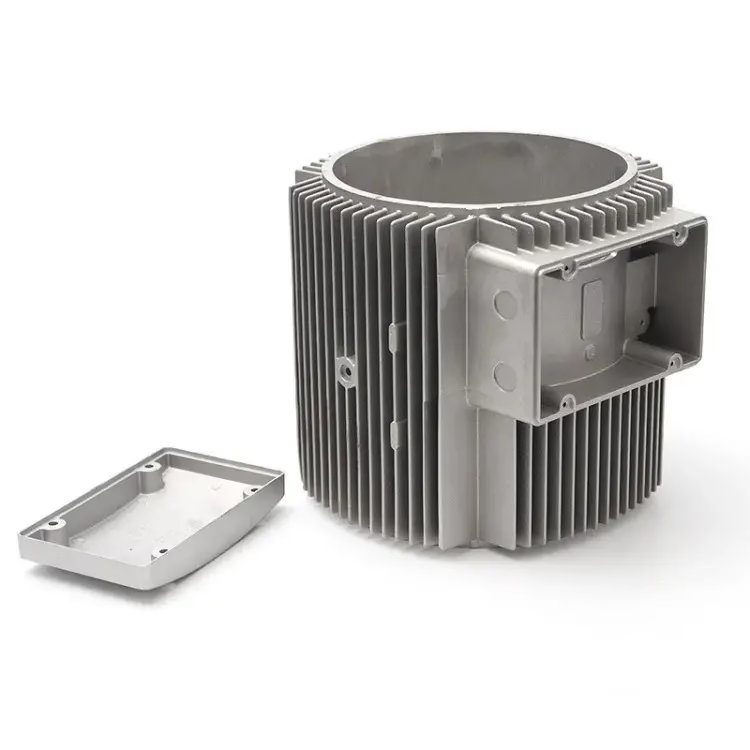
Die casting machine types at a glance
Ratings assume a well-gated mold and a stable alloy melt.
| Machine type | Best alloy fit | Typical tonnage | Cycle time | Wall thickness |
|---|---|---|---|---|
| Hot chamber | Zinc, magnesium, lead | 50–400 t | 1–3 s | 0.5–1.5 mm |
| Cold chamber | Aluminum, brass, copper | 200–4,000 t | 20–90 s | 1.5–4 mm |
| Vacuum assisted | Aluminum, thin walls | 300–2,500 t | 25–95 s | 1.0–2.5 mm |
| Squeeze casting | Aluminum, thick hubs | 400–1,600 t | 40–120 s | 3–8 mm |
| Hot chamber miniature | Zinc, small parts | 5–50 t | 0.5–2 s | 0.3–1.0 mm |
Hot chamber vs cold chamber: the first split
Almost every die casting machine falls into one of two families. In a hot chamber machine the injection cylinder sits inside the melt pot. The plunger strokes through liquid metal on every cycle, so there is no ladle, no transfer time and no air pocket drawn in with the shot. That is why zinc cycles in 1 to 3 seconds and wall sections down to 0.5 mm hold.
Cold chamber machines work the other way. A ladle pours metal into a shot sleeve outside the furnace, then the plunger drives it into the die. Aluminum melts at around 660 °C and attacks ferrous parts, so keeping the injection system out of the pot is not a preference, it is a requirement. The trade is a longer cycle and a small amount of entrained air unless you add vacuum.
The practical question is not which machine is better. It is which alloy the part needs. Zinc and magnesium go hot chamber. Aluminum, brass and copper go cold chamber. If a supplier offers to run aluminum in a hot chamber machine, the gooseneck will fail in weeks.
- 1Hot chamber limitGooseneck and plunger erode fast above 450 °C melt temperature.
- 2Cold chamber limitShot sleeve and plunger tip are consumables; budget 20,000–80,000 shots.
- 3Both need ventingAir has to leave the cavity before the metal seals the gate.
Tonnage, shot weight and projected area
Locking force holds the die halves shut against the injection pressure. If the force is too low the die cracks open and the part flashes. The number you need comes from projected area, not part weight. Multiply the part's projected area in cm² by the cavity pressure in bar, then divide by 1,000 to get tonnes, and add 20 to 30 percent margin for spikes.
A 300 t machine runs about 250 cm² of projected area at 800 bar cavity pressure. A 1,200 t machine handles roughly 1,000 cm². Wall thickness shifts the required pressure more than size does: a 4 mm aluminum wall may need 700 bar, while the same part at 1.5 mm can push past 1,200 bar because the metal freezes before it fills.
Shot weight matters for a different reason. The plunger and shot sleeve have to hold the metal volume plus a biscuit and runner. On cold chamber machines a shot weight above roughly 60 percent of rated capacity usually causes excessive porosity at the gate end.
- 1Rule of thumbProjected area × cavity pressure ÷ 1,000 = required locking force in tonnes.
- 2Add margin20–30 percent covers pressure spikes and thermal drift.
- 3Check the sleeveShot sleeve diameter limits maximum shot volume, not the tonnage.
Vacuum assisted and squeeze casting
Standard cold chamber dies trap air. You can see it as gas porosity after machining, usually near the last-filled region or in thick sections. Vacuum assisted casting pulls 50 to 100 mbar in the cavity before the shot, which reduces trapped gas and lets you run thinner walls. It adds a vacuum valve, seals and a control loop, so tooling cost climbs.
Squeeze casting goes the other direction. The die fills slowly with minimal turbulence, then a secondary ram compresses the still-liquid core at 50 to 100 MPa. Thick hubs, suspension arms and brake caliper bodies benefit because shrinkage porosity collapses under pressure. Cycle time rises to 40–120 seconds and the die needs a movable core, so it suits parts where pressure tightness is non-negotiable.
For most enclosures, brackets and housings, vacuum is enough. Reserve squeeze casting for parts that will be machined into a sealing surface or tested at pressure.
- 1Choose vacuum whenWall is 1.0–2.5 mm and porosity specs are tight.
- 2Choose squeeze whenSection exceeds 6 mm and the part must hold pressure.
- 3Neither fixesBad gating, cold dies or wet shot sleeves.
What each machine type cannot do
Hot chamber machines cannot run aluminum. The melt dissolves the gooseneck and plunger, and the failure is not gradual. Cold chamber machines cannot match hot chamber cycle times, because ladling and shot sleeve travel add seconds on every cycle. On a 1 million part run that gap decides the program.
Vacuum assisted machines cannot tolerate poor die sealing. A worn seal drops cavity pressure and the porosity returns, often intermittently, which is worse than a consistent defect. Squeeze casting dies cannot be simple. The movable core, the two-stage shot profile and the longer cycle mean tooling cost is usually two to three times a conventional cold chamber die.
Miniature hot chamber machines cannot scale up. Below 50 t they are excellent for zinc connectors and small hardware, but projected area runs out fast. Above 400 t hot chamber machines are rare for a reason: the gooseneck becomes a handling problem.
- 1Material lockAluminum rules out hot chamber entirely.
- 2Cycle lockCold chamber adds 10–60 s per shot versus hot chamber.
- 3Tooling lockSqueeze and vacuum dies cost more and take longer to build.
How the machine choice affects machining
Die cast parts are near net shape, not finished. Holes under 3 mm, threads, tight bores and sealing faces usually come off the casting and onto a CNC. The machine type sets the stock allowance you have to plan for. Hot chamber zinc parts can hold ±0.05 mm on a cast dimension, so machining allowance can be 0.3 mm. Cold chamber aluminum typically needs 0.5 to 0.8 mm.
Porosity location drives fixture design too. If the gate end is porous, do not put a sealing face there. We review the casting layout against the machining drawing before the die is cut, which is far cheaper than re-cutting a die after the first article fails a leak test.
Tolerance on machined features can reach ±0.005 mm and surface finish Ra 0.8–1.6 μm when the casting is clean and the setup is rigid.
- 1AllowanceZinc 0.3 mm, aluminum 0.5–0.8 mm on machined faces.
- 2Gate locationKeep sealing surfaces away from the last-filled zone.
- 3One setupCast datums let us machine multiple features without re-clamping.
The choice in one line
Zinc or magnesium at high volume: hot chamber. Aluminum with tight porosity: vacuum assisted cold chamber. Thick, pressure-tight aluminum sections: squeeze casting. If the part is still a prototype, machine it from billet first and prove the design before you commit to a die.
Common questions
Can one machine run both zinc and aluminum?
No. Hot chamber machines are built around a submerged gooseneck that zinc and magnesium tolerate. Aluminum at 660 °C destroys that hardware.
A cold chamber machine can run zinc, but it loses the cycle time advantage and usually costs more per part than a dedicated hot chamber cell.
How do I estimate the tonnage before I have a quote?
Take the projected area of the part plus runner in cm², multiply by the cavity pressure in bar you expect for that wall thickness, and divide by 1,000.
Add 20 to 30 percent. For a 1.5 mm aluminum wall assume 1,000–1,200 bar; for a 4 mm wall assume 600–800 bar.
Is vacuum assisted casting worth the extra tooling cost?
It is worth it when you need thin walls, tight porosity limits or a cosmetic surface that will be anodized. Anodizing shows gas porosity as dark spots.
For a thick, non-cosmetic bracket it usually is not. Standard cold chamber with good gating is cheaper.
What wall thickness should I design for?
Zinc hot chamber: 0.5–1.5 mm works. Aluminum cold chamber: 1.5–4 mm is the stable band.
Below 1.0 mm in aluminum you need vacuum and a well-tuned shot profile. Above 6 mm, shrinkage porosity rises and squeeze casting becomes the better route.
How many parts before the die pays off?
Die casting wins on volume. The break-even point depends on part size, alloy and how much machining the casting removes.
For low volumes or design still in flux, machining from billet or vacuum casting avoids the die cost and the lead time.
Can you machine castings after they come out of the die?
Yes. We machine die cast aluminum, zinc and magnesium parts on 3-axis, 4-axis and 5-axis centers, including mill-turn work.
Tolerances reach ±0.005 mm on machined features, with 100 percent inspection before shipment and reports on request.
Send us your casting drawing
We review the alloy, wall thickness and machining allowance, then tell you which machine type fits and where the porosity risk sits. Quote and DFM analysis back within 12 hours.
12-hour quote100% inspectionNo minimum order
More from the shop floor
We publish setup notes, tooling trials and inspection data from the factory floor.











