GreatLight CNC Machining Factory logo
CNC Machining
Rapid Prototyping
Materials
Industries
News
About GL

Get Instant Quote

Stainless Steel Turned Parts

Custom Made Stainless Steel CNC Turning Parts

We turn 303, 304, 316L, 420 and 17-4PH bar into shafts, fittings and valve bodies. Tolerances to ±0.005 mm, finishes down to Ra 0.2 μm, and every batch inspected before it ships.

±0.005 mm turning tolerance303 / 304 / 316L / 17-4PHØ400 mm rotary tableRuns from one part up
aluminum-vs-stainless-steel-cnc-lathing-machining-service
127High-precision CNC machines
16Mill-turn centers
±0.005 mmTurning tolerance
99.99%Qualification rate
Common Problems

Where Stainless Turning Goes Wrong

Four failures we see on incoming drawings every week.

01

Do your threads gall during assembly?

Austenitic grades work-harden fast. A tool that rubs instead of cuts tears the surface, and 304 threads pick up on the mating part. We run sharp inserts, higher feed and a sulfur-bearing grade such as 303 when the part does not need corrosion resistance.

02

Are your bores drifting out of round?

Long slender shafts and thin-wall tubes deflect under cutting force. Turn the OD first and the bore comes back oval by 0.02 mm or more. We sequence roughing and finishing in separate passes and check roundness on the machine before the part comes off.

03

Does the surface finish fail on 316L?

316L is gummy. Light finishing passes smear rather than shear, leaving Ra above 1.6 μm and visible chatter marks on a sealing face. We push feed rate and depth of cut instead of dropping them, then verify with a profilometer.

04

Are you scrapping parts at final inspection?

Stainless moves after machining as residual stress releases. A part that measures in tolerance on the lathe can go out of tolerance two days later. We rough, stress-relieve when the drawing allows, then finish and measure at 20 °C.

Our Approach

Turning Stainless So It Stays in Tolerance

Grade selection, tooling and inspection sequence decided before the first chip.

cnc-machining-steel
Grade Selection

Pick the Alloy Before You Pick the Toolpath

Most stainless turning problems are material problems wearing a machining costume. 303 machines cleanly and holds a fine finish, but its sulfur content limits weldability and slightly lowers corrosion resistance. 304 is the general-purpose choice and work-hardens readily. 316L adds molybdenum for chloride environments and turns gummier than either.

For high-strength parts we use 17-4PH (SUS630), which reaches roughly 1,100 MPa after aging. 420 and 440C cover wear surfaces such as shafts and valve stems. We recommend a grade from the drawing's function, not from what is already on the shelf.

  • 1
    303Free-machining, best finish, limited weldability
  • 2
    304 / 316LGeneral purpose and chloride service, work-hardens
  • 3
    17-4PH / 420 / 440CHigh strength and wear resistance after heat treat
CNC Milling & Turning Services
Process Control

Rough, Rest, Finish, Then Measure

Stainless bar arrives with residual stress from rolling or drawing. Cut a lot of material off one side and the part bends toward the relieved side. On a Ø30 mm shaft with an 8 mm flat, that movement can exceed the ±0.005 mm drawing tolerance before the part ever reaches inspection.

We rough with stock left on, let the part equalize, then take the finishing pass. For parts with tight concentricity we turn the critical diameters in one clamping on a mill-turn center instead of moving the part between operations. That removes the re-chucking error entirely.

  • 1
    Separate rough and finishLeaves 0.3–0.5 mm for the finishing pass
  • 2
    One-clamp turningConcentric bores and faces from one setup
  • 3
    Temperature-controlled checkFinal measurement at 20 °C on a CMM
Grade Chart

Stainless Grades and What They Cost You

Machinability is rated against 303 as the baseline.

GradeTypical useMachinability
303Shafts, fittings, no weldingBest, reference grade
304General parts, food equipmentGood, work-hardens
316 / 316LMarine, chemical, medicalFair, gummy, needs sharp tools
17-4PH (SUS630)High-strength shafts, aerospaceFair, age to ~1,100 MPa
420 / 431Valve stems, pump partsGood, harden to 50 HRC
440CBearings, wear surfacesHard to turn, 58 HRC max
Services

What We Do Alongside Turning

One shop covers the turned part and everything that happens to it after.

01

CNC Turning and Mill-Turn

16 mill-turn centers and 127 machines total handle bar work from Ø2 mm up to 4,000 mm, with live tooling for cross-holes and flats in the same setup.

02

5-Axis Machining

16 simultaneous 5-axis centers cut angled ports, impeller passages and complex contours that a lathe alone cannot reach.

03

Rapid Prototyping

Turned prototypes ship in 3–5 days so the design can be tested on the bench before tooling is committed.

04

Surface Finishing

Passivation, bead blasting, polishing, electroless nickel and laser marking, with character height down to 1.5 mm.

05

Sheet Metal and Casting

Enclosures, brackets and die-cast housings for the assembly your turned part sits inside.

06

Inspection and Reporting

Raw material certificates, in-process checks and final dimensional reports on request, with 100% inspection before shipment.

Turned Part Scope

Turning Capacity at a Glance

Numbers are for the Dongguan plant unless noted.

ItemRange
Turning tolerance±0.005 mm (±0.0002 in)
Fine finishRa 0.2–0.8 μm
Standard finishRa 0.8–1.6 μm
As-machined finishRa 1.6–3.2 μm
Rotary tableØ400 mm
Maximum part size4,000 mm
Order quantityOne prototype to 10,000+ parts
Quote turnaround12 hours with free DFM analysis
Why GreatLight

What You Get With the Quote

Six things that decide whether the turned parts fit the first time.

±0.005

Tolerance Held in Production

Not just in the sample. Process capability is monitored on every batch, and 99.99% of parts meet the drawing at final inspection.

12H

Quote and DFM in 12 Hours

We flag thin walls, sharp internal corners and tolerances that will cost you money before you place the order.

24H

Production Starts in 24 Hours

Once the drawing and material are confirmed, the first operation can be on a machine the next working day.

15Y

Fifteen Years on Stainless

Founded in 2011, three wholly-owned plants and 150 technicians working mainly in stainless, steel and aluminum.

ISO

Four Certifications

ISO 9001:2015, IATF 16949:2016, ISO 13485:2016 and ISO 27001:2022 cover quality, automotive, medical and data handling.

1 pc

No Minimum Order Quantity

One prototype or a 10,000-part run goes through the same inspection process and the same report format.

7,600 m²Manufacturing space
150Technicians
3Wholly-owned plants
<2%Historical late-delivery rate
Industry Fit

Where These Parts End Up

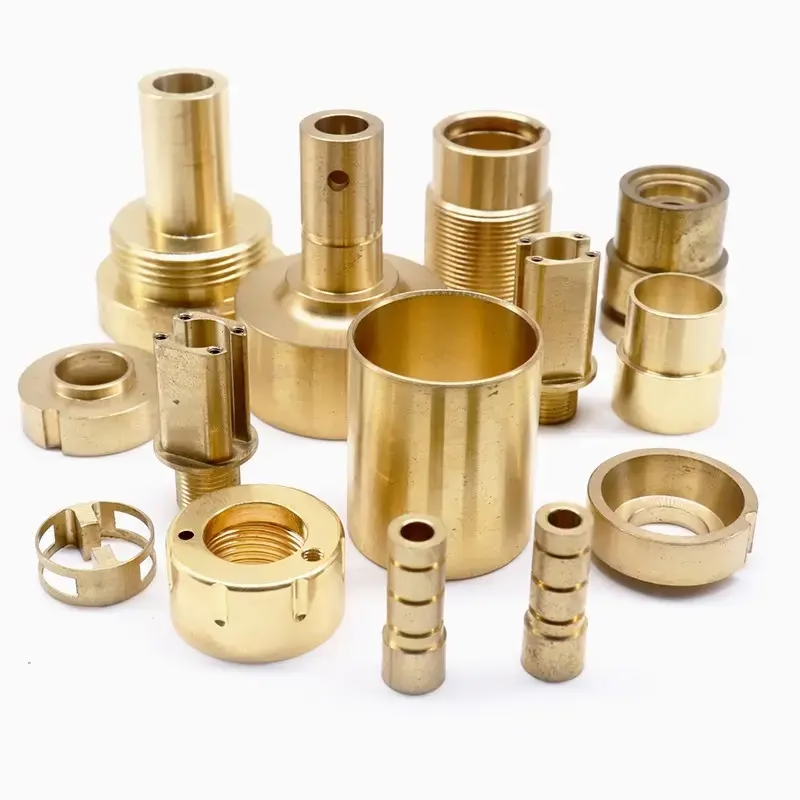
turning-copper-parts-3

Automotive and EV

Sensor housings and fluid fittings turned from 303 and 316L, then passivated and laser marked.

  • ±0.005 mm
  • IATF 16949:2016
cnc-alloy-steel

Medical Devices

316L and titanium shaft components with fine finishes for instrument assemblies.

  • Ra 0.2–0.8 μm
  • ISO 13485:2016
cnc machining

Industrial Machinery

Valve stems and drive shafts in 420 and 431, heat treated and ground where the drawing calls for it.

  • 100% inspection
  • Ø400 mm table
cnc-machining-hdpe

Aerospace and Robotics

17-4PH actuator pins and joint hardware turned to tight concentricity in one clamping.

  • 17-4PH
  • One-clamp turning
FAQs

Questions Engineers Ask Before Ordering

Which stainless grade should I specify for a turned part?

Start from the service environment. Chlorides or washdown means 316L. If the part only needs strength and finish, 303 turns faster and cheaper. Welded assemblies rule out 303 because of its sulfur content.

When the drawing calls for high strength, 17-4PH is the usual answer. It machines in the annealed condition and ages to roughly 1,100 MPa without the distortion of a quench-and-temper cycle.

Can you hold ±0.005 mm on a long stainless shaft?

Yes, within limits. Diameter and concentricity on a rigid part are routine. Length over 300 mm is where thermal growth and deflection start to matter, and we may need to turn between centers or add a steady rest.

If a feature is genuinely beyond that, we will say so in the DFM report rather than quote a number we cannot hold.

How do you stop thin-wall stainless parts from deforming?

Cutting force is the enemy. We take lighter radial passes, support the wall with a fixture or expanding mandrel, and finish in a separate operation after the part has cooled.

Walls below 0.8 mm get a design note, because at that thickness the clamping pressure alone can leave a mark.

What surface finish can I expect on a turned sealing face?

Standard turning gives Ra 1.6–3.2 μm. A controlled finishing pass reaches Ra 0.8–1.6 μm, and polishing or lapping takes it to Ra 0.2–0.8 μm.

Tell us the seal type and the finish requirement together. A face that is too smooth can fail to hold a static seal as well as one with the specified roughness.

Do you passivate parts after turning?

Yes. Passivation removes free iron left by tooling and restores the chromium oxide layer on 304, 316L and 17-4PH. It matters most on parts headed for chemical, marine or medical service.

Bead blasting, tumbling and brushing are also available when the drawing calls for a cosmetic finish instead.

What do you need to quote a turned part?

A STEP or IGES file, a 2D drawing with tolerances and finish callouts, the grade, and the quantity. Material certificates and inspection reports are quoted on request.

Missing a dimension is common. We flag it in the DFM analysis instead of guessing, and you get the quote and the notes together within 12 hours.

Is there a minimum order quantity?

No. One prototype and a 10,000-part run both go through the same process. The difference is in the fixturing and the inspection sampling plan, not in whether we will take the job.

Prototypes typically ship in 3–5 days once production starts.

How do you handle drawings under NDA?

We sign your NDA or provide ours. Uploads are handled as confidential, access is limited to the engineers and machinists on the job, and ISO 27001:2022 covers our information handling.

Ask for the NDA before you send files if your process requires it.

Send a Drawing, Get a Turned Part Quote

Upload your file and we will return pricing, lead time and a DFM note within 12 hours. No minimum order quantity, and 100% inspection before anything ships.

12-hour quote100% inspectionNo minimum order quantityNDA on request

Trusted by engineers and manufacturers worldwide

Tesla Ford Motor Company BYD Auto Denso Magna International Boeing Airbus Medtronic KUKA FANUC