
CNC Processing Service: What to Check Before You Commit
This guide is for engineers and buyers comparing a CNC processing service for a real part. We cover the checks that change the outcome: tolerance, machine fit, lead time, order quantity, certifications, and what a quote should tell you. Read it and you can judge a supplier in one call.
In this article
- 1
- 2
- 3
- 4
- 5
- 6
- 7
- 8
Seven checks that decide the part
What each check actually tells you
Score a supplier against these before you send a PO.
| Check | What to ask | Good answer | Red flag |
|---|---|---|---|
| Tolerance | Which features need ±0.005 mm? | Feature-by-feature review | One number for the whole part |
| Machine fit | Max part size you can hold? | 4,000 mm travel available | Only 500 mm machines |
| Setup count | How many setups per part? | Two or fewer on 5-axis | Four setups, no fixture plan |
| Lead time | When does the clock start? | DFM in 12 hours, cut in 24 | Quote only, no DFM |
| Order size | Minimum order quantity? | No MOQ, 1 to 10,000+ | Tooling charge per revision |
| Certifications | Which standards apply? | ISO 9001, IATF 16949, ISO 13485 | Certificate on request only |
| Quote detail | Is material and finish listed? | Line-item breakdown | One lump price |
| Inspection | What is checked before ship? | 100% inspection, reports on request | Sample check only |
Pick the shop that answers the technical questions
If a supplier reviews your critical dimensions, names the setups, and quotes line by line, the part will land closer to print. If they quote a single price and a short lead time, keep looking.
Tolerance is a feature decision, not a shop claim
Every machined part carries a tolerance stack, and the stack is set by the features that matter. A bearing bore at Ø25 H7 and a mounting slot at ±0.2 mm do not need the same process control. When a supplier quotes a single number for the whole part, ask which features drive it. That answer tells you whether they read the drawing or just the title block.
We hold ±0.005 mm on critical features and ±0.0002 in when the drawing is written in inches. Those limits come from the machine, the fixture, and the thermal state of the part, not from a marketing number. A thin wall in 6061 will move after clamping. A 17-4PH shaft may need a stress-relief step between roughing and finishing. Both cases change what the real tolerance can be.
For a new CNC processing service, send the drawing with the critical dimensions marked. Then ask for a DFM note on which of them are hard and which are easy. If the reply lists only the hard ones, the shop is being honest. If it lists every dimension as tight, they are guessing.
- 1Mark critical dimensionsHighlight bores, seal faces, and mating surfaces before you send the file.
- 2Ask for the stackA shop that explains the stack understands where the risk sits.
- 3Check the materialAluminium 6061-T6 and titanium TC4 behave differently at the same tolerance.
Match the machine to the part, not the brochure
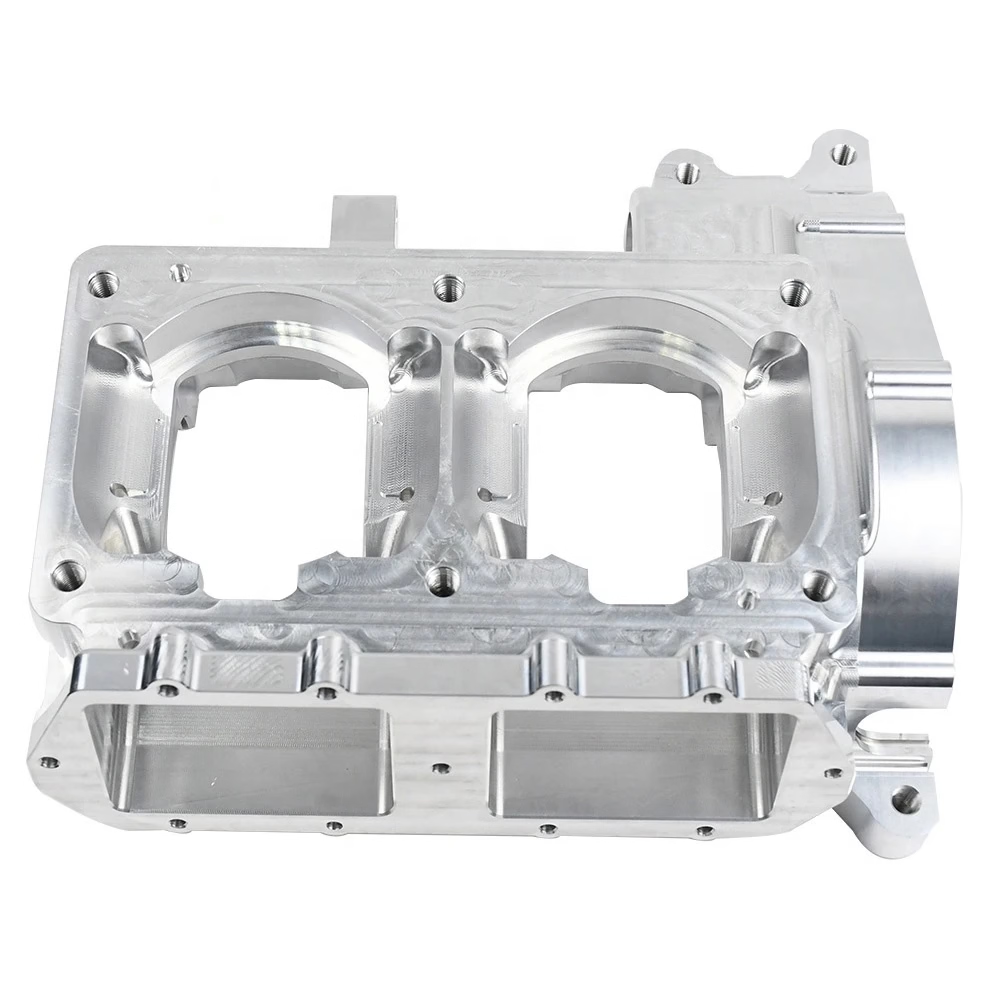
Five-axis machining is not automatically better. It is better when the part has features on multiple faces, deep pockets with compound angles, or a shape that would need three fixtures on a three-axis mill. For a flat plate with two holes, a three-axis machine is faster and cheaper. The judgment is geometric, not brand-based.
Part size is the first filter. Our largest travel is 4,000 × 400 × 150 mm, which covers long rails and beams. Medium work runs on 750 × 1,150 × 550 mm and 600 × 600 × 600 mm cells. Compact parts go on 500 × 500 × 450 mm or 500 × 310 × 200 mm machines. A Ø400 mm rotary table handles cylindrical and disc parts that need indexed faces.
The second filter is accuracy under load. A simultaneous five-axis cut with a long tool will deflect, and no control can correct for that after the fact. For deep cavities, we shorten the tool, reduce stepover, and accept a slower cycle. That trade is normal. A shop that promises full speed and full accuracy on a deep pocket is not being straight with you.
If your part fits a three-axis machine and has no compound angles, say so in the RFQ. You will get a lower price and a shorter schedule. Save the five-axis capacity for the parts that need it.
- 1Count the facesFeatures on three or more faces are a five-axis candidate.
- 2Check the envelopeCompare part size to travel before anything else.
- 3Watch the tool lengthDeep pockets need shorter tools or a slower cycle.
Setup count drives accuracy and cost
Every setup introduces a new datum and a new chance for position error. A part machined in five setups on a three-axis machine can pass each operation and still fail the assembly because the datums drifted. On a five-axis center, we finish most faces in two setups, sometimes one. Position between features holds because the part never leaves the fixture.
Ask a supplier how many setups a part needs. A vague answer is a warning. A specific answer, with the fixture type and the datum for each setup, tells you they have planned the job. For production runs, ask about soft jaws, vacuum plates, or dedicated fixtures. Fixture planning is part of the quote, even when it is not a separate line.
The trade-off is volume. A dedicated fixture costs money and time, so it pays off above a few hundred parts. For a one-off prototype, a machinist who can hold ±0.05 mm on a vise is often the better choice than a fixture program that takes two days to build. Match the method to the quantity.
- 1Ask for the setup planDatums and fixture type should appear in the quote.
- 2One setup is not always bestFor single parts, simple workholding can win on time.
- 3Fixtures pay back at volumeDedicated workholding makes sense above a few hundred pieces.
Lead time starts when DFM lands, not when the PO is signed
Most schedule slips happen before the spindle turns. A drawing with an unclear datum or a missing thread callout sits in an inbox for days. A shop that returns a DFM analysis and a quotation within 12 hours removes that delay. Production can then start within 24 hours of approval, and parts ship in 3–5 days for standard jobs.
Ask two questions: when does the clock start, and what stops it? The honest answer names the blockers. Missing material certifications, an unclear surface finish, or a tolerance that needs a fixture decision will all push the start date. A supplier who says nothing stops it has not looked at the file.
Historical data helps here. Our late-delivery probability sits below 2%, and the number is built on jobs where the DFM was closed before cutting started. When a customer insists on cutting from an unreviewed file, that risk goes up. The review is not paperwork. It is the step that protects the date.
- 1Time the DFMA 12-hour DFM response is the first real schedule signal.
- 2Name the blockersMaterial certs and finish specs are common causes of delay.
- 3Do not skip reviewCutting from an unreviewed file raises the risk of a rework loop.
Order quantity, certifications, and quote detail
A CNC processing service that sets a high minimum order quantity is not built for prototyping. We run from one piece to 10,000+ part runs with no MOQ. That matters when you need a fit check before committing to a mold or a production fixture. One part, measured, is worth more than a spreadsheet of predicted results.
Certifications are a filter, not a badge. ISO 9001:2015 covers general quality management. IATF 16949:2016 applies to automotive and EV work. ISO 13485:2016 applies to medical devices. ISO 27001:2022 covers information security, which matters when your drawings are confidential. Match the certificate to the industry, and ask for the scope statement, not just the logo.
The quote itself is a test. A line-item quote lists material grade, stock size, machining operations, finish, and inspection. A lump price hides the assumptions. When the material price moves or the finish changes, the lump quote gets renegotiated and the schedule slips. Ask for the breakdown. It also tells you whether the shop understood the drawing.
Uploads stay confidential. We sign an NDA on request, and files are not shared outside the project team.
- 1No MOQOrder one piece to validate the design before tooling.
- 2Match the certificateIATF for automotive, ISO 13485 for medical, ISO 27001 for IP.
- 3Demand a line-item quoteMaterial, operations, finish, and inspection should each be visible.
Step by step: qualify a supplier in one week
Run these in order. Stop when a step fails.
- 1Send the drawing with critical dimensions markedUse a PDF with the tolerance block and a 3D STEP file. Mark bores, seal faces, and mating surfaces. Do not send only a 2D print with general notes; the shop needs the geometry to plan the setup.
- 2Request DFM and a quote in the same messageAsk for both within 12 hours. A DFM note should list hard features, suggested tolerances, and any design change that lowers cost. If the reply is a price only, treat it as incomplete.
- 3Check machine fit against the part envelopeCompare your part size to the supplier's travel. For parts over 1,000 mm, confirm the long-travel machine and the fixture. For parts under 200 mm, confirm the compact cell and the spindle speed range.
- 4Ask for the setup and inspection planGet the number of setups, the datum for each, and the inspection method. For ±0.005 mm features, ask whether a CMM report is included or costs extra. 100% inspection before shipment is the baseline.
- 5Confirm material and finish in writingState the alloy grade, temper, and finish spec. For anodizing, say clear, color, hardcoat, or conductive. For plating, name the thickness range. Ambiguity here causes the most rework.
- 6Run a small order before the production releaseOrder one to five pieces with no MOQ pressure. Measure them against the drawing. If the first article passes, release the full run. If it fails, you have lost days, not weeks.
- 7Close the loop with the inspection reportAsk for dimensional results on the critical features. Raw material check, in-process monitoring, and final inspection should all be documented. Keep the report with the part history.
Questions buyers ask before the first order
What tolerance can a CNC processing service hold in production, not just in a sample?
On critical features we hold ±0.005 mm, or ±0.0002 in. That is a production number, not a one-off result. It depends on the feature, the material, and the fixture. A thin wall or a deep pocket will relax the limit, and we say so during DFM.
For non-critical dimensions, ±0.05 mm is normal and cheaper. Ask which features need the tight limit. Paying for tight tolerance everywhere raises cost without adding function.
Do I need five-axis machining for my part?
Only if the part has features on three or more faces, compound angles, or deep pockets that would need multiple fixtures on a three-axis mill. A flat plate with holes on one face runs faster on a three-axis machine.
Send the STEP file and ask. A shop that pushes five-axis for every job is selling capacity, not solving your problem.
What is the minimum order quantity?
There is no minimum order quantity. We run from one prototype to 10,000+ part runs. The first article is the cheapest way to validate a design before you commit to tooling or a larger batch.
At high volume, unit cost drops because the setup and fixture cost is spread across more parts. The quote should show that split.
How fast can parts ship?
Quotation and free DFM analysis come back within 12 hours. Production can start within 24 hours of approval, and standard jobs ship in 3–5 days. Complex parts with special material or finish take longer, and the quote states the date.
Our historical late-delivery probability is below 2%. That figure depends on a closed DFM before cutting starts.
Which certifications should I ask for?
ISO 9001:2015 is the baseline for quality management. IATF 16949:2016 matters for automotive and EV parts. ISO 13485:2016 applies to medical devices. ISO 27001:2022 covers information security and is relevant when your drawings are confidential.
Ask for the scope statement, not just the certificate number. The scope tells you which processes and sites are covered.
How do you protect my design?
Uploads are secure and confidential. Files stay with the project team and are not shared outside it. An NDA is available on request before you send drawings.
If your program needs a controlled data flow, say so at the RFQ stage so the file handling is set up before the first drawing arrives.
Send the drawing and get a DFM review
Quotation and free DFM analysis within 12 hours. No MOQ. Uploads stay confidential, with an NDA available on request.
12-hour quoteNo MOQ100% inspectionNDA on request
More from GreatLight
We publish setup notes, tooling trials and inspection data from the factory floor.











