
CNC System Design of the Roller Machine
This page explains how a plate rolling machine is controlled: the motion controller, the PLC layer, interpolation of the two bottom rolls, and the feedback loop that keeps the top roll parallel. It is written for machine builders and plant engineers who need to judge whether a given control architecture fits their duty cycle. Read it and you can tell where a design will drift, stall, or hold tolerance.
In this article
- 1
- 2
- 3
- 4
- 5
- 6
- 7
What CNC System Design of the Roller Machine Actually Controls
A plate rolling machine is not a milling machine. There is no tool path in the usual sense. The axes move slowly, the loads are large, and the geometry is defined by three rolls squeezing a plate. A CNC system design of the roller machine has to manage that geometry, not a spindle.
The controller commands two bottom roll positions and one top roll position, plus rotation of the main drive. The goal is a target radius on the finished cylinder. The math is simple. Holding it under load is not.
Most designs split the work. A motion controller handles position and velocity loops. A PLC handles sequencing: pinch, clamp, tilt, eject. The human interface sits on top and shows the operator the current radius and the roll positions.
That split matters. If the PLC tries to close the position loop, cycle times stretch and the radius wanders. If the motion controller tries to run the sequence, the logic gets rigid and hard to change.
- 1Two layers, one machineMotion control for axes, PLC for sequence and safety.
- 2Radius is the outputEvery axis command exists to hit a target curvature.
- 3Load changes the answerSpringback and roll deflection shift the real radius.
Motion Control and Interpolation of the Bottom Rolls
The two bottom rolls must rise together. If one leads the other, the plate twists and the cylinder comes out conical. The motion controller interpolates both axes from a single command so they share a trajectory.
Typical designs use a position loop in the controller and a velocity loop in the drive. The controller updates the command at 1–4 kHz. The drive closes current at a much higher rate. That division keeps the controller free for geometry.
Parallelism is the hard part. A small offset between the two bottom rolls translates into a visible taper. Mechanical linkage helps, but it wears. Electronic synchronization has to be tuned so both axes reach the target within a tight window.
On a machine that rolls 4,000 mm plate, the two bottom rolls may travel over 200 mm. A 0.05 mm mismatch at the start becomes a measurable gap at the seam. The controller has to correct for that during the pass.
- 1Single command, two axesInterpolation keeps the bottom rolls level.
- 2Fast inner loopCurrent loop in the drive, position loop in the controller.
- 3Tune for the loadGains set on a free roll will overshoot under plate load.
Feedback Devices and Why They Decide the Real Tolerance
The controller only knows what the feedback tells it. On most roller machines, each bottom roll carries a linear encoder or a glass scale. The top roll often uses an indirect measure, such as a motor encoder plus a lead screw pitch.
Indirect feedback is cheaper and easier to mount. It also hides backlash and screw wear. If the machine rolls thin plate, that error may be acceptable. If it rolls 20 mm plate, the same error shows up in the seam.
Direct measurement is better when the tolerance is tight. A linear scale on each bottom roll removes screw error from the loop. The trade-off is cost and protection. Rolling machines see scale, grit, and vibration. The scale has to be shielded.
A common mistake is to put a high-resolution encoder on a weak structure. Resolution is not accuracy. If the frame flexes 0.1 mm under load, a 1 μm encoder will report a position that the roll never reaches.
- 1Direct beats indirectLinear scales remove screw and backlash error.
- 2Resolution is not accuracyFrame stiffness sets the floor.
- 3Protect the scaleShielding matters more than resolution on a roller.
Sequence Logic, Safety, and the Operator Interface
The PLC owns the sequence. It checks that the plate is clamped, that the top roll is down, and that the safety gate is closed before it enables the main drive. Those checks are interlocked, not advisory.
The operator interface shows the target radius, the current roll positions, and the pass count. On a good design, the operator can correct the radius after the first pass without editing the program. That correction is stored as an offset.
Data logging helps more than most builders expect. If a batch drifts, the log shows whether the drift came from roll position, load, or material. Without it, the operator blames the machine.
Do not put safety logic in the motion controller. Safety functions belong in a dedicated path that can remove power independently. Mixing them slows the motion loop and complicates certification.
- 1Interlocks are hardSequence checks must block motion, not warn.
- 2Offsets per passLet the operator correct radius without a new program.
- 3Keep safety separateA dedicated safety path is easier to certify.
When a Simple Control Design Is the Right Choice
Not every roller machine needs full interpolation. A small machine rolling thin sheet at low volume can run on a PLC with analog drives and limit switches. The radius is set by mechanical stops.
That design is cheap and easy to service. It also has limits. Changing the radius takes time. Repeatability depends on the stops, not the control. It works when the shop rolls a few radii and the plate is thin.
Full CNC design pays off when the machine rolls thick plate, when radii change often, or when the seam has to close without rework. In those cases, the cost of the controller is small next to the cost of a scrapped shell.
There is a middle path. A PLC with servo drives and a simple position loop covers many shops. It gives repeatable roll positions without the complexity of full interpolation and radius calculation.
- 1Stops and PLCBest for thin sheet and a fixed set of radii.
- 2Servo PLCA middle path for repeatable positions.
- 3Full CNCJustified by thick plate and frequent radius changes.
How the Mechanical Parts Behind the Control Are Made
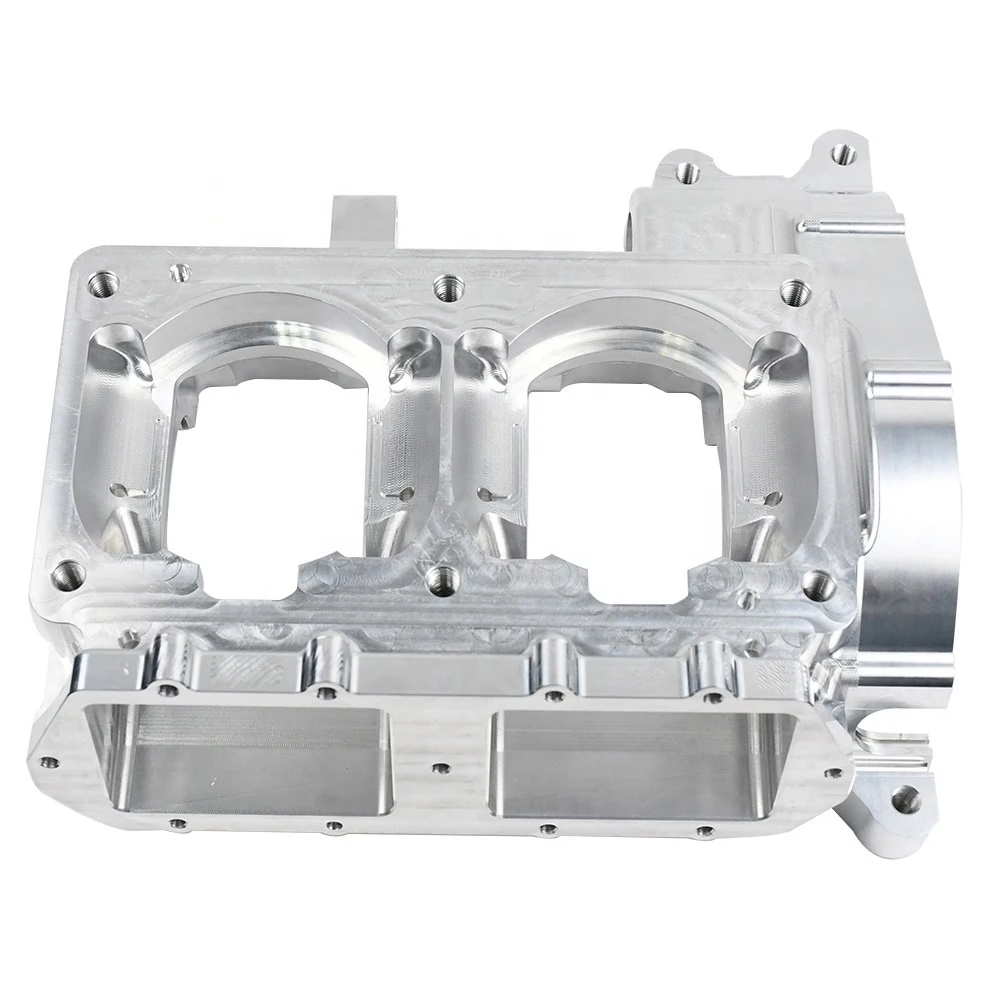
The control design sets the requirements for the mechanics. Roll journals, bearing housings, and the frame that carries the load all have to hold their geometry. If the housing bores are out of line, no amount of tuning will fix the roll parallelism.
Bearing housings for roller machines are usually machined from steel or cast iron. The bore tolerance and the perpendicularity of the mounting face matter. A housing that is 0.02 mm out of square tilts the roll and shows up as taper.
At GreatLight, we machine these parts on 3-axis, 4-axis, and 5-axis centers. We hold ±0.005 mm on critical features and inspect 100% before shipment. Reports are available on request.
We work from 6061 and 7075 aluminium, 304 and 17-4PH stainless, and 4140 and 4340 steel. For wear surfaces, hardcoat anodizing or electroless nickel is common. The finish depends on whether the part sees sliding contact or just locates.
- 1Housing bores set parallelismLine boring or single-setup machining keeps them true.
- 2Material follows the loadAluminium for light frames, 4140 for loaded journals.
- 3Inspection before assemblyCatch the geometry error before it becomes taper.
Control Architectures for a Roller Machine
Match the architecture to plate thickness, radius changes, and volume.
| Architecture | Feedback | Best for | Main limit |
|---|---|---|---|
| PLC with mechanical stops | Limit switches | Thin sheet, few radii | Slow radius changes |
| PLC with servo drives | Motor encoders | Repeatable positions, medium volume | Screw error stays in the loop |
| Motion controller, indirect feedback | Motor encoder plus screw | Mixed plate, moderate tolerance | Backlash and wear go uncorrected |
| Motion controller, linear scales | Linear scale per bottom roll | Thick plate, tight seams | Cost and scale protection |
| Full CNC with radius model | Linear scales plus load cell | Frequent radius changes, high value | Tuning and operator training |
Pick the Control That Matches the Plate
If you roll thin sheet and rarely change radius, a PLC with stops is enough. If you roll thick plate and need the seam to close without rework, use a motion controller with linear scales on both bottom rolls and correct the radius after the first pass.
Questions Engineers Ask
Can a standard PLC handle the position loop on a roller machine?
It can, but the update rate is the limit. A standard PLC scan runs in the 5–20 ms range. A roller axis moving at 10 mm/s covers 0.05–0.2 mm per scan.
For thin sheet and loose tolerance that is fine. For thick plate and tight seams, use a dedicated motion controller. It closes the loop at 1–4 kHz.
Why do the two bottom rolls need interpolation instead of separate commands?
Separate commands arrive at slightly different times. The difference is small, but it tilts the plate during the pass.
Interpolation sends one trajectory to both axes. They start, ramp, and stop together. That keeps the plate square to the rolls.
How do we correct for springback?
Measure the radius after the first pass and apply an offset. The controller stores the offset and uses it on the next pass.
For a given material and thickness, the offset is repeatable. For a new material, expect one trial pass. Do not try to model springback for every alloy.
What causes taper on a rolled cylinder?
Taper almost always comes from a mismatch between the two bottom roll positions or from a tilted top roll. Check the feedback first.
If the feedback is clean, check the bearing housings and the frame. A housing that is out of square tilts the roll under load.
Is a load cell worth adding to the control?
It helps when the machine rolls different plate thicknesses without a setup change. The load cell tells the controller how hard the rolls are working.
The controller can then adjust the roll gap or flag an overload. On a single-thickness line, the load cell adds cost without much benefit.
How tight should the machined housings be?
Bore tolerance and perpendicularity of the mounting face are the two features that matter most. Hold them to ±0.005 mm where the roll journal seats.
Inspect before assembly. A geometry error in the housing cannot be tuned out by the control.
Send Us the Control Housing and Roll Journal Drawings
We quote in 12 hours and machine the parts that keep your rolls parallel. Upload your files and we will confirm tolerance, material, and finish before cutting.
12-hour quote100% inspectionISO 9001:2015No minimum order quantity
More CNC Knowledge
We publish setup notes, tooling trials and inspection data from the factory floor.











