
Customized Pump Prototypes: How to Choose a CNC Pump Company
A buyer guide for engineers and sourcing teams who need one housing, one impeller, or a small pump build fast. You will see what to specify, which process fits which geometry, and how to compare quotes without gambling on the sealing fits.
In this article
- 1
- 2
- 3
- 4
- 5
- 6
- 7
- 8
Key takeaways
Machined prototypes vs. die casting for pump bodies
Use this when the housing or impeller geometry is still moving.
| Factor | CNC machined prototype | Die casting |
|---|---|---|
| Typical lead time | Parts ship in 3–5 days after programming | Weeks for tooling before a first part |
| Up-front cost | Program and fixture only | Hard tooling cost before part one |
| Design change | Edit the model, re-cut one part | Repair or cut a new tool |
| Wall thickness | Thin walls and deep pockets are fine | Needs draft and thicker walls |
| Internal features | Volute, ribs, and cross-drill in one setup | Requires cores and slides |
| Surface finish | Ra 0.8–1.6 μm standard, finer on request | Depends on tool condition |
| Best for | Validation builds, low volume, tight fits | Production runs above a few thousand |
The short verdict
Machine the prototype if the seal fits or the volute are still in flux or the volume is under a few thousand. Cast it once the design is frozen and the tooling cost is paid back by volume. Send the model and the duty point, and we will tell you which side of that line your part is on.
What customized pump prototypes have to prove
A pump prototype is not just a shape. It is a test of whether a hydraulic design holds together in metal. The housing has to hold a seal, the impeller has to sit on a shaft at the right axial gap, and the bearing bores have to stay coaxial after the material moves. If any of those three slip, the pump weeps, vibrates, or loses head.
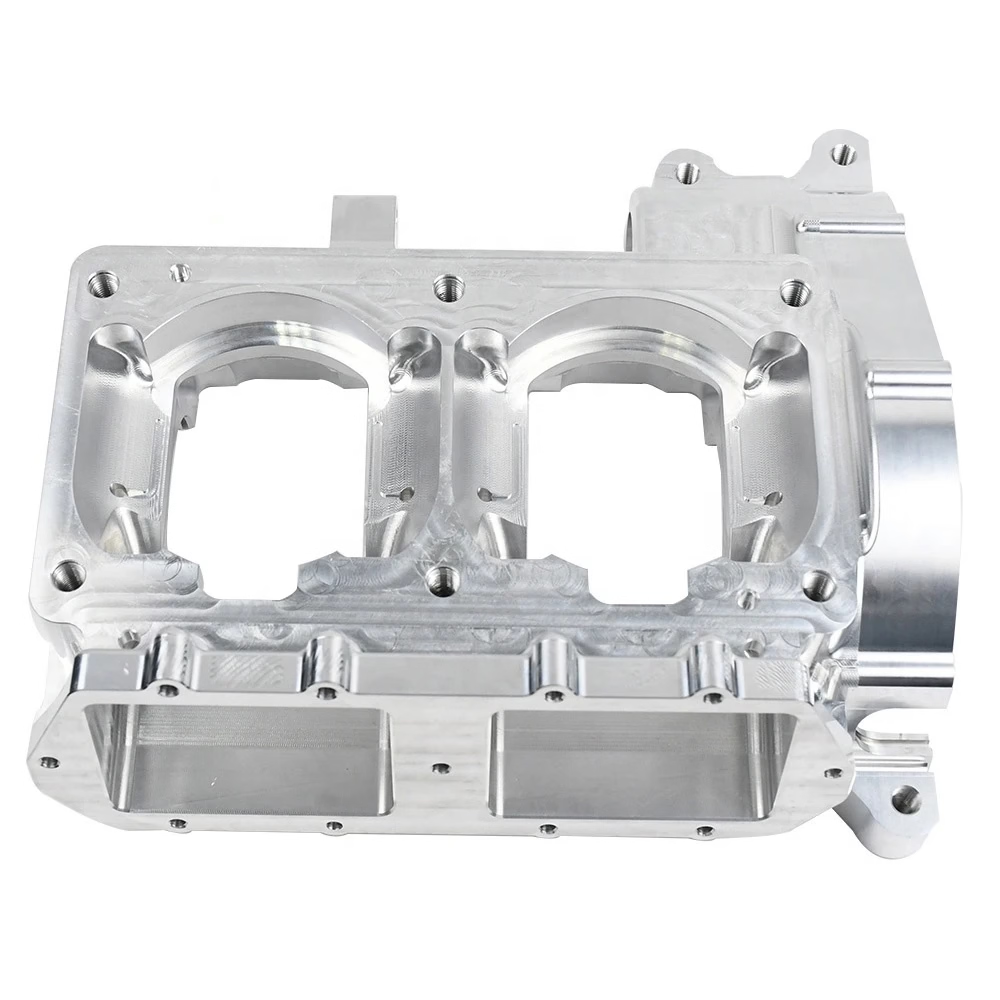
That is why customized pump prototypes are usually machined rather than cast at the first pass. A mold locks in geometry. Machining does not. You can change a volute depth, add a purge port, or open a clearance by 0.1 mm and hold the rest of the part to the original drawing.
Before you send a request for quote, write down what the pump must do on the test bench: flow at a given speed, head at a given back pressure, maximum leakage, and ambient temperature. Those four numbers tell the machinist which features deserve tight tolerance and which ones can stay loose.
- 1Seal bore diameter and finishUsually the single most important feature.
- 2Shaft runoutTotal indicator reading across the bearing journals.
- 3Axial clearanceImpeller to housing gap, set by a shoulder or shim.
- 4Bearing bore coaxialityBoth bores cut in one setup when geometry allows.
Picking a material for the housing and the impeller
Aluminum 6061-T6 is the default for prototype housings. It machines fast, holds a ±0.005 mm bore well, and anodizes cleanly. Use 7075 when you need higher strength in a thin flange or a small impeller boss. For seawater or mild chemical duty, move to 316L stainless; it costs more machine time but will not pit during a salt-spray test.
Impellers are a different question. An open impeller with thin vanes flexes while it is being cut, so we take light radial passes and finish the vane faces in a separate operation. Closed impellers are usually split into a hub and a shroud, machined separately, then joined. That is a design decision, not a machining one, so flag it before quoting.
Plastics have a place too. PEEK and POM handle non-lubricating fluids and keep weight down. They also move more with temperature. If your media runs above 80 °C, check the thermal expansion against your clearance before you commit to a plastic volute.
- 16061-T6General housings, covers, and mounting plates.
- 2316LCorrosive or marine media, sanitary service.
- 3PEEK / POMLight weight, chemical resistance, low temperatures.
- 417-4PHHigh-strength shafts that still need corrosion resistance.
How to compare CNC pump company quotes
Two quotes for the same file rarely mean the same thing. One may assume a 3-axis setup on a 6061 block with ±0.1 mm tolerances. The other may price a 5-axis operation, a matched fixture, and a final CMM report. The number on the page does not tell you which.
Ask each supplier to state the process plan, the tolerance they will hold, the finish callout, the inspection method, and the lead time in writing. A supplier that answers all five is easier to compare and easier to hold to. A supplier that answers only the price is asking you to trust the rest.
Volume also changes the answer. A one-off prototype and a 10,000-part run should not use the same process. If the design is stable after the first build, die casting, vacuum casting, or a mill-turn cell will often beat a single-spindle job on unit cost.
- 1Process planWhich machines, how many setups, which fixture.
- 2Tolerance statementPer feature, not one blanket number.
- 3Inspection methodCMM, gauge, or visual, and whether a report is included.
- 4Lead time basisFrom artwork approval or from PO date.
Sealing fits, clearances, and surface finish
Most prototype pump failures we see are not a broken part. They are a leak at a lip seal or an O-ring groove that was cut to the nominal size and no better. Seal performance depends on bore diameter, surface roughness, and lead-in chamfer. A Ra 0.8–1.6 μm bore is usually right for a lip seal; a polished Ra 0.2–0.8 μm bore can actually starve the lip of the film it needs.
Clearances are the other half. An impeller that rubs will wear through a housing in minutes. An impeller with too much axial gap loses head. The workable window is often 0.05 to 0.15 mm depending on material and temperature, and it has to be measured after the housing is at operating temperature, not on the bench at 20 °C.
Threads and ports deserve a mention. NPT and BSPP ports need the right chamfer and thread depth or they will leak at the joint, not the seal. If a port is close to a wall, say so on the drawing. A small shift in position can break through.
- 1Seal boreRa 0.8–1.6 μm, lead-in chamfer 15–30°.
- 2O-ring grooveCheck groove width and depth against the gland spec.
- 3Axial clearance0.05–0.15 mm typical, confirm hot.
- 4Port threadsFull thread depth, chamfered entry.
What a CNC pump company should show you
Ask what machines will run the job. A pump housing with a volute, a cross-drilled port, and a bearing bore on two sides usually needs 4-axis or 5-axis work to keep the features in one datum. A shop with only 3-axis mills can still do it, but it will re-fixture more often, and every re-fixture adds stack-up.
Ask about metrology. A ±0.005 mm bore is not verified with calipers. It needs a bore gauge or a CMM, and it needs to be checked with the part at a stable temperature. Suppliers who inspect in a temperature-controlled room will hold that tolerance more consistently than ones who inspect at the machine.
Finally, ask how they handle your files. Prototype pump work often involves patent-pending geometry. A supplier with a documented NDA process and controlled uploads is easier to work with than one that asks you to email a STEP file to a personal address.
- 1Machine listWhich spindles, which travels, which axes.
- 2MetrologyCMM or bore gauge, stable temperature.
- 3Quality systemISO 9001, IATF 16949, ISO 13485 as relevant.
- 4ConfidentialityNDA on request, secure upload.
Step by step: from drawing to a tested prototype
This is the sequence we use for a first pump build.
- 1Send the model and the duty pointSTEP or native CAD plus flow, head, speed, and media. Include the seal and bearing part numbers. Missing seal data is the most common cause of a slow quote.
- 2Review the DFM notesWe mark features that will be hard to hold, walls that are too thin for the material, and any datum that forces extra setups. Flag anything you cannot change.
- 3Lock the critical featuresAgree on tolerances per feature: seal bore at ±0.005 mm, bearing bores at ±0.01 mm, non-critical flange holes at ±0.1 mm. Put the finish callouts on the drawing.
- 4Cut the first partRough, stress-relieve if needed, then finish. Aluminum housings often need a light second pass after a day to catch movement from residual stress.
- 5Inspect and reportCheck the seal bore, bearing bores, and axial clearance. Records on request. 100% inspection before shipment.
- 6Assemble and bench testFit the seal dry first to check lead-in, then wet test at the target speed. Note leakage and head at your duty point before you change any geometry.
- 7Iterate one variable at a timeChange the volute or the clearance, not both. One part per change keeps the test result readable.
Common questions
Can you machine a pump housing with a closed impeller in one piece?
Sometimes, but it depends on the vane geometry and the size of the inlet. A closed impeller with narrow passages usually needs to be split into a hub and a shroud.
We machine the two halves, align them on a register, and join them. If you want a single piece, tell us the minimum passage width so we can check whether a cutter can reach it.
What tolerance should I put on the seal bore?
Start from the seal maker's data. For a lip seal, a bore tolerance of ±0.005 mm and a finish of Ra 0.8–1.6 μm covers most cases.
A bore that is too smooth can reduce the film under the lip. A bore that is too rough wears the lip. Stay inside the seal vendor's window rather than tightening it blindly.
Is there a minimum order quantity?
No. We run from one prototype to 10,000+ part runs.
For a single pump housing we still program and fixture the job, so the first part carries the setup cost. Later parts in the same revision are cheaper.
How fast can I get a quote and a first part?
Quotation and free DFM analysis come back within 12 hours of a complete file set. Production can start within 24 hours after that.
Parts typically ship in 3–5 days. If a feature needs a fixture or a second op, add a day or two.
Which certifications matter for a pump prototype?
For general industrial work, ISO 9001:2015 is the baseline. Medical pump components often need ISO 13485:2016. Automotive and EV pump work usually asks for IATF 16949:2016.
If your drawings are sensitive, ISO 27001:2022 for information security is worth checking as well.
Should I machine the prototype or go straight to casting?
Machine it first if the geometry is still moving or the volume is low. Casting makes sense once the design is frozen and the annual volume justifies tooling.
A machined prototype also gives you a known-good part to measure against, which makes the casting drawing easier to write.
Send your pump model for a 12-hour quote
Upload the CAD file and the duty point. You get DFM notes, a per-feature tolerance plan, and a price back within 12 hours.
12-hour quoteNo MOQ100% inspectionNDA on request
Follow GreatLight
We publish setup notes, tooling trials and inspection data from the factory floor.











