
CNC Phone Box Design: How Machining Shapes a Phone Housing
A phone box is not a decorative shell. It is a thin-wall enclosure that must hold a screen, spread heat, and pass an antenna signal. This page explains how CNC phone box design works, which geometries suit milling, and where the process stops making sense.
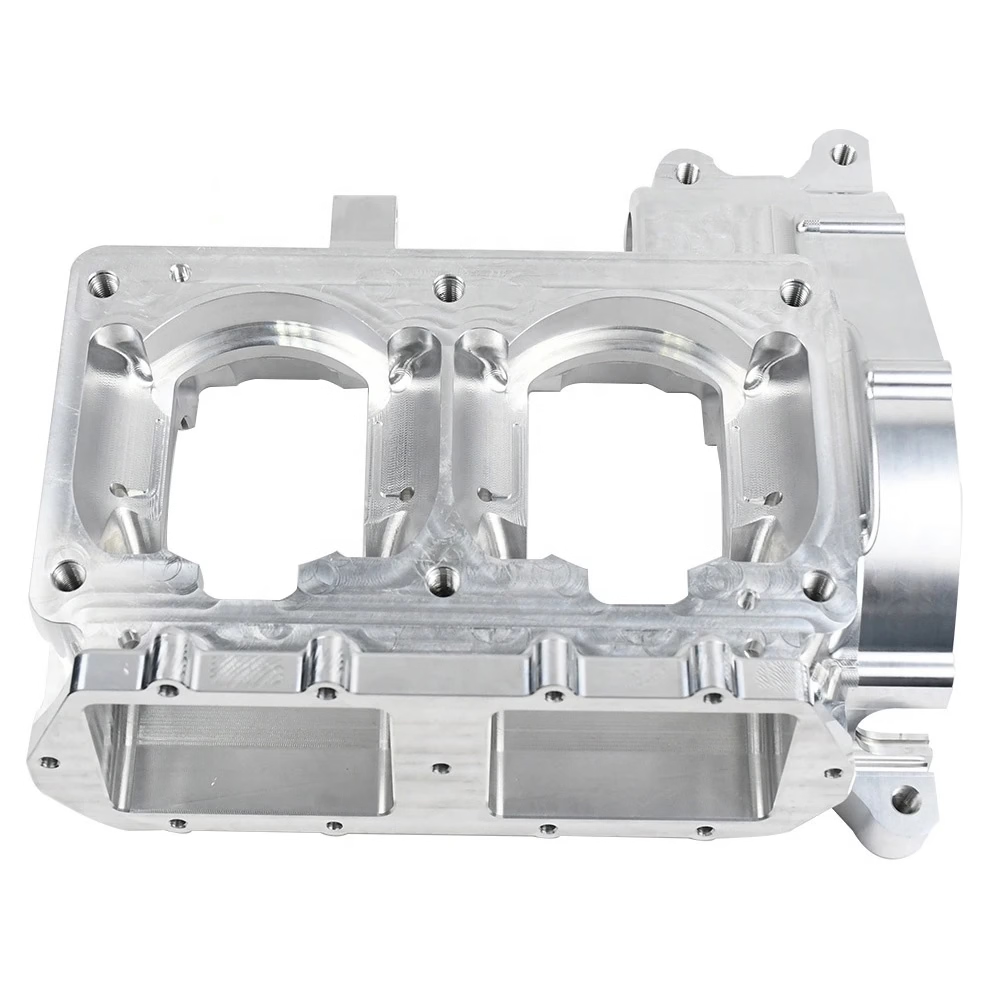
In this article
- 1
- 2
- 3
- 4
- 5
- 6
What a CNC phone box actually has to do
A phone box holds three jobs at once. It carries the display and battery, it moves heat away from the board, and it lets radio waves in and out. A machined box solves all three through geometry rather than through added parts. The screen sits in a pocket cut to ±0.005 mm, the battery sits in a second pocket, and the remaining web between them becomes the stiffener.
That web is where CNC phone box design gets interesting. Take too much material out and the box flexes under thumb pressure. Leave too much and the phone feels heavy and runs hot. Most production enclosures land between 0.8 mm and 1.5 mm on the outer wall, with a thicker boss around each screw hole.
The material does not just sit there. Aluminium 6061-T6 at 1 mm wall gives roughly the stiffness of 2 mm ABS at half the weight, which is why metal boxes dominate the premium tier. Plastics such as PC or PEEK appear when the design needs radio transparency or when the run is small and the buyer wants a cheaper blank.
- 1Pocket depthKeep at least 1.5× the cutter diameter in the corner radius to avoid chatter.
- 2Corner radiusA 3 mm end mill leaves a 1.5 mm corner. Sharper corners need EDM or a smaller tool.
- 3Boss heightScrew bosses should reach the mating face so the load path is short.
Why phone boxes suit 3-axis and 5-axis milling
A phone box is a prismatic part. Its main pockets are parallel to one face, so a 3-axis machine can cut most of it in two setups. Rough the cavity, flip the block, rough the back, then finish both sides. On a 600 × 600 × 600 mm travel machine, several boxes can be nested in one billet and cut in the same cycle.
Curved sides and blended corners change the plan. A 5-axis center tilts the tool so the flank of the end mill follows the curve instead of stepping down it. That removes the stair-stepping you get from a ball nose tool and cuts polishing time. The rotary table on our five-axis centers is Ø400 mm, which covers a phone box many times over.
Thin walls are the real test. A 1 mm wall on a 100 mm long side will ring if the finishing pass is too aggressive. We take lighter radial cuts, keep the tool flute count high, and support the wall from the inside with a wax or low-melt fixture when the geometry allows. This is a process decision, not a machine limitation.
- 13-axisFlat-backed boxes, speaker grilles, screw bosses, simple chamfers.
- 24-axisBoxes with features on three or four sides, cut with the part indexed.
- 35-axisCurved rails, blended corners, and angled camera openings.
Alloy choice changes the wall, the finish, and the antenna
Aluminium 6061-T6 is the default for machined phone boxes. It machines fast, anodizes cleanly, and holds a 1 mm wall without distortion. Grade 7075 is stronger but anodizes to a darker, less uniform color, so it usually stays unpainted or gets a hardcoat. 5052 and 5083 bend well if part of the enclosure is formed rather than cut.
Stainless 304 and 17-4PH give a heavier feel and better scratch resistance. The trade-off is cycle time. 304 work-hardens under the cutter, so feeds and speeds need to be set to stay in the cut. 17-4PH in the H900 condition reaches high strength after aging, which matters if the box doubles as a structural frame.
Titanium TC4 (Ti-6Al-4V) is the lightest strong option but conducts heat poorly and cuts slowly. It suits small runs and premium products where the material story is part of the sale. Plastics such as PC, POM, and PEEK are cut when the design needs an insulating or RF-transparent section. Carbon fibre is possible but leaves abrasive dust, so it runs on dedicated tooling.
- 16061-T6General purpose. Good finish, good anodizing, 1 mm walls.
- 27075-T6Higher strength. Hardcoat anodize, darker color shift.
- 317-4PHStainless with high strength after aging. Slower to cut.
- 4TC4Light and strong. Slow cutting, poor heat transfer.
When CNC phone box design is the wrong process
Machining wins on small and medium runs, on tight tolerances, and on shapes that need to be one piece. It loses when the part is a thin shell with no internal structure. A 0.4 mm wall across a 150 mm face will chatter no matter how the tool is set, and the cost per part stays high because cycle time does not drop with volume.
Die casting and vacuum casting take over above roughly a few thousand identical units. The tooling cost is real, but the per-part cycle is seconds rather than minutes. A cast box then gets a light CNC pass on the mating faces, the screen pocket, and the screw threads. That hybrid route is common for consumer electronics.
3D printing sits in the middle. It is useful for fit checks and for boxes with internal channels that milling cannot reach. It does not match the surface finish or the tolerance of a machined face, so a printed prototype usually leads to a machined pilot run before tooling is cut.
- 1Choose CNC whenRun is under a few thousand, tolerance is tight, or the shape is one piece.
- 2Choose casting whenThe design is stable and the volume justifies tooling.
- 3Choose printing whenYou need internal channels or a fast fit check.
Finishing and marking decisions that affect the drawing
Anodizing adds 5–25 μm of oxide depending on the type. Clear anodize grows about 5–10 μm per surface, and hardcoat can reach 25 μm. That growth changes the screen pocket. If the pocket is cut to the final size before anodizing, the coating will close it down. We cut the pocket oversize by the coating thickness and let the anodize bring it back to nominal.
Laser marking needs room. Minimum character height is 1.5 mm, and the mark should sit on a flat or gently curved face. Engraving into an anodized surface exposes bare aluminium, which reads as a light mark on a dark background. That is often the desired look, but it must be called out because it changes corrosion behavior at the mark.
Bead blasting before anodizing gives a matte, even surface. Brushing leaves visible directional lines, so it suits boxes with straight rails. Polishing to Ra 0.2–0.8 μm is possible but adds hand work, and it shows every fingerprint. Powder coating is thicker than anodize and can bridge small features, so avoid it on fine speaker holes.
- 1Clear anodizeAdds 5–10 μm per surface. Adjust pockets before coating.
- 2HardcoatUp to 25 μm. Dimensional allowance matters more.
- 3Laser marking1.5 mm minimum character height. Flat face preferred.
Process comparison for phone box enclosures
Pick the route that matches volume, wall thickness, and finish target.
| Process | Best volume | Wall range | Finish as cut |
|---|---|---|---|
| 3-axis CNC | 1–2,000 | 1.0–3.0 mm | Ra 1.6–3.2 μm |
| 5-axis CNC | 1–2,000 | 0.8–2.5 mm | Ra 0.8–1.6 μm |
| Die casting | 5,000+ | 0.8–2.0 mm | Ra 3.2–6.3 μm |
| Vacuum casting | 50–500 | 1.0–3.0 mm | Ra 1.6–3.2 μm |
| 3D printing | 1–50 | 0.6–2.0 mm | Ra 6.3–12 μm |
| Sheet metal | 100–10,000 | 0.5–2.0 mm | Ra 0.8–1.6 μm |
The verdict on process choice
If the box is one piece with tight pockets and the run is under a few thousand, machine it. If the design is stable and the volume is in the thousands, cast it and machine only the critical faces. Do not machine a thin shell just to avoid tooling cost.
Questions engineers ask before quoting
How thin can a machined phone box wall be?
With aluminium 6061-T6 we hold 1.0 mm walls on a 100 mm length as a normal job, and 0.8 mm with extra support and lighter finishing passes. Below 0.6 mm the wall deflects under cutting force and the risk of a scrapped part rises fast.
Stainless and titanium need a thicker minimum because they push back harder on the tool. For those, plan on 1.2 mm and up unless the box is short.
Do I need 5-axis, or is 3-axis enough?
If every pocket is parallel to one of two faces and the outer profile is straight, 3-axis is enough and cheaper. You pay for two setups plus a flip.
Choose 5-axis when the sides are curved, when a camera opening is angled, or when you want the tool flank to follow a blended corner. That removes hand polishing and holds the blend to ±0.005 mm.
How does anodizing change the fit of the screen pocket?
The oxide grows outward from the aluminium surface, so a clear anodize adds roughly 5–10 μm per coated face. A pocket cut to nominal will end up tight by twice that amount once both sides are coated.
We cut the pocket oversize by the coating thickness on the drawing. Tell us the anodize type and target thickness and we set the allowance.
Will a metal box block the antenna?
A fully closed metal box shields RF. Real designs leave a plastic or glass window, a slot, or a thin non-conductive section where the antenna sits. That window is usually a separate insert bonded or overmolded into the machined frame.
If the antenna layout is not fixed yet, machine the frame with a generous opening and finalize the window material after RF testing. Changing a window later is cheaper than re-cutting a solid wall.
What surface finish can I expect straight off the machine?
Standard milling leaves Ra 1.6–3.2 μm. A finer finishing pass on a five-axis center reaches Ra 0.8–1.6 μm, which is close to a bead-blasted look once anodized.
Mirror finishes at Ra 0.2–0.8 μm need polishing after machining. That adds cost and is best reserved for exposed faces.
Can you run one prototype and then a small batch?
Yes. There is no minimum order quantity, so a single prototype and a 500-piece run use the same process and the same inspection routine. The difference is setup amortization, not capability.
Uploads are handled as confidential, and an NDA is available on request if the design is not public yet.
Send a phone box drawing and get a DFM review
We review wall thickness, corner radii, and coating allowance before quoting, so the first part you hold is the one you drew.
12-hour quoteFree DFM analysis100% inspection
More machining notes
We publish setup notes, tooling trials and inspection data from the factory floor.











