
CNC Machining Shops Near Me: How to Judge a Supplier
Most buyers searching for CNC machining shops near me are really asking one question: can this shop hold my tolerance, hit my date, and keep my drawing confidential? This guide gives engineers and purchasing teams a short list of checks, in the order they matter.
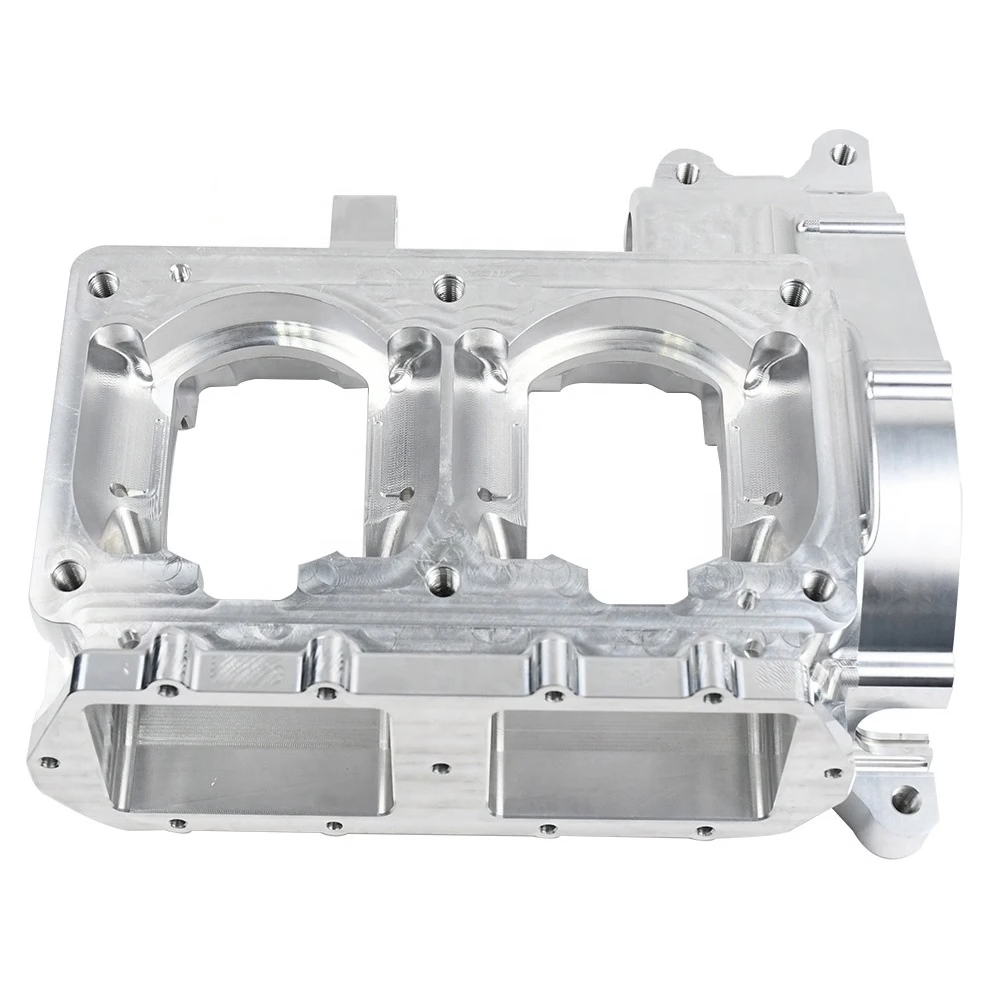
In this article
- 1
- 2
- 3
- 4
- 5
- 6
- 7
- 8
- 9
What actually separates one shop from another
Which supplier profile fits your project
Pick the row that matches your part, not the shop with the biggest machine list.
| Your situation | What to look for | What to avoid |
|---|---|---|
| One prototype, tight geometry | No MOQ, DFM feedback, 3-axis or 5-axis access | Shops quoting only at 100+ pieces |
| ±0.005 mm functional features | Stated tolerance range plus inspection reports | Tolerance claims with no measurement plan |
| Automotive or EV parts | IATF 16949:2016 in scope | Generic ISO 9001 only |
| Medical device components | ISO 13485:2016 plus material traceability | No clean handling or lot control |
| Large frames, up to 4,000 mm | 4,000 × 400 × 150 mm travel available | Shops that sub the part out |
| Confidential or export-controlled work | ISO 27001:2022 and NDA on request | Uploads going to a public email box |
| Runs from 1 to 10,000+ parts | 127 machines across 3 plants | Single-machine shops with no backup |
Pick the shop that answers technical questions first
If a supplier can tell you which machine runs your part, how many setups it needs, and which dimensions get inspected, the price comparison is worth having. If not, keep looking.
What cnc machining shops near me can actually hold
Tolerance is the first filter, and it is the one most often misread. A shop advertising ±0.005 mm is describing its best case on a stable feature with a rigid setup. That number does not apply to a 600 mm thin-wall aluminum frame in one pass. When you compare quotes, ask for the tolerance on the specific dimensions that matter to your assembly, not a blanket figure for the whole drawing.
GreatLight works to ±0.005 mm (±0.0002 in) on qualified features, with surface finishes from Ra 0.2–0.8 μm for sealing faces up to Ra 1.6–3.2 μm as-machined for brackets and covers. The useful question is where on your part each band applies. A bearing bore and a cosmetic outer edge do not need the same callout, and paying for both is the most common way prototype budgets drift.
Machine count is a proxy for capability, not a guarantee. A shop with 16 simultaneous 5-axis machining centers, 12 four-axis mills, 27 three-axis machines and 16 mill-turn centers can choose the process that fits your geometry. That matters because a part with features on five faces may need three fixtures on a 3-axis machine, and each re-fixture adds stack-up error and labor.
- 1Ask for the machineWhich model and axis count will run my part?
- 2Ask for the setupHow many fixtures, and where are the datums?
- 3Ask for the reportWhich dimensions get measured and recorded?
Lead time, quote speed and what sits behind them
Quote speed is a real signal. A shop that returns a quotation and a free DFM analysis within 12 hours has already reviewed your model. A shop that returns a number with no comments usually has not. The DFM note is where you learn that a 1.5 mm internal corner needs a 3 mm cutter, or that a tapped hole sits too close to a wall.
Production timing follows the same pattern. When drawings and material are confirmed, production can start within 24 hours, and parts ship in 3–5 days for the work we quote on that basis. GreatLight reports a historical late-delivery probability below 2%, which is a record, not a promise for your specific order. Treat any shop's date as a planning input and confirm it against your assembly schedule.
Be careful with shops that quote a fast date and then discover the material is not in stock. For 6061-T6, 17-4PH or Ti-6Al-4V, availability drives the schedule more than spindle time. If your part uses a less common grade such as Inconel or magnesium AZ31B, ask when the stock is confirmed, not when the machine is free.
Certifications, traceability and confidentiality
Certifications tell you which risks the shop has already built a system around. ISO 9001:2015 covers general quality management. IATF 16949:2016 adds automotive-specific controls such as PPAP discipline and change management. ISO 13485:2016 covers medical device manufacturing. ISO 27001:2022 covers information security, which is the one most buyers forget to check.
If your drawings carry a customer name, an unreleased product, or export-sensitive geometry, information security is not optional. Ask how files are stored, who can open them, and whether an NDA is available before you upload. GreatLight states that uploads are secure and confidential and provides an NDA on request.
Traceability matters when a part fails in the field. Raw material check, in-process monitoring and final inspection with 100% inspection before shipment give you a chain from stock certificate to finished part. Reports are available on request. A 99.99% qualification rate is only meaningful if you can see the inspection record behind it, so request a sample report before the first order, not after.
- 1ISO 9001:2015Baseline quality management system
- 2IATF 16949:2016Automotive and EV programs
- 3ISO 13485:2016Medical device components
- 4ISO 27001:2022File handling and data security
Materials and finishes: where quotes diverge
Two shops can quote the same drawing 40% apart because they planned different materials or finishes. Aluminum 6061-T6 is the default for machined housings and fixtures. 7075 gives higher strength for aerospace brackets but machines slower and costs more. 304 stainless is common for food and medical hardware, while 17-4PH is chosen when you need strength plus corrosion resistance after heat treatment.
Finishes change both cost and lead time, so specify them early. Anodizing comes in clear, color, hardcoat and conductive types, and hardcoat adds a dimensional build-up on tight bores. Electroless nickel, zinc, silver and gold plating serve different conductivity and wear needs. Powder coating and black oxide are cosmetic or corrosion barriers. Bead blasting, tumbling, brushing and polishing change surface texture without changing dimensions much.
Laser marking and engraving have a practical limit: minimum character height 1.5 mm. If your part number or serial scheme needs smaller text, plan for a different marking method. When a shop flags this before cutting metal, it is a sign the DFM review was real.
Order size, capacity and who owns the risk
A shop with no minimum order quantity is set up for both ends of the range. One prototype and a 10,000+ part run can sit on the same floor when capacity is spread across 127 high-precision CNC machines in three wholly-owned plants covering 7,600 m². That structure also matters when your program ramps: the same supplier can move from prototype to production without a second qualification.
Size limits decide feasibility before price. A 4,000 mm maximum processing size with 4,000 × 400 × 150 mm travel handles long frames and rails. Medium work fits 750 × 1,150 × 550 mm and 600 × 600 × 600 mm envelopes. Compact parts run on 500 × 500 × 450 mm and 500 × 310 × 200 mm machines, with a Ø400 mm rotary table for round features. Send the envelope early; it eliminates shops faster than any price comparison.
Ask who owns the risk when something goes wrong. A supplier with in-house finishing and inspection controls more of the schedule than one that subcontracts anodizing and heat treatment. Subcontracting is not disqualifying, but it adds days and handoffs you should see in the plan.
How to compare quotes without getting fooled
Line up the quotes side by side and check what each one includes. Material grade and temper, tolerance band per feature, finish type and thickness, inspection level, packaging, and whether tooling or programming is charged separately. A low price that excludes hardcoat anodizing is not a low price.
Ask for the assumptions in writing. If a quote says ±0.05 mm when your drawing says ±0.01 mm, that is a different part. If it lists 6061 instead of 7075, the strength is different. These mismatches are usually honest planning errors, and they are cheap to fix before cutting starts.
Finally, test communication with a small order. A shop that answers technical questions clearly on a one-piece job will usually behave the same way on a 5,000-piece release. GreatLight was founded in 2011 and now runs 150 technicians across its plants in Dongguan and Singapore, so there is a real engineering team behind the quote, not a reseller.
A short sourcing sequence that saves weeks
Run these in order. Each step removes suppliers before you spend time on price.
- 1Fix your envelope and critical featuresList overall size, the dimensions that carry function, and any thin walls under 2 mm. This alone filters out shops without the right travel.
- 2Set a tolerance band per featureReserve ±0.005 mm for mating and bearing surfaces. Leave cosmetic and clearance features at ±0.1 mm or looser to control cost.
- 3Send the model for DFM reviewExpect notes on corner radii, tool reach, and tapped hole depth. A 12-hour quote with comments is the target.
- 4Confirm material grade and stockState temper and condition, for example 6061-T6 or 17-4PH. Ask when the stock is confirmed, not just when the machine is free.
- 5Specify finish and maskingName the finish type and thickness. Note which bores and threads must stay free of coating build-up.
- 6Agree on inspection and reportsDecide which dimensions get recorded and request the report format before the run, not after.
- 7Place a small first orderRun one or two pieces to verify fit, finish and paperwork. Scale to 10,000+ only after the report matches the drawing.
Questions buyers ask before the first order
How close is a shop to me, and does distance matter?
Distance affects freight time and the cost of a plant visit, not machining quality. For most machined parts, the engineering review and inspection record matter more than the drive.
GreatLight operates from Dongguan, China and a Singapore facility at No.3 Joo Koon Circle, Singapore 629032, and ships worldwide.
What is the smallest order you accept?
There is no minimum order quantity. Work ranges from a single prototype to 10,000+ part runs on the same floor.
For first articles, one or two pieces is a normal starting point.
How fast can I get a quote and then parts?
Quotation and free DFM analysis come back within 12 hours. Production can start within 24 hours once drawings and material are confirmed.
Parts ship in 3–5 days on that basis. The historical late-delivery probability is below 2%.
Which tolerances and finishes can you hold?
Tolerance is ±0.005 mm (±0.0002 in) on qualified features. Finishes run Ra 0.2–0.8 μm for fine surfaces and Ra 1.6–3.2 μm as-machined.
Available finishes include anodizing, electroless nickel, zinc, silver and gold plating, powder coating, black oxide, bead blasting, tumbling, brushing and polishing.
Are my drawings kept confidential?
Uploads are handled as secure and confidential, and an NDA is available on request.
ISO 27001:2022 covers information security, alongside ISO 9001:2015, IATF 16949:2016 and ISO 13485:2016 for quality scope.
What should I check before scaling to production?
Confirm the inspection report matches your drawing, verify material certificates, and check that finish thickness did not close a critical bore.
After that, a ramp to 10,000+ parts is a capacity question, not a re-qualification.
Send your drawing and get a reviewed quote
Upload a STEP file and we will return a quotation with DFM notes, tolerance feedback and a production window.
12-hour quote100% inspectionNo MOQNDA on request
More from GreatLight
We publish setup notes, tooling trials and inspection data from the factory floor.











