
CNC Machining RI: What Rhode Island Shops Can and Cannot Do
A practical read for engineers and buyers comparing Rhode Island machine shops with overseas suppliers. We cover the process basics, the tolerance and size limits that decide the quote, and the point where a local shop stops being the right answer.
In this article
- 1
- 2
- 3
- 4
- 5
- 6
- 7
How CNC Machining Turns a CAD File Into a Part
CNC machining RI work starts with a solid model. The shop imports it, builds a toolpath, and posts code the machine controller can run. Everything that follows, tolerance, finish, cost, depends on decisions made in that first hour. Get the setup wrong and no amount of machine time will fix the part.
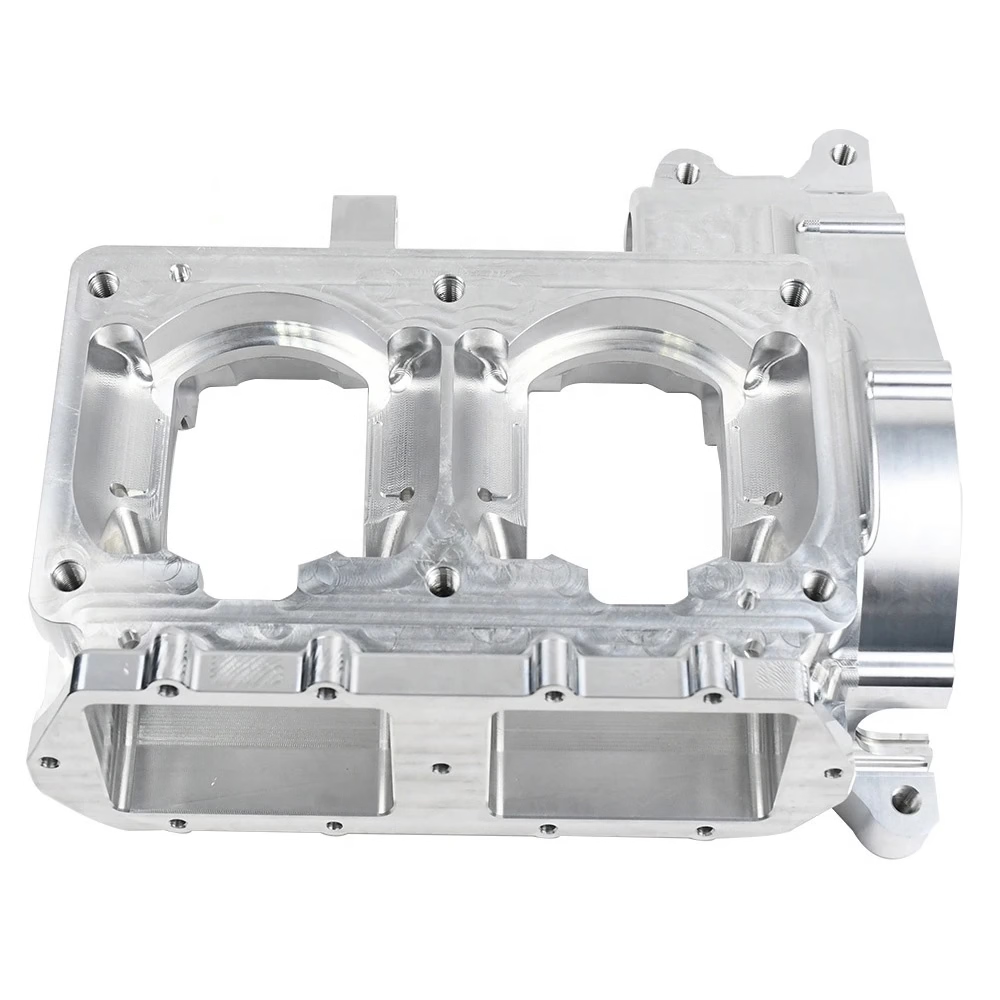
A three-axis mill moves the cutter in X, Y and Z while the part stays clamped. That covers most prismatic CNC machining RI work: plates, housings, brackets, manifolds. Add a fourth axis and the part rotates about one axis, so you can machine four sides without re-fixturing. A fifth axis tilts the tool or the table, which lets a ball-nose cutter reach undercuts and blended surfaces in a single setup.
Turning is different. The part spins, the tool stays mostly still, and you get round features with tight concentricity. Mill-turn centers combine both on one platform, which is why they handle valve bodies and hydraulic fittings that would need three separate operations otherwise.
The controller never sees your intent. It only sees coordinates. If the model has a 0.05 mm mismatch between two surfaces, the machine will cut that mismatch faithfully. This is why DFM review before cutting saves more money than any toolpath trick afterward.
What the Rhode Island Manufacturing Base Actually Offers
Rhode Island's machining base grew out of jewelry, textiles and later submarine and defense work. That history left a dense cluster of small shops around Providence, Cranston, Warwick and Pawtucket. Many of them are strong on small turned parts, tooling, and short-run work for local OEMs.
The same history explains the limits. Most shops in the state run three-axis mills and CNC lathes. Simultaneous five-axis capacity is thinner, and the shops that have it are usually booked around aerospace or defense schedules. If your part needs five-sided access in one setup, the local shortlist gets short fast.
Labor is skilled but not cheap, and it is aging. A Rhode Island shop quoting a 500-piece run carries a higher burden rate than a shop in Dongguan or Singapore. That gap shows up mostly in labor-heavy operations: deburring, inspection, secondary finishing, assembly.
None of this makes Rhode Island a bad choice. It makes it a specific choice. Match the shop to the part instead of assuming local always wins on total cost.
Tolerance, Surface Finish and What Drives the Price
Tolerance is a cost curve, not a checkbox. A part held to ±0.13 mm is cheap. Push to ±0.025 mm and you add fixturing, slower feeds, and more inspection. At ±0.005 mm, thermal drift and tool wear start to matter, so the shop needs temperature control and in-process probing.
Surface finish moves the same way. As-machined aluminum lands around Ra 1.6–3.2 μm. A clean high-speed pass gets Ra 0.8–1.6 μm. Below that you are usually looking at polishing or a coated insert, and the cycle time climbs.
Material choice changes everything downstream. 6061-T6 cuts fast and holds tolerance well. 304 stainless work-hardens, so the toolpath has to keep engagement constant. Ti-6Al-4V runs hot and slow. Inconel will eat a cheap end mill in minutes.
Here is the rule we use: specify the tolerance the assembly needs, not the tightest number the drawing allows. Every extra decimal place is paid for twice, once at the machine and once at inspection.
Why Setup Counts Decide the Real Unit Price
On a 100-piece order, setup can be 30 percent of the cost. Each new orientation means a new fixture, a new datum check, and a new first-article inspection. Reducing the number of setups lowers the price faster than speeding up the spindle.
This is the strongest argument for five-axis work on complex geometry. A part that needs five orientations on a three-axis mill becomes one setup on a five-axis center. Datum stack-up disappears. So does the risk of a re-clamp error that only shows up at final inspection.
Fixturing also decides whether thin walls survive. A 1 mm aluminum wall will deflect under clamping pressure. Soft jaws, vacuum plates, or sacrificial tabs hold the part without squeezing it out of tolerance.
If you cannot say how many setups your part needs, the quote you get back is a guess. Ask the shop to list the operations. A good one will.
Inspection, Documentation and Certificates
A certificate does not measure a part. It describes a system. ISO 9001:2015 covers general quality management. IATF 16949:2016 is the automotive standard. ISO 13485:2016 applies to medical devices. ISO 27001:2022 covers information security, which matters when you upload proprietary CAD.
What actually protects your parts is inspection coverage. Raw material check on receipt, in-process monitoring during the run, and final inspection before shipment. With 100% inspection before shipment, dimensional reports come on request.
Ask which instruments are used and how often they are calibrated. A CMM report with no calibration trace is a printout, not evidence.
For regulated programs, get the documentation scope in writing before the first chip is cut. Adding paperwork after the run is expensive and sometimes impossible.
How to Decide Between a Local Shop and an Overseas Partner
Start with the part, not the map. Small quantities of simple prismatic parts with a domestic assembly deadline usually belong at a local Rhode Island shop. You can drive over, look at the first article, and fix a problem the same day.
Move offshore when the geometry gets complex, the tolerance gets tight, or the volume gets large. A five-axis part with blended surfaces is cheaper to run where the machines exist and are not booked out for months. Quotes come back within 12 hours with a free DFM analysis, and production can start within 24 hours of approval.
Watch the hidden costs. Freight, duties, and travel time all land on your schedule. Parts ship in 3–5 days from our plants, but a change to the design mid-run still costs you a week. Freeze the drawing before you release the order.
Confidentiality is a real concern for many buyers. Uploads are handled as secure and confidential, and an NDA is available on request. If your program needs one, ask early rather than after the files are sent.
The honest answer for most teams is a split. Keep prototypes and emergency spares local. Send the production volumes and the hard geometry to a partner with the capacity and the process control to run them.
CNC Machining RI vs Overseas Sourcing: Where Each One Fits
Match the row to your part, not to a preference.
| Factor | Rhode Island shop | Overseas partner |
|---|---|---|
| Typical tolerance | ±0.013 mm on well-fixtured work | ±0.005 mm (0.0002 in) achievable |
| Five-axis capacity | Limited, often booked out | 16 simultaneous 5-axis centers |
| Max part size | Varies; large work is rare | Up to 4,000 mm |
| Setup cost per revision | High, hourly engineering rate | Absorbed into DFM review |
| Best run size | 1 to a few hundred pieces | 1 pc to 10,000+ pieces |
| Freight and customs | Domestic, none | Adds days, needs paperwork |
| Schedule control | Same time zone, easy visits | Fixed milestones, photo reports |
| Finishing in house | Often subcontracted locally | Anodize, plate, coat in one flow |
The Verdict
If you need a same-day first article and a short drive to the shop, pick a local Rhode Island supplier. If you need ±0.005 mm on complex geometry at volume, send the file to a partner with 16 five-axis centers and full finishing in house.
Questions Engineers Ask About CNC Machining RI
Is CNC machining in Rhode Island more expensive than overseas?
For labor-heavy operations, yes. Deburring, inspection and secondary finishing carry a higher hourly burden in Rhode Island than in Dongguan or Singapore.
For a single prototype that needs a same-day fix, the local premium is often cheaper than a week of shipping delay. Compare total landed cost, not the quote line.
What tolerance should I put on a drawing for a Rhode Island shop?
Use the loosest tolerance the assembly will accept. Most Rhode Island shops hold ±0.013 mm comfortably on well-fixtured work.
Below ±0.005 mm you should expect a conversation about temperature control, probing, and cost, wherever the shop is located.
Can a Rhode Island shop handle five-axis work?
Some can, but simultaneous five-axis capacity in the state is limited and often committed to aerospace or defense schedules.
If your part has undercuts or blended surfaces that need five-sided access in one setup, ask about machine availability before you ask about price.
How do I protect my design when sourcing overseas?
Ask for an NDA before you send files, and confirm how uploads are stored and who can open them.
An information security certificate such as ISO 27001:2022 tells you the supplier has a documented process for handling customer data.
What is the largest part a CNC shop can machine?
It depends on the machine envelope, not the shop's marketing. Our largest travel is 4,000 × 400 × 150 mm.
Medium platforms cover 750 × 1,150 × 550 mm, and compact cells handle 500 × 500 × 450 mm. Match the envelope to your bounding box plus clamping room.
Do I need a different supplier for finishing?
Not necessarily. Anodizing, plating, powder coating, black oxide, bead blasting and laser marking can all run in the same production flow.
If finishing is subcontracted, add the transit time to your schedule and confirm who owns the part if a coating batch fails.
Send Your Drawing, Get a Quote in 12 Hours
Upload a STEP file and we return pricing, a free DFM analysis, and a setup plan. No minimum order quantity, from one prototype to 10,000+ parts.
12-hour quote100% inspectionNDA on request
More From the Shop Floor
We publish setup notes, tooling trials and inspection data from the factory floor.











