
CNC Machining Parts Purchase Guide
This cnc machining parts purchase guide explains what actually determines the price, lead time and fit of a machined component. It is written for design and sourcing engineers who send drawings out for quote and need to compare offers on the same basis.
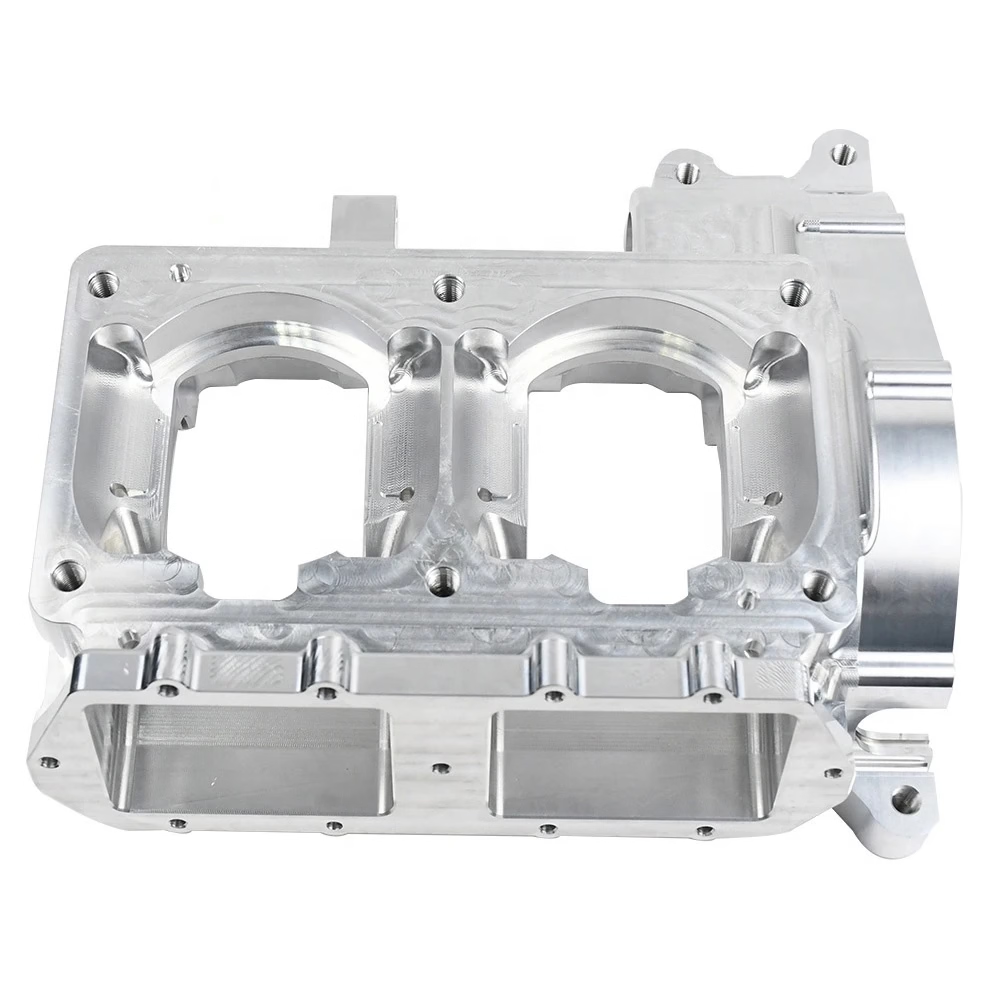
What the quote is really pricing
A CNC quote is not a price for a shape. It is a price for a sequence of operations: fixturing, roughing, semi-finishing, finishing, inspection and any secondary process. Two suppliers can look at the same drawing and quote very different numbers because they count those steps differently. When you compare offers, ask which operations each one includes rather than which total is lower.
The single biggest cost driver is how many setups the part needs. A part that can be reached from five faces in one setup on a 5-axis center costs far less than the same geometry split across four fixtures on a 3-axis machine. Every extra setup adds a re-clamp, a new datum, and a fresh chance for the part to move. That is why setup count, not cycle time, is usually the first thing a process engineer looks at.
Material is the second driver. Aluminium 6061 machines roughly three times faster than 316 stainless at the same tolerance, and titanium is slower again. Material also changes tooling: 7075 and Ti-6Al-4V wear carbide faster, so tool cost per part climbs. A quote that lists only the blank price hides this. Ask for the material grade, the stock form, and whether the price assumes bar, plate or casting.
Tolerance is the third driver, and it is not linear. Going from ±0.05 mm to ±0.005 mm does not add a few percent; it can double the price, because it forces slower feeds, more finishing passes, temperature control and tighter inspection. Define tolerance only where the function needs it. Blanket tolerances on every dimension are the most common reason a simple bracket comes back expensive.
Finally, quantity sets the amortization. A first article needs programming, a fixture and a setup that a 10,000-piece run spreads across thousands of units. Buyers often ask for a low-volume price and a high-volume price at the same time, which is the right move: it shows how much of the quote is one-time cost versus repeat cost.
Choosing the process before the supplier
Most machined parts fall into one of four routes: 3-axis milling, 4-axis milling, 5-axis simultaneous machining, or mill-turn. Picking the route first makes supplier comparison much easier, because you are then comparing capability instead of brand. A flat plate with holes on one face belongs on a 3-axis machine. A shaft with cross holes and flats belongs on a mill-turn center.
Parts with undercuts, deep cavities or features on angled faces are where 5-axis pays off. Instead of building a custom fixture to tilt the part, the machine tilts the tool. That removes setups and improves positional accuracy between features. It also shortens the path from CAD to metal, because less work goes into fixture design. GreatLight runs 16 simultaneous 5-axis machining centers alongside 27 three-axis machines, so the route can be matched to the geometry rather than forced into one machine type.
There is a limit to this. Five-axis machining does not fix a bad design. Thin walls that deflect under cutting force will still deflect, whether the tool approaches from three axes or five. Deep pockets with a small corner radius still need a small tool, and small tools break. If a pocket has a 2 mm corner radius and is 40 mm deep, no machine choice will make that cheap. Change the corner radius and the price drops.
For turned parts, the split between a lathe with live tooling and a separate mill is worth checking early. Mill-turn centers keep concentricity between the turned diameter and milled features in one clamping. Doing the same job as two operations adds a re-chuck, and re-chucking is where runout appears. If the drawing calls for 0.01 mm concentricity, that decision is already made for you.
Sizes matter too. GreatLight machines parts up to 4,000 mm, with common travels of 750 × 1,150 × 550 mm and 600 × 600 × 600 mm on medium frames, and 500 × 500 × 450 mm on compact ones. If your part sits near a travel limit, say so in the RFQ. It changes which plant and which machine can run it.
How material choice moves the price
Aluminium is the default for prototypes and most enclosures, and the range is wide. 6061 and 6061-T6 cover general work, 7075 gives higher strength for stressed parts, and 2024, 5052, 5083, 6063, 6082 and ADC12 cover everything from marine plate to die-cast housings. If you have no reason to specify otherwise, 6061-T6 is usually the fastest and cheapest route to a good part.
Stainless is where quotes jump. Grades 303 and 304 machine reasonably well, 316 and 316L resist corrosion better but work-harden faster, and 17-4PH (SUS630) can be heat treated after machining for high strength. 440C and 420 are for wear surfaces. If your part only needs corrosion resistance and not strength, 303 or 304 will usually beat 316 on both price and lead time.
Steel grades 1018, 1045, 4130, 4140, 4340 and A36 behave differently under the same tool. 1018 is soft and forgiving. 4140 and 4340 are often specified pre-hardened, which means slower cutting and more tool wear but no post heat treat distortion. Decide early whether the strength comes from the alloy or from a later heat treatment, because that choice changes the process plan.
Titanium and nickel alloys are a different category. TA1, TA2, TC4 (Ti-6Al-4V), Inconel and magnesium AZ31B or AZ91D all cut slowly and generate heat at the edge. They are used when weight or temperature demands it, not as a default. Expect longer lead time and a higher unit price, and keep tolerances realistic.
Plastics such as ABS, PC, PMMA, POM, PA, PEEK, PP, HDPE and carbon fibre machine fast but move after machining. POM and PA absorb moisture and change dimension; PEEK is stable but expensive. For plastics, specify the tolerance you need after the part has settled, not while it is still warm on the table.
Finishing adds a separate step and a separate line on the quote. Anodizing (clear, colour, hardcoat, conductive), electroless nickel, zinc, silver and gold plating, powder coating, black oxide, bead blasting, tumbling, brushing and polishing are all available. Laser marking needs a minimum character height of 1.5 mm, so plan your part numbers and logos around that limit.
What to put in the RFQ package
A good RFQ package has four things: a 3D model, a 2D drawing, a material and finish callout, and a quantity. The model tells the supplier the shape. The drawing tells them what matters. If the two disagree, the drawing normally wins, so keep it current. Sending only a STEP file and expecting the supplier to guess tolerances is the fastest way to get quotes that cannot be compared.
On the drawing, mark datums and only the tolerances that carry function. A general tolerance block is fine for everything else. If a bore needs ±0.005 mm, say so and give the datum it is measured from. If a surface needs Ra 0.8–1.6 μm, name the face. Where a general callout of Ra 1.6–3.2 μm is enough, use it, because every face pushed to a finer finish adds polishing time.
Add the inspection requirement. Standard practice at GreatLight is 100% inspection before shipment, covering raw material check, in-process monitoring and final inspection, with reports on request. If your application needs a first article inspection report or a specific sampling plan, put it in the RFQ so it is priced in rather than discovered later.
Say whether the parts are prototypes or production. A prototype often benefits from a design review; production parts benefit from a fixture that pays back over the run. If you are between the two, ask for both a prototype price and a production price at the same time. It takes one extra line on the quote and tells you where the cost break sits.
Confidentiality is part of the package. Uploads are handled as secure and confidential, and an NDA is available on request. If you are working under a customer NDA yourself, mention it in the first message so the paperwork runs in parallel with the quote.
For parts with tight requirements, ask for the DFM analysis. GreatLight returns a quotation and free DFM analysis within 12 hours, which usually flags wall thickness, tool reach and tolerance conflicts before they reach the machine.
Questions that separate suppliers
Ask what the last operation is before packing. A supplier that machines, deburrs and inspects in-house controls the final condition of the part. One that outsources anodizing cannot tell you why a batch came back with a colour shift. The answer to this question usually reveals how much of the process is actually under one roof.
Ask how they hold a datum across setups. If the answer is a vise stop and a dial indicator, that is fine for ±0.05 mm work but not for ±0.005 mm. For tight work you want to hear about probing, fixture plates or single-setup machining. The tooling answer tells you more than the tolerance claim.
Ask for the qualification rate and how it is measured. A stated 99.99% qualification rate is only meaningful if you know what counts as a failure and what happens to a failed part. Good suppliers scrap and remake rather than ship and argue.
Ask about capacity in the specific machine class you need. A shop with 127 high-precision CNC machines is not automatically a fit for a 4,000 mm frame if only one machine takes that size. Match the machine, not the headline count.
Ask about certifications relevant to your industry: ISO 9001:2015 for general quality systems, IATF 16949:2016 for automotive, ISO 13485:2016 for medical devices, and ISO 27001:2022 for information security. If your product is regulated, a supplier without the matching certificate adds audit work on your side.
Ask about scheduling honestly. Production can start within 24 hours in many cases, and parts ship in 3–5 days, but that assumes a released drawing, available material and a clear finish callout. Hold-ups usually come from the RFQ package, not the machine.
Which process fits your part
Match the geometry to the route before you send the RFQ.
| Part geometry | Best route | Why | Watch out for |
|---|---|---|---|
| Flat plate, holes on one face | 3-axis milling | One setup, no rotation needed | Thin plate chatter |
| Shaft with cross holes | Mill-turn center | Concentricity held in one chucking | Live-tool reach limits |
| Features on 5 faces | 5-axis simultaneous | Fewer setups, better position | Higher hourly rate |
| Deep cavity, small radius | 3-axis or 5-axis | Tool size sets the limit | Long cycle, tool breakage |
| Large frame up to 4,000 mm | Large-travel mill | Fits in one setup | Fewer machines available |
| Tight roundness on a bore | Turning, then grinding | Grinding holds the roundness | Extra operation, extra cost |
| Prototype, 1–5 pieces | 3-axis or mill-turn | Programming spread over few parts | Setup dominates price |
The short version
If you need one complex part fast, choose 5-axis and accept the higher hourly rate. If you need thousands of simple parts, fix the design first and put it on a 3-axis or mill-turn cell where the setup is amortized. Spend your tolerance budget only on the features that carry function.
Purchase questions engineers ask
Should I send a 3D model or a 2D drawing?
Send both. The model defines the shape and gives the CAM programmer a clean surface to work from. The drawing defines what is critical: datums, tolerances, surface finish and any feature that must be inspected.
If you only have a model, the supplier has to assume a general tolerance, and that assumption will not match yours. If you only have a drawing, expect more questions and a slower quote.
How do I decide which tolerances to tighten?
Tighten a tolerance only when the function depends on it: a bearing bore, a mating face, a locating pin hole. Everything else can sit in a general tolerance block.
Going from ±0.05 mm to ±0.005 mm changes the process, not just the inspection. It usually means more finishing passes, slower feeds and sometimes temperature control, so the price step is larger than most people expect.
What is a realistic minimum order quantity?
There is no minimum order quantity at GreatLight, so a single prototype and a 10,000-piece run can both be quoted. What changes is how the cost is distributed.
On one part, programming, fixturing and setup dominate. On 10,000 parts, material and cycle time dominate. Ask for both prices and the break becomes visible.
How fast can a machined part ship?
Quotation and DFM analysis come back within 12 hours in most cases, production can start within 24 hours, and parts typically ship in 3–5 days.
Those numbers assume a released drawing, a defined material and finish, and stock availability. Missing finish callouts and unclear datums are the usual causes of delay.
Do I need an NDA before sending drawings?
If your drawings are customer-owned or under a confidentiality agreement, say so at the start. A non-disclosure agreement is available on request and uploads are handled as secure and confidential.
Signing the NDA before the RFQ goes out keeps the quote and the paperwork on the same timeline.
Can one supplier handle machining and finishing?
Yes, and it is usually the better option. Anodizing, plating, powder coating, black oxide, bead blasting, brushing, polishing and laser marking can all be scheduled as part of the same order.
When finishing is handled in one flow, the supplier owns the final appearance and the inspection that follows it. Splitting it across two vendors makes it harder to trace a defect back to its cause.
Send the drawing, get a usable answer
Upload your model and drawing for a quotation and a free DFM analysis within 12 hours. No minimum order quantity, from one prototype to 10,000+ parts.
12-hour quote±0.005 mm100% inspectionNo MOQ
More from the shop floor
We publish setup notes, tooling trials and inspection data from the factory floor.











