
CNC machining NW England: what engineers should know before quoting
This page explains how CNC machining NW England supply chains actually work: which shops fit which parts, how tolerance and finish drive cost, and what to check before releasing drawings. Written for design and sourcing engineers who need a clear decision, not a sales pitch.
In this article
- 1
- 2
- 3
- 4
- 5
- 6
- 7
Key takeaways
Why CNC machining NW England looks different from other regions
North West England built its manufacturing base on textiles, then aircraft, then automotive. That history left a dense network of subcontract machine shops, toolmakers and surface treatment houses within a short drive of each other. For a buyer, the practical effect is that a single part can move through milling, turning, heat treatment and anodizing without leaving the region.
The industrial mix also shapes what those shops are good at. Aerospace work near the Wirral and Preston pushes tight tolerances and full traceability. Automotive work around the M62 corridor pushes volume, IATF 16949 paperwork and cost per part. Medical device work pushes clean handling and ISO 13485 discipline. The same 3-axis mill can serve all three, but the surrounding process control is not the same.
That is why 'CNC machining NW England' is not one capability. It is a set of shops with different quality systems, different machine mixes and different ideas about a sensible order size. Before you shortlist anyone, decide which of those three worlds your part belongs to. The answer changes what you should ask for.
How the cutting process sets your real tolerance
CNC machining removes material with a rotating cutter against a programmed path. Accuracy comes from three things: machine rigidity, thermal stability, and how many times the part is re-fixtured. A rigid machine in a temperature-controlled room holds tighter numbers than the same machine next to a loading door.
Each re-fixture adds stack-up error. A part machined on five faces in five setups can drift 0.02–0.05 mm even when every individual cut is accurate. A 5-axis center that reaches five faces in one setup removes most of that drift, which is why complex brackets and housings often justify the higher hourly rate.
Tolerance is not free. Holding ±0.005 mm on a 300 mm aluminium housing usually means a finishing pass with light depth of cut, a dedicated fixture, and CMM verification. Loosen the callout to ±0.05 mm and the same shop can run faster feeds and skip some inspection. Both parts work. Only one is cheap.
Surface finish follows the same logic. As-machined surfaces sit around Ra 1.6–3.2 μm. A fine finish at Ra 0.2–0.8 μm needs slower feed rates, sharper tooling and often a separate finishing operation. Specify finish only on the faces that seal, slide or mate.
- 1One setup beats fiveFewer fixtures mean less stack-up error and shorter cycle time.
- 2Tight tolerances need tight roomsThermal swing of 5 °C can move a 400 mm steel part more than the tolerance itself.
- 3Finish is local, not globalCall out Ra values per face on the drawing, not as a blanket note.
Matching part geometry to 3-axis, 4-axis or 5-axis work
Most parts do not need 5-axis. A flat plate with holes, pockets and a chamfer cuts fastest on a 3-axis mill, and the programming is simple. If the part has features on four sides but no compound angles, a 4-axis mill with a rotary table handles it in two setups.
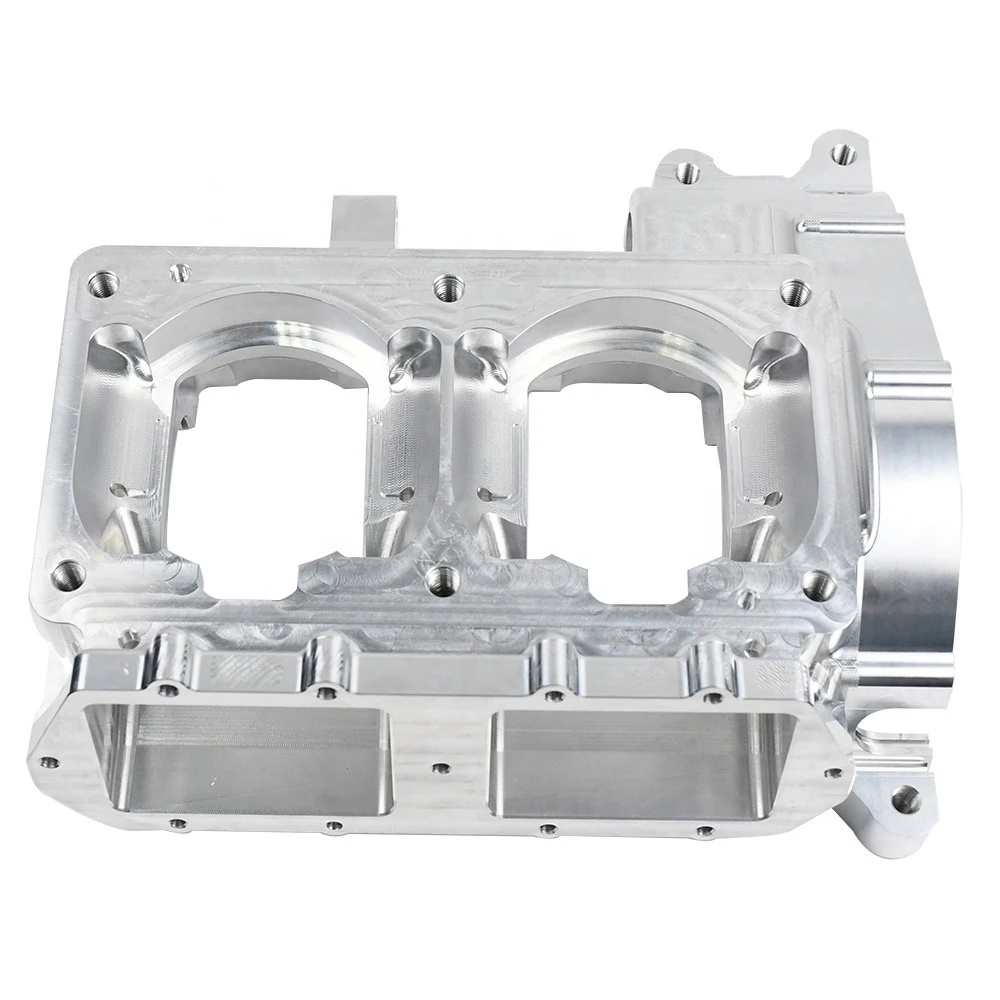
5-axis earns its cost when the part has undercuts, deep cavities, or faces that meet at odd angles. A turbine blade root, a robot arm joint, or a manifold with ports on six planes all fall into this group. Simultaneous 5-axis also lets a short, stiff tool reach deep pockets that would need a long, flexible tool on a 3-axis machine, which improves both finish and accuracy.
Size matters as much as shape. Large frames and housings need travel that most compact machines do not have. A 4,000 mm bed handles long extrusions and weldments; a 500 mm machine handles small precision components but cannot reach across a big part.
The practical decision rule: if the part fits on a 3-axis table and every feature is reachable from one direction plus one flip, do not pay for 5-axis. If you find yourself designing special fixtures just to reach a feature, the 5-axis rate is probably cheaper than the fixture.
- 1Prismatic parts3-axis, one or two setups, lowest cost per part.
- 2Four-sided features4-axis with rotary table, two setups, moderate cost.
- 3Undercuts and compound angles5-axis, one setup, highest hourly rate but shortest total time.
Material choice and what it does to machinability
Aluminium 6061 and 6082 cut fast and hold good finish, which makes them the default for brackets, housings and prototype frames. 7075 is stronger but gummier, so it needs sharper tooling and lighter cuts. If the part sees high load, 7075 is worth the extra cycle time; if it is a cover, 6061 is enough.
Stainless 303 machines cleanly and is the easiest of the austenitic grades. 304 and 316 work-harden quickly, so a light finishing pass on a hardened surface can dull a cutter in minutes. 17-4PH gives high strength after heat treatment but must be machined in the annealed state or it will fight the tool.
Titanium Ti-6Al-4V and Inconel sit at the hard end. They conduct heat poorly, so the cutting edge absorbs temperature and wears fast. Expect slower speeds, more tool changes and a higher price per cubic centimeter removed. Magnesium AZ31B machines beautifully but needs chip control because fine chips ignite.
Plastics behave differently again. POM and PEEK hold tolerance well; ABS and PP flex and can be pulled into the cutter. Carbon fibre is abrasive and wears tooling quickly. None of this is a reason to avoid a material. It is a reason to tell the shop what you picked and why.
Lead time, quantity and the paperwork that follows
Lead time in this region depends less on machining hours than on queue position and outside processes. A shop with free capacity can start a 3-axis job quickly. The same shop may wait days for anodizing or heat treatment because those houses serve everyone in the region.
Quantity changes the method. One prototype is usually cut from billet with simple workholding. A run of 10,000 parts justifies a dedicated fixture, a tooling plan and possibly a casting or forging near-net shape to reduce machining time. The crossover point is different for every part, but the logic is always the same: fixture cost divided by part count.
Certification is the hidden variable. Aerospace and medical buyers need material certificates, inspection reports and a documented traceability chain. Automotive buyers need IATF 16949 process control. A shop that holds these systems has already built the paperwork into its workflow, which is why it may quote higher than a general machine shop.
Payment terms, NDA coverage and data handling matter too. Confidential drawings should move through a controlled channel, and an NDA should be in place before detailed models are shared. Ask about this early. It is easier to set up than to retrofit.
- 1Queue time is realAsk when the machine is free, not when the shop opens your file.
- 2Outside processes add daysAnodizing, plating and heat treatment sit outside the machine shop schedule.
- 3Volume changes the methodAbove a few hundred parts, dedicated fixtures usually pay for themselves.
Choosing a CNC machining NW England supplier by part type
Use the row that matches your part, then check the supplier holds the matching quality system.
| Part type | Best machine | Typical tolerance | What to verify |
|---|---|---|---|
| Flat bracket or plate | 3-axis mill | ±0.05 mm | Fixture plan and deburring method |
| Four-sided housing | 4-axis mill | ±0.02 mm | Setup count and datum strategy |
| Undercut or angled port | 5-axis center | ±0.005 mm | Simultaneous 5-axis programming skill |
| Long extrusion or frame | Large-travel mill | ±0.05 mm | Bed length and thermal control |
| Turned shaft or fitting | Mill-turn center | ±0.01 mm | Bar feed size and concentricity check |
| Aerospace structural part | 5-axis + CMM | ±0.005 mm | AS9100-style traceability and certs |
| Automotive volume part | Mill-turn or 4-axis | ±0.02 mm | IATF 16949 process control |
The short version
If your part is prismatic and the tolerance is ±0.05 mm or looser, pick a 3-axis shop and spend the savings on finishing. If it has undercuts, compound angles or a ±0.005 mm callout, pay for 5-axis and a documented inspection plan. Choosing the wrong one costs more than either hourly rate.
Questions engineers ask before releasing drawings
How tight a tolerance can CNC machining hold on a 300 mm aluminium part?
±0.005 mm is achievable on critical features when the machine is rigid, the room is temperature-controlled and the feature is cut in a single setup. Across a 300 mm span, thermal expansion and fixture stack-up eat most of that budget.
If the feature is not a sealing or mating surface, ±0.05 mm is far cheaper and usually sufficient. Put the tight callout only where it matters.
Does a part made in NW England need a UK-based supplier?
Not necessarily. The region's advantage is its process network, not its postcode. What matters is whether the supplier can reach comparable machining, finishing and inspection capability with a schedule you can plan around.
For prototypes and small runs, many buyers compare regional shops against overseas suppliers on total landed cost, including freight and duty, rather than hourly rate alone.
What surface finish should I specify for a machined housing?
As-machined at Ra 1.6–3.2 μm is fine for non-critical exterior faces. A high finish at Ra 0.8–1.6 μm suits visible covers and sliding surfaces.
Fine finish at Ra 0.2–0.8 μm is reserved for sealing faces and precision bores. Specify it per face, not as a blanket drawing note.
When does 5-axis machining beat 3-axis on cost?
When the alternative is three or more setups, a special fixture, or a long reach tool. The 5-axis hourly rate is higher, but the total time and the scrap risk usually drop.
For simple flat parts, 3-axis wins on both cost and programming time. There is no benefit in paying for simultaneous motion you do not use.
How do I protect drawings before sending them out for quote?
Ask for an NDA before releasing detailed models, and use a supplier with a documented file-handling process. ISO 27001 certification is one signal that data controls exist.
Send 2D PDFs for the first quote round if the geometry allows it. Share full 3D models only after the confidentiality terms are signed.
What causes a machined part to fail inspection after it looked fine on the machine?
Most often it is thermal drift, a loose fixture, or a tool that wore during the run. A part measured hot on the machine can shrink below tolerance once it cools.
In-process monitoring plus a final check at 20 °C catches this. Ask the supplier what they measure, when, and with what instrument.
Send drawings, get a quote and a DFM review
Upload your files and an engineer will return pricing with a free DFM analysis, usually within 12 hours.
12-hour quoteFree DFM analysis100% inspection
More machining notes
We publish setup notes, tooling trials and inspection data from the factory floor.











