
CNC Machining Most Engineers Get Wrong: Rules That Change the Game
Five practical rules that decide whether a part comes off the machine on size, on finish and on schedule. Written for design engineers, manufacturing engineers and sourcing staff who quote machined parts every week. You will see where 5-axis pays off, where 3-axis is enough, and which tolerances actually cost money.
In this article
- 1
- 2
- 3
- 4
- 5
- 6
- 7
- 8
- 9
Key takeaways
CNC Machining Most Shops Do on Three Axes
A three-axis mill cuts along X, Y and Z with the part held in one orientation. It is fast, rigid and cheap to program. For a plate with pockets, slots and drilled holes all opening on one face, that is the correct machine. There is no reason to move the work to a five-axis center just because the center is newer.
The problem starts when features sit on four or five faces. The classic approach is a sequence of three-axis setups: cut face one, unclamp, rotate the part in the vise, re-zero, cut face two, and repeat. Each rotation brings the part back to the spindle with a small positional error. On a bracket with three datums, those errors stack.
A single five-axis setup removes that chain. The part stays clamped while the table tilts and rotates, so every face is cut from the same zero point. Datum shift between operations drops to the machine's own positioning error, which matters on hole patterns that must stay concentric.
The trade-off is real. Five-axis programming takes longer, the machine hour rate is higher, and the fixture has to clear the tilting head. When a part only needs two faces, the honest answer is that three-axis work is cheaper and just as accurate.
- 1Use three-axis whenAll critical features open on one or two faces, and depth-to-diameter ratios are moderate.
- 2Use five-axis whenHoles, pockets and faces are spread over four or more sides, or when one datum must control everything.
Where Tolerance Limits Stop Being Free
A tolerance callout is a cost instruction. ±0.005 mm on a 20 mm bore is a normal day on a good machining center with a warm spindle. The same callout on a 4,000 mm long weldment is a different job. The machine has to hold that band across a long travel, and thermal drift becomes part of the error budget.
Engineers often copy a general tolerance block onto every dimension. In practice, only a few features carry function: bearing seats, dowel holes, sealing faces, mating pilots. Those deserve a tight callout. Bolt clearance holes at H12, slot widths at ±0.1 mm and non-critical step heights do not.
Tightening an unnecessary callout does three things. It slows the cutting passes, it forces more in-process checks, and it increases the scrap risk on features that would have worked loose. We see parts where the tight dimensions are not the ones the assembly actually uses.
One practical test: ask what happens if the feature sits at the full tolerance limit. If nothing changes in the assembly, loosen it. If the part fails, keep it tight and tell the shop which dimension is the control dimension.
- 1Control dimensions firstMark the two or three features that locate the part in the assembly.
- 2Leave clearance holes looseH12 or +0.2 mm on bolt holes saves cycle time with no loss of function.
- 3Check the datum schemeA tight tolerance on a feature measured from the wrong datum cannot be inspected.
Material Choice Sets the Cutting Data
Aluminium 6061-T6 cuts at high surface speed with a good finish straight from the tool. It is the default for prototypes, brackets, housings and manifolds. 7075 gives higher strength but is less forgiving on thin walls, and it needs sharper tooling to avoid torn edges.
Stainless 303 and 304 machine well on a rigid setup. 316L and 17-4PH work-harden if the cutter rubs instead of cuts, so feeds must stay above a minimum chip load. Titanium TC4 (Ti-6Al-4V) and Inconel behave the same way but more severely: low thermal conductivity keeps heat in the cutting zone, so coolant delivery and tool life become the limiting factors.
Plastics split into two groups. POM and PA cut cleanly and hold size. PEEK holds size at temperature but is expensive, so roughing strategy matters. Carbon fibre eats carbide edges and needs diamond-coated tooling for any volume.
The part geometry should drive the material as much as the application does. A thin-wall housing in 7075 may deflect under clamping force that would not trouble a solid block of 6061. When in doubt, say which property is fixed and which one can move.
- 1Fast and clean6061-T6, 6082, brass C36000.
- 2Wear resistant17-4PH, 440C, tool steel.
- 3Light and strong7075, Ti-6Al-4V, magnesium AZ31B.
Fixturing Decides the Real Accuracy
A machine tool's accuracy specification assumes the part is held rigidly and cut without chatter. Most dimensional problems on a shop floor trace back to the fixture, not the spindle. A vise clamping a thin plate will bow it, and the part springs back when released.
For thin plates, we machine soft jaws to the part profile so the clamping load spreads across a face. For long parts, we support the overhang with adjustable jacks or a tailstock. For parts that must be cut on five sides, we leave a tab or a boss that the fixture grips and remove it in a finishing pass.
Clamping force is a number worth thinking about. A standard vise can apply several tonnes on a small area. On a 2 mm wall, that is enough to close the wall and cut it undersize. Light clamping with a stop pin often holds better than heavy clamping.
The fixture also sets the setup count. A well-designed tombstone or pallet holds several parts at once, so the spindle keeps cutting while the operator loads. That is where real cycle-time savings live, more than in spindle speed.
- 1Soft jaws for thin partsMachined to the profile, so the load spreads and the part does not bow.
- 2Support the overhangJacks or a tailstock stop the part singing during heavy passes.
- 3Palletize for volumeMultiple parts per cycle cut the non-cutting time share.
Surface Finish Is a Tool Path Decision
Ra 0.8–1.6 μm is a standard machined finish on aluminium and steel when the cutter, stepover and feed are matched. You get there with a finishing pass at small stepover, not with a slow spindle. Ra 0.2–0.8 μm needs a finer stepover, a sharp edge and often a dedicated finishing cutter.
As-machined surfaces at Ra 1.6–3.2 μm are fine for most brackets, covers and internal parts. Asking for a mirror finish on a non-visible face adds cycle time and buys nothing. If the drawing calls a fine finish, say whether it applies to the whole part or to a sealing face.
Cutter marks follow the tool path. A ball nose cutter leaves scallops; a flat end mill leaves lines along the pass direction. If the surface will be anodized, those marks show through the coating, so the direction of the finishing pass matters as much as the Ra value.
Post-processing can hide some of this. Bead blasting evens out light tool marks, tumbling softens edges on small parts, and polishing brings a local area to a low Ra. But no finishing operation fixes a dimension that was cut wrong.
- 1Ra 1.6–3.2 μmAs-machined, fine for internal and covered faces.
- 2Ra 0.8–1.6 μmStandard visible finish, one finishing pass.
- 3Ra 0.2–0.8 μmSealing and bearing faces, slower cycle.
How These Rules Play Out on Real Parts
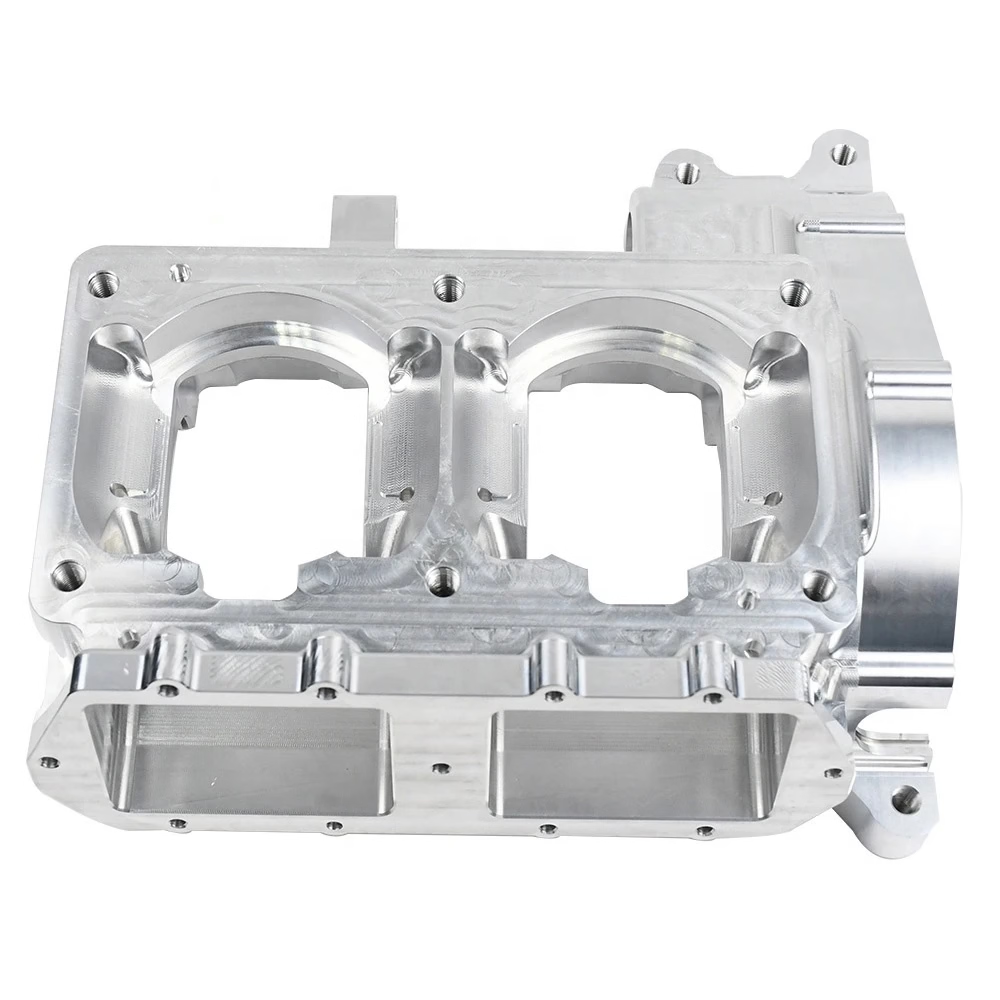
An engine mount bracket usually has bores on two planes that must stay parallel. Cut on three axes, the part is rotated between operations and the parallel error grows with each rotation. Cut on five axes, both bores come from one zero and the error stays inside the machine's positioning band.
Aerospace prototype housings often combine a deep pocket with a flange full of bolt holes on a different plane. The pocket needs a long reach tool, which deflects. The flange needs a rigid setup. Splitting these across two operations, one for each feature family, often beats trying to finish everything in a single pass.
Medical instrument bodies are typically small, 316L or titanium, with fine surface requirements on the sealing face only. The rest of the body can run at Ra 1.6–3.2 μm. Marking the sealing face on the drawing keeps the cycle time down.
Robotics and automation parts sit in the middle. Gearbox plates, sensor mounts and end-effector plates are usually flat with pockets, so three-axis work covers most of them. The arm segments with angled bores are the ones that justify five axes.
- 1Automotive and EVBrackets and housings with bores on two planes.
- 2AerospacePrototype housings with deep pockets and angled flanges.
- 3Medical devicesSmall 316L and titanium bodies with local sealing faces.
- 4Industrial machineryFlat plates with pockets and drilled patterns.
What the Shop Needs From You
A 3D model plus a 2D drawing with the control dimensions marked is the fastest path to an accurate quote. If only a model exists, we work from the model and flag any dimension that looks functional so you can confirm it before cutting starts.
Tell us the lot size and whether it can change. A single prototype and a 10,000 part run use different fixtures, different tool paths and sometimes different machines. The earlier we know the volume, the earlier we can pick the right setup.
State the material grade, not just the family. 6061 and 7075 both count as aluminium, and 304 and 316L both count as stainless, but the cutting data and the risk profile are not the same. Grade affects finish, tool life and cycle time.
Finally, list any post-processing in the same request. Anodizing, plating, laser marking and bead blasting all add steps after machining, and some of them change dimensions slightly. Keeping them in one plan avoids a part that is correct off the machine and out of spec after coating.
We hold ISO 9001:2015, IATF 16949:2016, ISO 13485:2016 and ISO 27001:2022. Every part is inspected before shipment, and reports are available on request. Uploads are handled as confidential, and an NDA is available if you need one.
- 1Model plus drawingMark the control dimensions so the shop knows which ones matter.
- 2Volume up frontPrototype and production quantities route to different setups.
- 3Full material grade6061-T6 and 7075 need different cutting data.
- 4Finishing in the same planCoating and marking can shift dimensions slightly.
Which Machining Route Fits the Part
Match the route to feature count, size and lot size.
| Part situation | Recommended route | Why | Watch out for |
|---|---|---|---|
| Features on one face | 3-axis mill | Lowest setup count and rate | Vise jaw marks on soft material |
| Features on four or five faces | 5-axis simultaneous | One datum, no re-fixturing | Fixture must clear the tilting head |
| Turned part with cross holes | Mill-turn center | Turning and milling in one setup | Bar size limits part diameter |
| Thin plate under 3 mm | 3-axis with soft jaws | Clamping load spreads over a face | Light cuts to avoid deflection |
| Prototype, one to ten parts | 3-axis or 5-axis, no MOQ | Fast changeover, no tooling cost | Hand finishing may be needed |
| Repeat runs over 1,000 parts | Palletized 5-axis or mill-turn | Non-cutting time shared across parts | Fixture cost spread over volume |
| Long part near 4,000 mm | Large-travel 5-axis | Travel fits without repositioning | Thermal drift needs monitoring |
The rule that decides the route
If the critical features sit on one or two faces, buy three-axis work and spend the savings on inspection. If one datum must control features on four or five faces, pay for the five-axis setup once instead of paying for re-fixturing five times.
Questions engineers ask before ordering
When is five-axis machining worth the higher rate?
When critical features sit on four or five faces and must share one datum. The alternative is multiple three-axis setups, and each re-fixturing step adds positional error and handling time.
If only one or two faces carry functional features, three-axis work is usually cheaper and equally accurate.
Can you hold ±0.005 mm on a large part?
We hold ±0.005 mm, and the practical limit depends on the feature size and the machine travel. A short feature on a small part behaves differently from the same tolerance across a long dimension.
On large parts we manage thermal drift and plan the inspection sequence around the temperature of the part, not just the machine.
What surface finish comes standard?
As-machined faces typically land at Ra 1.6–3.2 μm. A finishing pass brings visible faces to Ra 0.8–1.6 μm, and sealing or bearing faces can reach Ra 0.2–0.8 μm.
Tell us which faces need which finish. Applying a fine finish to the whole part adds cycle time for no functional gain.
Do you have a minimum order quantity?
No minimum order quantity. We run from one prototype up to 10,000+ part runs on the same quality process.
Small lots are quoted with the same attention to the control dimensions, because a prototype that does not fit wastes more time than a production batch.
How fast can you quote and ship?
Quotation and a free DFM analysis come back within 12 hours. Production can start within 24 hours of approval, and parts ship in 3–5 days.
Historical late-delivery probability is below 2%. If a part needs a special material or a long fixture build, we say so in the quote rather than after the order.
How do you protect our drawings?
Uploads are secure and confidential. We hold ISO 27001:2022 for information security, and an NDA is available on request before any file exchange.
Files are shared only with the engineers and machinists who need them for the job.
Send the model and the control dimensions
Upload your 3D model and drawing. You get a quotation and a free DFM analysis within 12 hours, with the machining route and the tolerance calls explained.
12-hour quoteFree DFM analysis100% inspection
More shop-floor notes
We publish setup notes, tooling trials and inspection data from the factory floor.











