
CNC Machining Malaysia: How the Supply Chain Actually Works
This page explains what CNC machining Malaysia really means for a buyer in Europe or North America: who quotes, who cuts metal, how tolerances are held, and where the model breaks down. Read it and you can tell whether a Malaysia route fits your part before you send a drawing.
In this article
- 1
- 2
- 3
- 4
- 5
- 6
What CNC Machining Malaysia Means in Practice
When an engineer searches for CNC machining Malaysia, the phrase usually describes a sourcing route, not a single machine. The drawing leaves your desk, a quotation comes back with a unit price and a lead time, and the part is cut somewhere in the Malaysian industrial belt or, more often than buyers expect, in a partner plant across the region. The route matters because it decides who controls tolerance, inspection and paperwork.
Malaysia built its machining base around electronics, semiconductor tooling, oil and gas valves, and medical device assembly. That history shapes what local shops are good at: small housings, jigs and fixtures, connector bodies, valve bodies, and mid-size aluminium parts. It also shapes what they avoid. Very large weldments and heavy hog-outs from tool steel often leave the region.
The word that matters most in a Malaysia quote is not price. It is who owns the process. If the shop quoting your part also programs, fixtures and inspects it, tolerance and delivery sit with one team. If the part is brokered to a second shop, you now own two relationships and one of them has no reason to tell you about a problem until it is expensive.
So the useful question is not whether Malaysia can machine your part. It is which parts should travel and which should not. Simple geometry in aluminium or brass, moderate size, no exotic secondary process: good fit. Complex five-axis geometry with tight callouts on five faces: only worth it if the quoting shop runs its own five-axis capacity and can show an inspection plan.
How Five-Axis Work Changes the Tolerance You Can Hold
Tolerance is not a number a shop prints on a brochure. It is the result of machine geometry, workholding, thermal behaviour and how many times the part is re-clamped. A three-axis machine holding a part in three separate setups stacks the error of each fixture. Every setup adds a datum shift that no controller can correct.
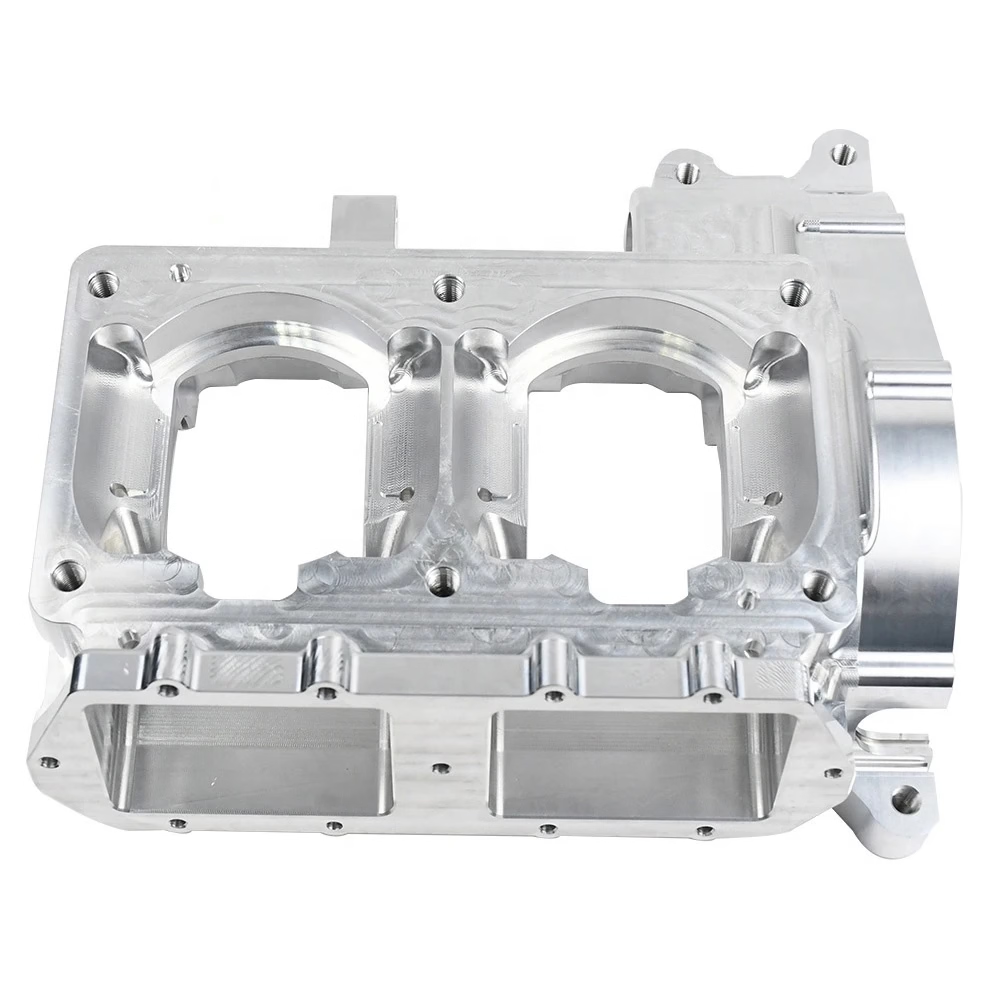
Five-axis machining removes setups rather than adding speed. With a Ø400 mm rotary table and simultaneous motion, the tool reaches five faces of a part in one clamping. Fewer setups means fewer datum shifts, which is why ±0.005 mm (±0.0002 in) becomes realistic on features that share a datum. Ten years of experience on 16 simultaneous five-axis centers teaches the same lesson: the fixture decides the tolerance before the spindle does.
Surface finish follows the same logic. A fine step-over on a ball-nose tool can reach Ra 0.2–0.8 μm on aluminium, but only where the tool can actually reach. Deep pockets, thin walls and long tool overhangs push the finish back to Ra 1.6–3.2 μm and cut the achievable tolerance with it.
Here is the boundary. If your part has a wall thinner than 1 mm, a depth-to-diameter ratio past 6:1, or a tolerance callout that applies across two faces machined in different setups, the quote will climb. Ask for a DFM review before you accept any price. A free DFM pass in the quotation stage often removes one setup and one inspection fixture.
Which Materials Travel Well and Which Do Not
Material choice decides whether a Malaysia route saves money or creates a shipping bill you did not plan for. Aluminium grades 6061, 6061-T6, 2024, 5052, 5083, 6063, 6082, 7075 and ADC12 cut fast, hold tolerance, and weigh little. They are the default for a first order.
Stainless 303, 304, 316, 316L, 420, 430, 431, 440C and 17-4PH (SUS630) machine well but work-harden. They need rigid setups, sharp tooling and slower feeds. A shop without the right insert grade will scrap parts and blame the drawing. Steel grades 1018, 1045, 4130, 4140, 4340 and A36 behave predictably; tool steel and Inconel do not.
Titanium TA1, TA2, TC4 (Ti-6Al-4V), Inconel and magnesium AZ31B / AZ91D sit at the hard end. Heat stays in the cut, tool life drops fast, and the process window is narrow. Only quote these where the shop runs them routinely. Copper and brass families such as C101, C110, C36000 and beryllium copper machine cleanly and are good candidates for small, high-value parts.
Plastics change the rules again. ABS, PC, PMMA, POM, PA, PEEK, PP, HDPE and carbon fibre all cut differently. PEEK and carbon fibre need sharp tooling and dust control. POM moves with temperature, so a part measured on the machine at 30 °C may not pass inspection in a 20 °C room. Let the part sit before final inspection.
Shipping, Inspection and the Real Lead Time
Lead time has three parts: quotation, production and freight. A quotation with free DFM analysis can come back within 12 hours, and production can start within 24 hours. Parts can ship in 3–5 days after that. Freight to Europe or North America is the variable nobody controls, and it is where a two-week promise quietly becomes four.
Inspection is the part of the route buyers underestimate. A 100% inspection before shipment costs money, and skipping it costs more. Raw material check, in-process monitoring and final inspection with reports on request are the three checkpoints that keep a 99.99% qualification rate meaningful. Ask what is measured, with what instrument, and whether the report travels with the parts.
Packaging matters as much as measurement. A part that passes inspection in Dongguan and arrives with a dented sealing face has failed. Ask for individual wrapping, edge protection and a desiccant where the finish is cosmetic. Anodized and plated surfaces scratch easily in transit.
Then there is the paperwork layer. Aerospace and medical buyers need traceability from melt lot to finished part, and automotive buyers need PPAP-style documentation. ISO 9001:2015 covers the baseline. IATF 16949:2016 and ISO 13485:2016 cover automotive and medical work. ISO 27001:2022 covers how your drawings and CAD files are stored. Check these before you send files, not after.
When a Malaysia Quote Makes Sense and When It Does Not
A Malaysia route fits when your part is small to medium, your material is common, your geometry is machinable in one or two setups, and your volume runs from a single prototype to 10,000+ parts. With no minimum order quantity, a one-off prototype and a 10,000-part run can sit on the same process plan, which keeps the transition cheap.
It fits less well when the part is a weldment over 2 m, when the material is a specialty alloy the shop does not stock, or when your schedule depends on a two-day freight lane. It also fits poorly when your drawings change weekly. Long-distance machining rewards frozen designs.
Cost is not the only reason to choose it. A supplier that offers 5-axis machining, 4-axis and 3-axis milling, CNC turning, rapid prototyping, sheet metal fabrication, die casting, vacuum casting, 3D printing and surface finishing under one roof removes the handoffs that usually cause delays. Anodizing, electroless nickel, zinc, silver and gold plating, powder coating, black oxide, bead blasting, tumbling, brushing, polishing and laser marking can all sit on the same production order.
The trade-off is distance. You gain cost and process range, you lose the ability to walk onto the shop floor. Close that gap with documentation: a first article report, an inspection plan, photos before shipment, and an NDA on file. Uploads are secure and confidential, and an NDA is available on request. That is how a remote supplier becomes a workable one.
Which Parts Suit a Malaysia Machining Route
Match your part to the row and read the verdict.
| Part profile | Setup count | Route verdict | Watch-out |
|---|---|---|---|
| Aluminium housing, 200 mm, 6061-T6 | 1–2 | Good fit | Anodize colour batch variation |
| Brass connector body, C36000 | 1 | Good fit | Thin walls deform in chucking |
| 5-axis impeller, TC4 titanium | 1 | Fit with proven shop | Tool life drives unit price |
| 2.5 m steel weldment | 4+ | Poor fit | Freight and distortion risk |
| PEEK seal, tight flatness | 2 | Fit with care | Measure after thermal soak |
| Inconel valve body | 3+ | Fit only if routine | Slow cutting, high tool wear |
| Prototype, 1 pc, PA12 nylon | 1 | Good fit | No MOQ, fast start |
| Cosmetic plated bezel | 2 | Fit with packing plan | Transit scratches the finish |
The Short Version
If your part is small to medium, machinable in one or two setups, and made from a common alloy, a Malaysia route cuts cost without touching tolerance. If it is a large weldment, a specialty alloy, or a design still moving, keep it close to home until the drawing freezes.
Questions Buyers Ask Next
Does CNC machining Malaysia mean the parts are cut in Malaysia?
Not always. The phrase describes a sourcing route as much as a location. Some work is cut in Malaysian shops, and some is cut in partner plants in the wider region under the same quotation.
Ask the quoting supplier where the spindle is. Any honest answer will name the plant and the machine. If nobody can answer, you are buying a broker, not a machining service.
What tolerance can I reasonably expect on a first order?
On features that share one datum and one setup, ±0.005 mm (±0.0002 in) is achievable on common alloys. Across multiple setups, expect the stack to grow.
Send the drawing with a DFM request. A setup count of one or two keeps the tolerance tight and the price sane. Four setups on the same callout is where scrap starts.
How do I protect my design when sending files overseas?
Put an NDA in place before the first upload, and send only the geometry the quote needs. Secure upload channels and restricted file access are standard at this stage.
If the part is patentable, file first. Confidentiality agreements protect drawings. They do not protect an idea you have not filed.
Which certifications should I ask for?
Match the certificate to the industry. ISO 9001:2015 is the baseline for general work, IATF 16949:2016 for automotive, ISO 13485:2016 for medical devices, and ISO 27001:2022 for information security.
Ask for the scope statement, not just the certificate number. A certificate that does not list your process is decoration.
What drives price up the most on a CNC quote?
Setup count, not machining time, is usually the biggest lever on small orders. Each extra setup adds a fixture, a datum shift and an inspection step.
After that comes material and finish. Exotic alloys and multi-step plating add cost quickly. Tightening one callout from ±0.05 mm to ±0.005 mm can double the inspection time.
Can I run a prototype and then a production order on the same process?
Yes, and it is the cheapest way to scale. With no minimum order quantity, the first article and the 10,000-part run can share the same fixture and inspection plan.
Freeze the drawing between the two. A design change after the fixture is cut resets the setup work and the price.
Send the Drawing, Get a Machinability Answer
Upload your CAD file and get a quotation with free DFM analysis within 12 hours. No minimum order quantity, from one prototype to 10,000+ parts.
12-hour quoteFree DFM analysis100% inspectionNDA on request
Follow GreatLight
We publish setup notes, tooling trials and inspection data from the factory floor.











