
CNC Machining in Italy: How the Supply Chain Actually Works
Italy has a deep machine-tool and subcontract machining base, mostly built around small and mid-size workshops. This page explains how that base is structured, what tolerances and materials it handles well, and how to tell whether your part belongs in an Italian shop or somewhere else. Written for design engineers and sourcing managers comparing options.
In this article
- 1
- 2
- 3
- 4
- 5
- 6
- 7
What the Italian Machining Base Looks Like
Italy's metalworking sector grew out of automotive, packaging machinery and industrial equipment clusters, mostly in the north. Emilia-Romagna, Lombardy, Veneto and Piedmont hold the densest concentration of subcontract machine shops. Many are family-run, 5 to 40 employees, with a handful of lathes and mills and one measurement room.
That shape matters when you buy. A small shop gives you direct access to the owner and fast decisions on one-off parts. It also means single-source risk: if the one operator who runs the five-axis machine is out sick, your job waits. Ask how many people can set up your part before you place the order.
Most Italian shops sit one tier down from the OEM. They quote from a 2D drawing and a 3D model, machine the part, and ship it to a plant that does assembly. Few own the finishing steps. Anodizing, heat treatment and plating usually go to separate specialists, often within 30 km, which adds a few days but keeps the shop lean.
The practical consequence is that your quote covers machining only. If your drawing calls out hardcoat anodizing, passivation or laser marking, expect a second line item and a second schedule. Get both in writing before you approve the PO.
Tolerances, Materials and Where Italian Shops Excel
A well-equipped Italian shop holds ±0.01 mm on a milling center and ±0.005 mm on a jig-bored hole or a ground journal. That is normal capability, not a specialty. What separates shops is metrology, not spindle speed: a climate-controlled room, a CMM, and a written inspection plan.
Materials follow the local industry. Aluminum 6082 and 7075, stainless 304 and 316L, and 17-4PH are common because automotive and food machinery consume them. Titanium and Inconel appear in aerospace and motorsport work, but the shop will usually subcontract the roughing to keep its own spindles free.
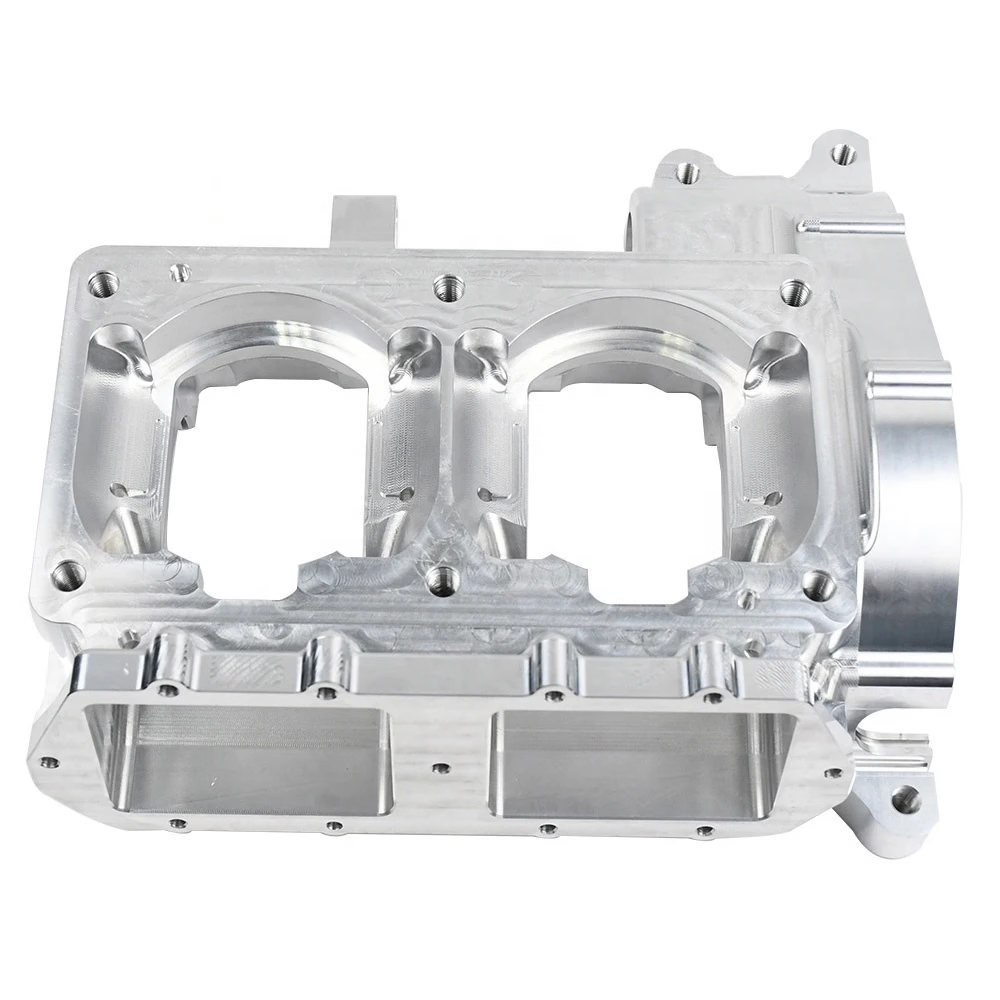
Part geometry decides the machine. A housing with features on five faces needs a simultaneous five-axis center, and those are less common in small Italian shops than three-axis mills with a fourth-axis rotary table. If your part needs one setup on five faces, ask directly how many simultaneous five-axis machines the shop owns.
Prototype quantities from one to fifty pieces fit the Italian model well. Beyond a few hundred pieces, the labor-heavy setup starts to hurt. At that point buyers usually look at a shop with more automation or at an Asia-based supplier running lights-out shifts.
Why Hourly Rates and Quotes Diverge
Italian machine-hour rates run higher than rates in China, Vietnam or India. Labor cost, energy cost and the euro explain most of the gap. A shop in Brescia cannot match a Dongguan rate, and it does not try. It competes on proximity, language and short domestic freight.
The rate is only part of the number. Setup time, programming, fixtures and inspection are billed too. A part with a complex fixture can cost more in non-recurring engineering than in cutting time. Ask for the NRE separate from the piece price so you can see which one is driving the quote.
Quantity shifts the winner. At 5 pieces, freight and duty from Asia can outweigh the machining saving, so a local shop often wins on total landed cost. At 500 pieces, the same freight is spread thin and the rate gap dominates. Run both numbers before you decide.
Currency adds a slow-moving factor. A euro-denominated quote and a dollar-denominated quote drift apart over a six-month program. If the program runs long, ask whether the price holds or floats, and how it floats.
Lead Time, Communication and Real Risks
Domestic Italian lead time for a repeat part is often 2 to 4 weeks. A new part with a fixture and a first-article inspection can take 5 to 8 weeks. Those numbers come from shop schedules, not from any guarantee, so confirm them per order.
Language is rarely the problem. English is common in northern shops and drawings travel fine. The friction sits in working hours and August. Most Italian plants close for two to three weeks in August, and a quote sent in late July may sit untouched until September.
For overseas buyers, the risk is distance from the shop floor. You cannot walk in and check a fixture. That is why remote buyers rely on inspection reports, material certificates and photos at each stage. Ask for in-process photos at first cut, not only at final inspection.
Certification matters by industry. Automotive work pushes shops toward IATF 16949, medical toward ISO 13485, and general industrial work usually accepts ISO 9001. If your program needs one of these, confirm the certificate covers the plant that will machine your part.
CNC Machining in Italy Compared With an Asia-Based Partner
For a European buyer, the honest comparison is not Italy versus Asia in the abstract. It is a specific part, a specific quantity and a specific deadline. Small, urgent, high-mix work usually stays in Europe. Large, stable, cost-driven programs usually move.
An Asia-based partner such as GreatLight runs 127 CNC machines across three plants, including 16 simultaneous five-axis centers, 16 mill-turn centers and 12 four-axis mills. Maximum part size reaches 4,000 mm. Tolerance holds at ±0.005 mm with finishes to Ra 0.2–0.8 μm on request.
Those numbers matter only if they match your drawing. A 4,000 mm travel is useless for a 20 mm connector. A mill-turn center is useful when one part needs turning and milling without a second setup. Match machine type to geometry first, then compare price.
Certification, confidentiality and quantity rules decide the rest. GreatLight holds ISO 9001, IATF 16949, ISO 13485 and ISO 27001, takes orders from one prototype to 10,000+ parts with no minimum, and signs an NDA on request. Quotes and DFM feedback come back within 12 hours.
How to Brief Either Supplier Properly
Send a 3D model in STEP plus a 2D drawing that carries the tolerances, datums and surface finish. A model alone leaves every tolerance to the shop's default, and the default is usually generous. State the critical dimensions instead of tolerancing everything tightly.
Name the material grade, not just the family. 6061-T6 and 6061-O machine differently and behave differently after anodizing. If the part is safety-related, add the standard the material must meet, and ask for a mill certificate with the shipment.
Say how the part will be inspected. A first-article report on every dimension costs money. A report on the critical few plus a CMM report on the datum scheme is usually enough, and it keeps the piece price lower.
Finally, state the quantity curve, not one number. A shop quotes differently for 10 pieces now and 2,000 next year. Sharing the curve lets the shop suggest the right process at each step, and it often lowers the average price.
Which Supplier Fits Your Part
Match the row to your job, then read across.
| Your situation | Italy-based shop | Asia-based partner |
|---|---|---|
| 1–10 prototypes, urgent | Strong fit, short freight | Viable if you allow 3–5 day shipping |
| 200–10,000 parts, cost-driven | Rate gap hurts at volume | Strong fit, automation absorbs setup |
| Part over 1,000 mm | Few shops have the travel | 4,000 mm travel available |
| Five faces in one setup | Confirm five-axis count first | 16 simultaneous five-axis centers |
| August deadline | Plant shutdown risk | No seasonal shutdown |
| IATF 16949 required | Common in auto clusters | Held and audited |
| Hardcoat anodize in-house | Usually subcontracted | Offered as a finishing step |
| Design still changing | Fast local iteration | DFM feedback within 12 hours |
The Straight Answer
If your part is small, urgent and headed to a European assembly line, keep it with a qualified Italian shop and pay for proximity. If your part is stable, cost-driven and runs past a few hundred pieces, an Asia-based partner with five-axis capacity, IATF and ISO 13485 coverage and no minimum order will land cheaper on total cost.
Questions Buyers Ask
Is CNC machining in Italy more expensive than in Asia?
Yes, per machine hour. Labor, energy and currency push Italian rates above rates in China, Vietnam and India.
The gap narrows at low volume, where freight, duty and travel for a supplier visit can erase the machining saving. Below about 50 pieces, total landed cost is often close.
What tolerance can Italian shops realistically hold?
±0.01 mm on a milling center and ±0.005 mm on a bored or ground feature is normal capability for a shop with a CMM and a temperature-controlled room.
Tighter than that is possible but usually means grinding, lapping or a second setup, and it should be quoted as a separate operation.
How long does an Italian shop take to quote and deliver?
Quotes often come back in 2 to 5 working days. Repeat parts ship in 2 to 4 weeks; a new part with a fixture and first-article inspection runs 5 to 8 weeks.
August is the exception. Many plants close for two to three weeks, so a July quote may not move until September.
Do I need a 3D model or is a 2D drawing enough?
Send both. The STEP file drives the toolpath, and the 2D drawing carries tolerances, datums and surface finish.
A model alone means the shop applies its own default tolerance, which is often ±0.1 mm or looser on non-critical features.
Which certifications should I check?
ISO 9001 covers general industrial work. Automotive programs usually require IATF 16949 and medical device work requires ISO 13485.
Ask whether the certificate covers the specific plant that will machine your part, not just the company name on the website.
Can a supplier in Asia handle European-quality documentation?
Yes, when the process is written down. GreatLight holds ISO 9001, IATF 16949, ISO 13485 and ISO 27001, inspects 100% of parts before shipment, and issues reports on request.
Ask for the inspection plan and a sample report before the first order, then compare it against your own drawing requirements.
Send One Part and Compare the Numbers
Upload a STEP file and a drawing. You get a quotation and DFM feedback within 12 hours, from one prototype to 10,000+ parts, with no minimum order and an NDA on request.
12-hour quote100% inspectionNo MOQNDA on request
Follow GreatLight
We publish setup notes, tooling trials and inspection data from the factory floor.











