CNC Machining in Ireland: What Engineers Should Know Before Sourcing
Ireland hosts a dense cluster of MedTech, automotive and aerospace manufacturers, and most of them buy machined metal parts rather than cut them in-house. This page explains how that supply chain actually runs: which materials dominate, what tolerances are realistic, when a local shop is the right call and when an overseas partner makes more sense. Written for design and sourcing engineers who need to make a build-or-buy decision this quarter.
In this article
- 1
- 2
- 3
- 4
- 5
- 6
What CNC machining in Ireland actually supplies
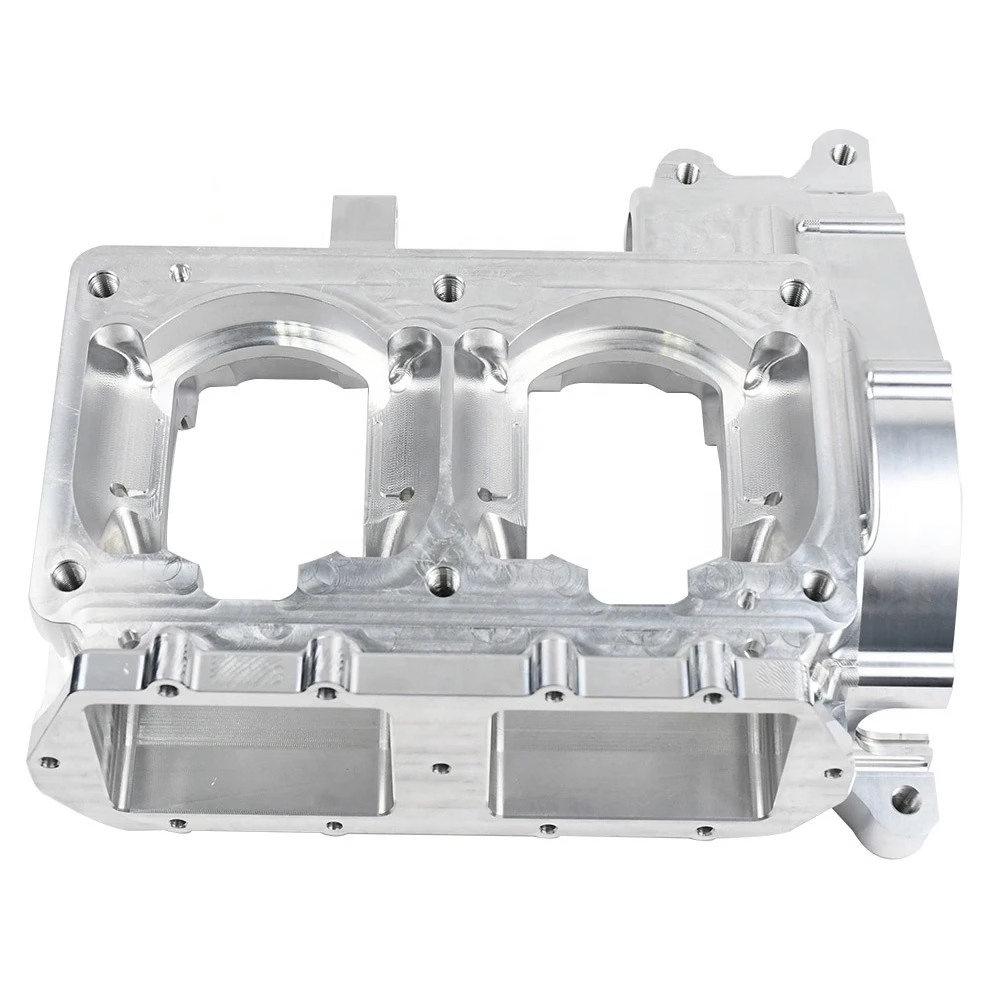
Ireland's manufacturing base is unusual. It is small in headcount but heavy in regulated output. Medical devices, automotive electronics and aerospace subassemblies dominate, and most of those plants assemble rather than cut metal. When a design engineer needs a manifold, a bracket or an implant trial body, the work usually goes to an external machine shop, often outside the country.
That pattern shapes what buyers ask for. Volumes are modest, part families change often, and documentation matters as much as the cut itself. A shop quoting CNC machining in Ireland has to handle 20-piece runs as comfortably as 10,000-piece runs, because the same plant may need both in one quarter.
The practical consequence: Irish buyers rarely choose a supplier on machine count alone. They weigh material traceability, inspection paperwork and how fast a first article can be turned around. Those three items decide most awards.
- 1Low volume, high mixPrototype and bridge quantities sit next to production runs.
- 2Documentation firstMaterial certs and inspection reports ship with the parts.
- 3Mixed material demandAluminium, stainless and titanium appear in the same plant.
Why tolerance and material choice drive the quote
Tolerance is the single largest cost driver in a machined part. A bracket held at ±0.1 mm may need one setup and a caliper check. The same bracket at ±0.005 mm needs a temperature-stable environment, a probe on the machine and a CMM report. The geometry has not changed. The process has.
Material follows close behind. Aluminium 6061 and 6082 cut fast, hold tight tolerances and take anodizing well, which is why they cover most brackets and housings. Stainless 316L and 17-4PH are common in medical and marine work; they cut slower and wear tooling faster. Titanium Ti-6Al-4V and Inconel sit at the far end, where cycle times can triple and tool life becomes the main cost line.
Surface finish works the same way. As-machined at Ra 1.6–3.2 μm is what comes off the tool. Ra 0.8–1.6 μm usually needs a finishing pass or light bead blasting. Ra 0.2–0.8 μm means slower feeds, sharper tooling and more inspection time, so it should only be specified where a seal, a bearing or a sliding surface actually needs it.
A useful rule: specify the coarsest tolerance and finish the function allows, then let the shop tell you what it can hold. Tolerance added 'just in case' is the most common source of avoidable cost in machined parts.
- 1±0.1 mmTypical for brackets, covers and non-mating features.
- 2±0.005 mmReserved for bearing bores, seals and mating faces.
- 3Ra 1.6–3.2 μmDefault as-machined finish on most alloys.
- 4Ra 0.2–0.8 μmOnly where a sealing or sliding surface requires it.
When a local Irish shop is the right choice
Local machining wins when the feedback loop matters more than the unit price. If a prototype will be tested on Friday and modified on Monday, a shop an hour away is worth a premium. Same-day pickup, a face-to-face setup review and quick rework all shorten the iteration cycle in ways a purchase order cannot capture.
Local also wins when the part is large, heavy or awkward to ship. A 4,000 mm frame or a 300 kg casting is expensive and slow to move across borders. If the geometry will not fit in a standard crate, keeping the work inside Ireland or inside the EU removes a real logistics risk.
The third case is regulated work where an auditor wants a short, inspectable supply chain. Some medical and aerospace quality systems prefer suppliers the quality team can visit. That is a legitimate reason to pay more, and it should be stated openly rather than hidden behind a generic 'quality' argument.
What local does not automatically give you is capacity. A small Irish shop may have two or three machines, so a sudden 5,000-piece order can stall. Ask about spare spindle hours before you commit a production schedule.
- 1Fast iterationDesign changes within days, not weeks.
- 2Oversized partsAvoids cross-border freight and crating risk.
- 3Audit accessQuality team can visit the floor directly.
When an overseas partner makes more sense
Once a design is frozen and the volume climbs, the economics shift. Overseas partners absorb setup cost across larger batches, run lights-out shifts and keep a wider material stock. For a part that will repeat for two years, that difference usually beats the local premium.
The trade-off is coordination. You need a supplier that answers engineering questions in hours, not days, and that can produce a DFM report before cutting metal. A shop quoting 12-hour DFM turnaround and 3–5 day shipping removes most of the delay people associate with offshore work.
Certification is the other filter. ISO 9001:2015 covers general quality systems. IATF 16949:2016 is what automotive buyers expect. ISO 13485:2016 applies to medical device work, and ISO 27001:2022 matters when you are sending CAD files and patient-adjacent data. Check which certificates the shop actually holds, not which ones appear in a brochure.
A supplier with 16 simultaneous 5-axis centers, 12 four-axis mills and 16 mill-turn centers can take on complex geometry without sub-contracting the hard operations. That matters because every sub-contractor is another place where tolerance and traceability can slip.
- 1Frozen designsBest fit once drawings stop changing weekly.
- 2Repeat volumeSetup cost spreads across the full run.
- 3Certification matchConfirm ISO 9001, IATF 16949 or ISO 13485 as needed.
Five checks before you place a purchase order
First, send a STEP file and a drawing, not a PDF alone. The shop needs both to quote features and tolerances correctly. A missing GD&T callout will come back as an assumption, and assumptions cost money later.
Second, ask for a DFM report with the quote. A good shop will flag thin walls, deep pockets, sharp internal corners and features that need a second setup. Those notes are free engineering and they usually save more than the quote difference between two suppliers.
Third, confirm the inspection plan. 100% inspection before shipment, with raw material checks, in-process monitoring and a final report on request, is the baseline for regulated work. If a shop cannot describe its inspection flow, that is your answer.
Fourth, settle confidentiality early. Uploads should be secure, and an NDA should be available on request rather than negotiated from scratch. For medical and defence-adjacent parts, this is not optional.
Fifth, test the response time. Send one technical question with your RFQ. A shop quoting production start within 24 hours should answer that question within a working day. Slow answers before the order rarely get faster after it.
- 1STEP plus drawingBoth files, every time.
- 2DFM in writingFlags risk before the first cut.
- 3Inspection flowAsk how, not just whether.
Local shop vs overseas partner: which fits the job
Use this when the design is close to frozen and you need to pick a route.
| Factor | Local Irish shop | Overseas partner |
|---|---|---|
| Typical quantity | 1–500 parts | 500–10,000+ parts |
| Design stage | Still changing weekly | Frozen or nearly frozen |
| Tolerance needed | ±0.05 mm and looser | ±0.005 mm with CMM report |
| Part size | Oversized, hard to crate | Fits standard freight |
| Lead time | Days for prototypes | 3–5 days after setup |
| Certification depth | Often ISO 9001 only | ISO 9001, IATF 16949, ISO 13485 |
| Unit price | Higher at low volume | Lower once volume repeats |
The short version
If the design is still moving or the part is too big to ship, use a local Irish shop and accept the higher unit price. If the design is frozen, the volume repeats and you need certified tight-tolerance work, an overseas partner with matching certifications will usually deliver a better total cost. Pick the route that matches your design stage, not the one with the lowest first quote.
Questions buyers ask next
What tolerance can a machined part realistically hold?
On a rigid setup with the right tooling, ±0.005 mm is achievable on critical features such as bearing bores and mating faces. That number applies to the feature, not the whole part.
General features on the same part normally sit at ±0.05 mm to ±0.1 mm. Specifying everything at ±0.005 mm adds cost without adding function.
How fast can a first article ship?
With a complete STEP file and drawing, quoting and DFM analysis can come back within 12 hours, and production can start within 24 hours. Simple parts then ship in 3–5 days.
Complex geometry, exotic alloys or a required CMM report will extend that window. Ask for a dated schedule rather than a general promise.
Is there a minimum order quantity?
Not at every shop. Some run from one prototype up to 10,000+ part runs on the same process, which suits companies that prototype and produce with one partner.
If a supplier insists on a high MOQ for a prototype, that supplier is optimized for volume and will not be a good fit for early-stage work.
Which certifications should I check for medical or automotive parts?
ISO 9001:2015 is the general baseline. IATF 16949:2016 applies to automotive production. ISO 13485:2016 is the medical device standard, and ISO 27001:2022 covers information security when you share design data.
Ask for the certificate scope, not just the logo. A certificate that does not cover your product category has limited value in an audit.
How should I handle CAD confidentiality?
Send files through a secure upload rather than email attachments, and request an NDA before sharing full assemblies. A one-page mutual NDA is usually enough for quoting.
Also ask who inside the shop can see the files. Access control is part of ISO 27001, and it is a fair question for any supplier handling new product designs.
What materials are commonly machined for Irish OEMs?
Aluminium 6061, 6082 and 7075 cover most housings and brackets. Stainless 303, 316L and 17-4PH appear in medical and marine parts. Titanium Ti-6Al-4V, Inconel and engineering plastics such as PEEK and POM cover the higher-specification end.
Material choice drives cycle time more than most engineers expect, so confirm availability before finalizing the drawing.
Send a drawing, get a machinability answer
Upload your STEP file and drawing for a free DFM review. Quotation and manufacturability notes come back within 12 hours, with no minimum order quantity and an NDA on request.
12-hour quote100% inspectionNo MOQ
More from the shop floor
We publish setup notes, tooling trials and inspection data from the factory floor.