
CNC machining cost estimator: what the number really means
A quote from any CNC machining cost estimator is a snapshot of five inputs: material, tolerance, geometry, quantity and finishing. This guide shows engineers and sourcing teams how to read those inputs, compare quotes on the same basis, and spot the line items that quietly move unit price.
In this article
- 1
- 2
- 3
- 4
- 5
- 6
- 7
Key takeaways
What each cost driver does to your unit price
Typical effect on a 100-part aluminium run at GreatLight.
| Cost driver | Low-cost setting | High-cost setting | How to judge |
|---|---|---|---|
| Material | 6061-T6 aluminium | Ti-6Al-4V or Inconel | Match alloy to load, not habit |
| Tolerance | ±0.05 mm | ±0.005 mm | Tighten only on mating features |
| Setup count | One setup, 3-axis | Three setups, 5-axis | Fewer setups beat fewer tools |
| Quantity | 1,000+ parts | 1 prototype | Setup spread is the whole story |
| Finish | As machined Ra 1.6–3.2 μm | Ra 0.2–0.8 μm + anodize | Specify Ra per surface, not per part |
| Wall thickness | 3 mm and above | Under 0.8 mm | Thin walls force light passes |
| Threads and holes | Standard metric taps | Deep small-diameter holes | Depth over 5× Ø needs peck cycles |
Get the estimate, then check the inputs
A CNC machining cost estimator is only as good as the inputs you give it. Fix the drawing, split tight and loose tolerances, and ask for a quantity ladder. The number will hold up.
What a CNC machining cost estimator is actually adding up
Most estimators, whether software or a human at a machine shop, start from the same four lines: material, setup, machining time and finishing. Everything else is a small correction on top. If a quote arrives as one lump number, you cannot tell which line moved when you change the design.
Material is the easiest line to check. Bar stock and plate are priced by weight plus a cut charge, and the alloy choice drives both. 6061-T6 machines fast and is cheap per kilogram. 17-4PH stainless costs more and cuts at roughly a third of the speed, so the price gap between the two is wider than the metal price alone suggests.
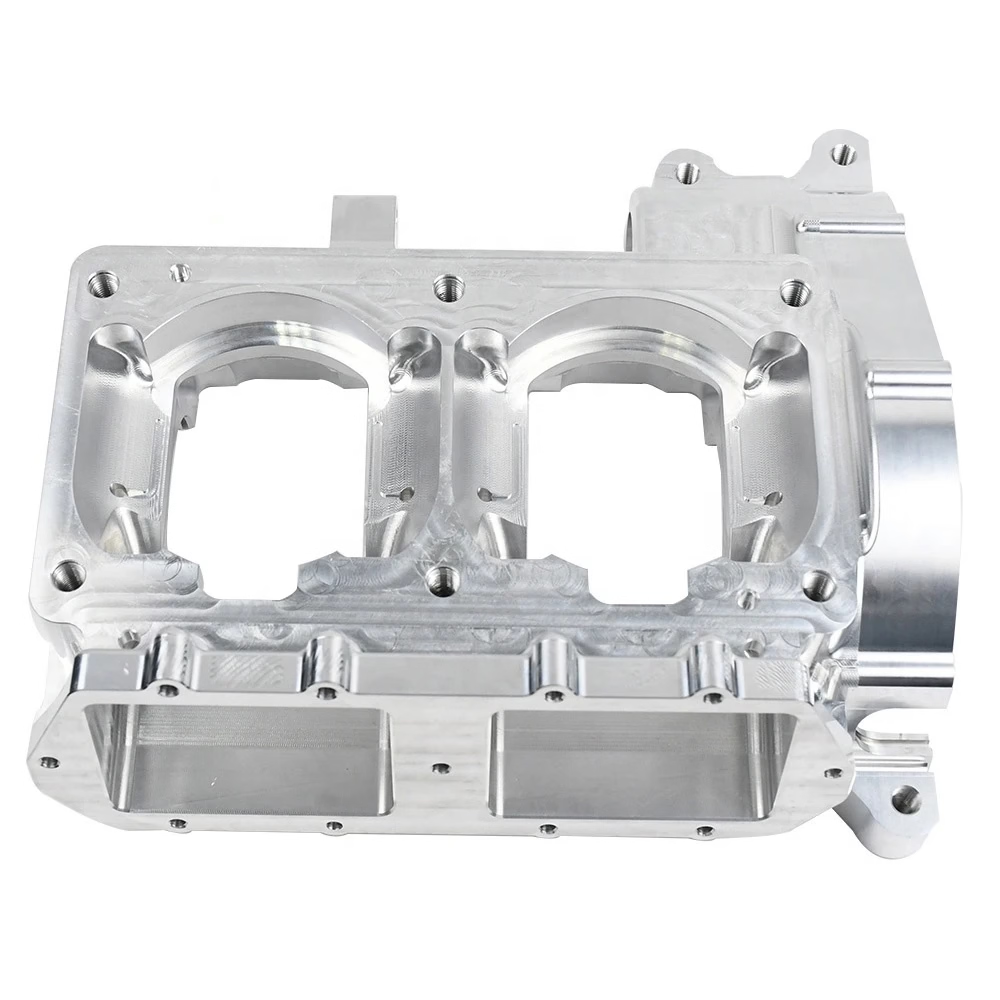
Machining time is the biggest line and the one engineers influence most. It depends on the volume of metal you remove, the number of tools, and how many times the part has to be re-clamped. A part that fits in one 3-axis setup at 750 × 1,150 × 550 mm travel is far cheaper than the same part split across three operations on a 5-axis center.
Setup is a fixed cost per run. It does not shrink when the part gets simpler. On a one-off prototype this line can be larger than the cutting time, which is why prototype quotes look expensive per part and production quotes do not.
- 1MaterialAlloy, stock form and cut charge
- 2SetupFixtures, probing, first-article checks
- 3Cycle timeRoughing, semi-finish, finishing passes
- 4FinishingAnodize, plating, blasting, laser marking
How part geometry changes the estimate before you send an RFQ
Pocket depth is the first thing to look at. A pocket 4× deeper than its widest point needs a long, thin tool that has to run at reduced feed and stepover. Costs climb quickly past that ratio. If a pocket can be designed at 3× depth or less, the same feature can often be cut with a stubby tool at full speed.
Undercuts and features on five faces push work onto a 5-axis machine or add re-clamping. That is not automatically bad. One 5-axis setup can still beat three 3-axis setups when the part has tight positional tolerance between faces, because you avoid stacking setup error. The trade is real, and it depends on which faces carry the critical tolerance.
Thin walls and floors are the second common driver. Below roughly 1 mm in aluminium, cutting forces start deflecting the part and the finishing pass has to be gentle. The estimator sees this as extra passes, not as a different material, so it rarely shows up as an obvious line item.
Cosmetic requirements add cost in a way that is easy to miss. A brushed or polished face may need a separate hand operation, and a cosmetic anodize finish rejects parts that a functional finish would accept.
- 1Pocket depth over 4× widthLong tools, light passes, higher cost
- 2Features on five faces5-axis setup or extra re-clamping
- 3Walls under 1 mmDeflection risk, slower finishing
- 4Cosmetic surfacesHand work and higher finish rejection
Quantity, lead time and MOQ: where the estimator stops being linear
Unit price does not fall in a straight line as quantity rises. It drops in steps. The first step is when setup is fully absorbed, which for a simple milled part might be around 20 to 50 pieces. The second step is when it becomes worthwhile to build a soft jaw or dedicated fixture. The third is when cycle time gets optimised with a better toolpath or a bar feeder.
This is why a quote for 100 parts is often not ten times the price of 10 parts. Ask a supplier to break the price at three quantities so you can see where the steps fall. A flat per-unit price across all quantities usually means the estimator applied a rough factor instead of looking at the process.
Lead time interacts with quantity in a way that catches buyers out. A low-volume run can start as soon as material arrives, but a high-volume run may wait for a dedicated fixture and a scheduled machine slot. On simple parts, production can begin within 24 hours and parts ship in 3–5 days, but that assumes the drawing is frozen and the stock size is standard.
MOQ is a separate question from price. Some shops set a minimum order value to cover setup and programming. GreatLight does not set a minimum order quantity, so a single prototype and a 10,000-part run go through the same quotation process.
- 1Break point 1Setup fully absorbed across the batch
- 2Break point 2Dedicated fixture becomes worthwhile
- 3Break point 3Toolpath and cycle time optimised
- 4Ask for three quantities10, 100 and 1,000 pieces, priced separately
Reading competing quotes on the same basis
The most common mistake in comparing CNC quotes is comparing different scopes. One supplier quotes as-machined with sharp edges broken. Another quotes deburred, inspected and anodized. The second number looks higher, but it includes operations the first one left out. Ask for a line-item breakdown before you compare totals.
Check the tolerance statement. A quote that says "machined to drawing" without naming a default tolerance is quoting a looser part than one that states ±0.005 mm on critical features. If the drawing calls out general tolerances plus specific tight features, the quote should reflect that split rather than applying one tolerance to the whole part.
Ask what is included in inspection. A supplier who checks 100% before shipment and can provide reports is pricing that work in. A supplier who checks first articles only is not. Neither is wrong, but the difference matters for medical, aerospace and automotive parts where traceability is part of the deliverable.
Finally, look at how the shop handles DFM feedback. A useful quote often comes back with two or three notes on features that will be slow or risky to cut. That feedback is worth more than a small price difference, because it usually removes cost before the chips are made.
- 1Compare scopeSame tolerance, same finish, same inspection
- 2Default toleranceAsk what the unmarked dimensions hold
- 3Inspection depth100% check versus first article only
- 4DFM notesA quote that flags risk is worth reading twice
Six steps to get a usable estimate
Run these in order. Skipping step 2 is what makes quotes come back incomparable.
- 1Freeze the drawingLock the revision and mark which dimensions are critical. An RFQ sent against a moving model will always be re-quoted.
- 2Split tight and loose tolerancesApply ±0.005 mm only to mating or locating features. Leave general dimensions at the drawing default, often ±0.1 mm or looser.
- 3Pick the material by functionChoose alloy from load, corrosion and weight needs. Then check stock form: plate, bar or near-net shape changes both price and lead time.
- 4Cut unnecessary setupsAsk whether the part can be machined from two faces instead of five. If two faces cannot hold the position tolerance, budget for a 5-axis setup instead.
- 5Request a quantity ladderAsk for unit price at prototype, mid and production quantities. Use the steps in the ladder to decide where to place the first order.
- 6Specify finish per surfaceName the Ra value and the finish type for each functional face. Blanket "Ra 0.8 everywhere" adds polishing time to surfaces that never touch anything.
- 7Confirm lead time and inspectionAsk when production starts, when parts ship, and what inspection report comes with them. Get it in writing before you release the PO.
Common questions
How accurate is an online CNC machining cost estimator?
A software estimator is usually within 20–30% for simple prismatic parts in common alloys. It gets less reliable when the part has deep pockets, thin walls, five-face features or tight positional tolerance, because those inputs are hard to read from a file alone.
Use the estimate to screen designs, then confirm with a shop quote. A shop that reviews the model and returns DFM notes will give a tighter number than a rule-based calculator.
Why did my second quote come in much higher than the first?
In most cases the scopes differ. Check the default tolerance, whether deburring and inspection are included, and whether finishing is inside or outside the quoted price.
The other common cause is quantity. A shop quoting 10 pieces spreads setup over a small batch, while a shop quoting 1,000 pieces does not. Ask both for a ladder at the same quantities.
Does a tighter tolerance always cost more?
Not always, but it usually does on the surfaces where it is applied. ±0.005 mm often requires a finishing pass, temperature-stable inspection and sometimes a second setup to hold the datum relationship.
The cost is manageable when you limit the tight tolerance to functional features. Applying it to every dimension on the drawing is the expensive version.
What information do I need before requesting a quote?
A frozen 3D model or 2D drawing with a clear revision, the material and stock form if you have a preference, the quantity ladder you want priced, and the finish specification per surface.
If the part is for a regulated industry, say so up front. It changes the inspection and documentation scope, and it is better to price it in than to add it later.
Can I get a quote without committing to a production order?
Yes. Send the model and get a quotation plus DFM analysis within 12 hours. There is no minimum order quantity, so a single prototype and a 10,000-part run are both quoted the same way.
Uploads are treated as confidential, and an NDA can be signed on request before files are shared.
Which parts are a poor fit for CNC machining?
Very large, thin-walled shells and parts with complex internal channels are often cheaper as castings or additively manufactured near-net shapes, then finished by CNC.
CNC still wins when you need tight tolerance, good surface finish, or a small number of parts made from solid stock without tooling cost.
Send your model, get a real number
Quotation and free DFM analysis within 12 hours. No minimum order quantity, from one prototype to 10,000+ parts.
12-hour quote±0.005 mm100% inspectionNo MOQ
More machining notes
We publish setup notes, tooling trials and inspection data from the factory floor.











