
CNC machining centers in Spain: industry overview for engineers
A practical look at how CNC machining centers in Spain are used across automotive, aerospace, medical, and machinery work. We cover typical part envelopes, tolerance expectations, and the points where a Spanish shop or an overseas partner fits better. Read it before you send an RFQ.
In this article
- 1
- 2
- 3
- 4
- 5
- 6
- 7
Key takeaways
What CNC machining centers in Spain actually run
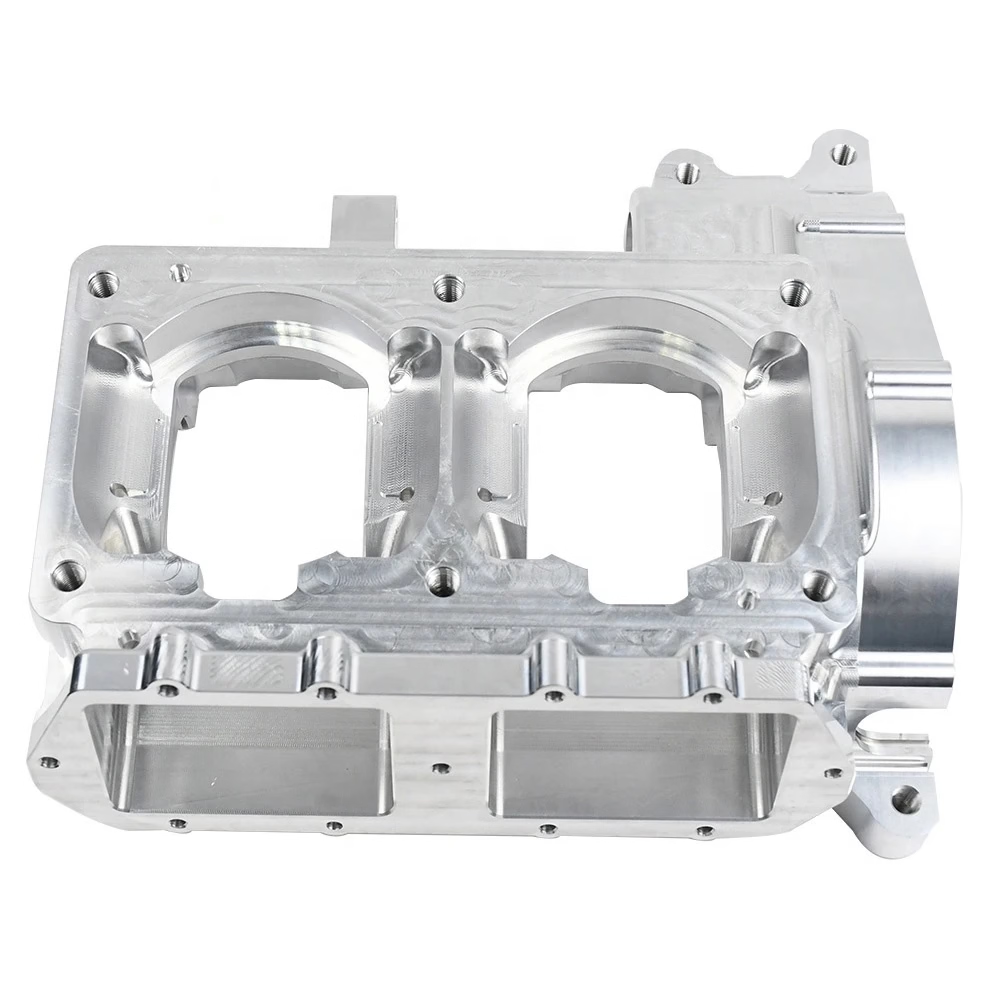
Spain's machining base grew out of the automotive supply chain, and that still shapes it. A large share of CNC machining centers in Spain are horizontal mills and mill-turn centers cutting cast iron and aluminum housings, gearbox parts, brake components, and EV drivetrain pieces. The Basque Country around Bilbao and Vitoria leans toward heavy parts and dies. Catalonia runs mixed batches for industrial equipment. Madrid and Aragon carry aerospace and rail work.
The typical Spanish shop floor splits into two groups. Job shops take batches from 50 to 5,000 pieces with 3-axis and 4-axis vertical mills. Tier 1 suppliers run dedicated cells with pallet changers, probing, and lights-out night shifts. If your part sits between those two worlds, expect a longer quote cycle because the shop has to decide which cell to interrupt.
Machine size matters more than brand here. A 4,000 mm travel machine is rare in Spain outside a few large-frame shops, and most vertical machining centers top out near 1,000 mm in X. For parts under 500 × 500 × 450 mm, capacity is rarely the constraint. Above that, the list of willing suppliers shrinks fast.
Materials follow the same pattern. Aluminum 6061 and 7075, stainless 304 and 316L, and steel 1045 and 4140 are everyday work. Titanium and Inconel get cut, but usually by shops with a specific aerospace qualification attached to the process.
- 1Automotive and EVHousings, brackets, motor parts, brake and steering components
- 2AerospaceStructural fittings, brackets, and prototype hardware in aluminum and titanium
- 3Industrial machineryFrames, manifolds, spindles, and custom tooling
- 4MedicalInstruments and device components, usually stainless and titanium
Tolerances, finishes, and what the drawing has to say
A Spanish shop quoting ±0.05 mm on a general tolerance block is normal. Tight features at ±0.01 mm are also normal, but only when the drawing marks them. The mistake we see most often is a drawing that leaves everything at the title-block default and then expects the shop to hit critical fits by instinct. It does not work that way in Spain, China, or anywhere else.
Surface finish follows the same logic. As-machined aluminum lands around Ra 1.6–3.2 μm. A bearing bore or seal face needs Ra 0.8–1.6 μm, and optical or sealing surfaces go to Ra 0.2–0.8 μm. Each step down adds a finishing pass, a different tool, or a secondary operation, and the quote reflects it.
Inspection is where quotes diverge most. Some shops check with calipers and micrometers and ship. Others run CMM reports, first article inspection, and material certificates. If your industry requires traceability, ask for the inspection plan before you compare prices, because a quote without CMM time is not the same product as one with it.
One more point on GD&T. Position and profile callouts with a datum scheme are handled well by qualified shops. Drawings that use ±0.05 mm across a 300 mm bolt pattern instead of a true position callout create arguments at incoming inspection, and those arguments cost more than the machining.
- 1General tolerance±0.05 mm is a realistic shop default for milled features
- 2Critical featuresMark them individually; ±0.005 mm is achievable but not free
- 3Finish calloutsRa 1.6–3.2 μm as-machined, Ra 0.8–1.6 μm for fits
- 4InspectionCMM reports and material certs should be a line item, not an assumption
Where the Spanish supply base gets tight
Capacity in Spain is not evenly distributed. Automotive Tier 1 plants book their machining cells months ahead, and a job shop that depends on one or two large customers will drop smaller RFQs when those customers ramp. If your order is 200 parts and the shop's main customer just doubled its forecast, your parts wait.
Cost is the second pressure point. Spanish labor and energy rates sit well above rates in China, Vietnam, or Turkey. For a one-off prototype that is fine, because the engineering time dominates the price. For a 10,000-piece run in aluminum, the hourly rate difference shows up clearly in the unit price, and it does not shrink with volume.
Tooling and finishing also narrow the field. Hardcoat anodizing, electroless nickel, and laser marking are available, but not in every region. Parts sometimes travel 300 km between the machine shop and the finisher, adding days and handling risk. Ask which operations are done in-house and which are subcontracted.
Finally, export paperwork. Spanish shops ship within the EU easily. Shipping to the US or Asia means customs, Incoterms, and a different set of questions about who handles the duty and the freight claim if something goes wrong.
- 1Capacity riskTier 1 ramp-ups push small RFQs to the back of the queue
- 2Unit costLabor and energy rates are higher than in Asia for long runs
- 3Finishing logisticsSubcontracted anodizing can add travel days and handling
- 4ExportEU shipping is simple; intercontinental freight adds paperwork
Matching the work to the right shop
Start with part size and volume, because those two numbers eliminate most of the field. Parts under 500 mm on a side with volumes under 500 pieces fit a job shop anywhere. Parts over 1,000 mm, or volumes over 5,000 pieces, need a supplier with the right machine and the right material purchasing power.
Then look at the qualification requirement. If the part needs IATF 16949 or ISO 13485 traceability, the supplier list is short and the audit trail matters more than the price. If the part is a fixture or a prototype bracket, a general ISO 9001 shop is enough.
When a Spanish shop is the right answer: the part is large, the customer is nearby, the engineering change cycle is fast, and the volume is modest. When an overseas partner is the right answer: the geometry is complex, the volume is high, the material is expensive and needs tight nesting, or the project needs 5-axis work at a competitive rate.
At GreatLight we run 127 high-precision CNC machines, including 16 simultaneous 5-axis machining centers, 12 four-axis mills, 27 three-axis machines, and 16 mill-turn centers. Maximum processing size reaches 4,000 mm, with travels of 4,000 × 400 × 150 mm, 750 × 1,150 × 550 mm, and 500 × 500 × 450 mm. Tolerance holds at ±0.005 mm, and every part is inspected before shipment.
- 1Small parts, small batchesLocal job shop is usually the fastest route
- 2Large framesFewer suppliers; confirm travel before quoting
- 3Regulated industriesCheck the certificate scope, not just the logo
- 4High volumeCompare landed cost, not unit price alone
How a Spanish buyer works with an overseas machining partner
The workflow is simpler than most buyers expect. Send a STEP file and a 2D drawing with GD&T, material, finish, and target quantity. We return a quotation and a free DFM analysis within 12 hours. If the drawing has a problem, we say so in that reply instead of discovering it on the shop floor.
Production can start within 24 hours of approval, and parts ship in 3–5 days for standard work. There is no minimum order quantity, so a single prototype and a 10,000-piece run go through the same process. Uploads are secure and confidential, and an NDA is available on request.
For Spanish buyers the practical details are freight and paperwork. We ship from Dongguan, China, and also operate a factory in Singapore at No.3 Joo Koon Circle, Singapore 629032. That second site helps when a project needs an Asian origin with a different logistics route.
Certifications cover the usual requirements: ISO 9001:2015, IATF 16949:2016, ISO 13485:2016, and ISO 27001:2022. Inspection includes raw material check, in-process monitoring, and final inspection, with reports on request. If you need first article inspection or material certificates, list them in the RFQ.
- 1Quote and DFMWithin 12 hours of receiving a complete package
- 2Production startWithin 24 hours after approval
- 3ShippingParts ship in 3–5 days
- 4ConfidentialitySecure uploads and NDA on request
Spanish shop vs overseas machining partner
Use part size, volume, and qualification needs to pick the column.
| Factor | CNC machining centers in Spain | Overseas partner (GreatLight) |
|---|---|---|
| Part size | Up to about 1,000 mm typical | Up to 4,000 mm travel |
| Batch size | 50–5,000 pieces, job shop friendly | 1 piece to 10,000+ pieces |
| Tolerance | ±0.01 mm on marked features | ±0.005 mm |
| Finish | Ra 0.8–1.6 μm common | Ra 0.2–0.8 μm available |
| Unit cost at volume | Higher labor and energy rates | Lower machine-hour cost |
| Lead time | Fast for local, slow when cells are full | Quote in 12 h, ship in 3–5 days |
| Certifications | IATF 16949, ISO 13485, ISO 9001 | ISO 9001, IATF 16949, ISO 13485, ISO 27001 |
| Best fit | Large parts, fast engineering loops | Complex geometry, high volume, tight tolerance |
The verdict
If your part is large, your engineering changes weekly, and you want the supplier down the road, stay with a Spanish shop. If the geometry is complex, the volume is high, or you need ±0.005 mm with a 5-axis process, send the drawing to us and compare the landed cost before you commit.
Questions engineers ask
Do Spanish shops use the same G-code and CAD standards as the rest of Europe?
Yes. Spain follows the same ISO GPS and ISO 2768 conventions used across the EU. STEP AP214 and AP242 files open cleanly, and 2D drawings follow ISO 128 line conventions.
The practical difference is not format but detail. A drawing that relies on implied symmetry or unstated datums will get a request for clarification, and that adds a day to the quote cycle.
Can I get 5-axis work done in Spain?
Yes, but the number of machines is limited compared with Germany or Italy, and they are usually booked by aerospace and automotive programs. Lead time for 5-axis slots stretches during ramp periods.
For complex impellers, housings, or parts with many angled features, an overseas 5-axis partner often returns a faster date because the machine is scheduled around your job rather than between two Tier 1 programs.
What material certificates should I ask for?
Ask for the mill certificate for the raw stock, plus a certificate of conformity for the finished part. For aerospace and medical work, add first article inspection and a CMM report.
If the part is plated or anodized, request the coating thickness report. It is a separate document from the machining inspection and often gets missed.
How does shipping from China to Spain affect the total cost?
Air freight for a 20 kg crate of machined aluminum typically lands in 5–8 days door to door, with duty and VAT charged at import. Sea freight costs less but adds three to five weeks.
Compare the landed cost, not the unit price. Machining savings usually exceed the freight difference once the batch passes a few hundred parts.
Can you work from a Spanish drawing with GD&T in Spanish or Catalan?
Yes. GD&T symbols are international, so the callouts translate directly. Text notes in Spanish are readable by our engineering team, and we confirm anything ambiguous before quoting.
We return the DFM report in English. If you need a Spanish version for your internal review, tell us in the RFQ.
What is the smallest order you accept?
One piece. There is no minimum order quantity, so a prototype and a production run go through the same quotation and inspection process.
For single prototypes we still run 100% inspection before shipment, and reports are available on request.
Send your drawing, get a quote in 12 hours
Upload a STEP file and 2D drawing. We return pricing and a free DFM analysis within 12 hours, and production can start within 24 hours of approval.
12-hour quote100% inspectionNo MOQNDA on request
More from GreatLight
We publish setup notes, tooling trials and inspection data from the factory floor.











