
CNC Machine Service Near Me: How to Choose a Supplier
This guide helps engineers and procurement teams vet a cnc machine service near me, or any partner you find further away. Read it to compare 5-axis capability, tolerance, lead time, MOQ and certifications before you send drawings.
In this article
- 1
- 2
- 3
- 4
- 5
- 6
- 7
What matters most
Choosing a cnc machine service near me: what to compare
Use this table to score suppliers on the criteria that decide whether your part can be made at all.
| Criterion | What to ask | Weak answer | Strong answer |
|---|---|---|---|
| Axis capability | How many simultaneous 5-axis centers? | Only 3-axis mills | 16 simultaneous 5-axis centers |
| Tolerance | What is your standard and how do you prove it? | ±0.05 mm, no report | ±0.005 mm with inspection data |
| Surface finish | Which finish range do you hold off the machine? | Polish by hand | Ra 0.8–1.6 μm as machined |
| Order size | Do you accept one piece? | 1,000-piece minimum | No MOQ, one to 10,000+ |
| Quote speed | How fast is a quote and DFM review? | 3–5 business days | 12 hours with free DFM |
| Certifications | Which quality systems are certified? | ISO 9001 claimed only | ISO 9001, IATF 16949, ISO 13485, ISO 27001 |
| Confidentiality | How are my files handled? | Email attachments | Secure uploads, NDA on request |
The verdict on choosing a machining partner
Pick the shop whose machines, inspection and finishing match your part, not the one with the shortest drive. Send one representative part first and judge the answer you get.
Start with the machine mix behind a cnc machine service near me
Every supplier page lists machine counts. The useful question is which machines, doing what. A shop with 27 three-axis mills can cut a flat bracket all day. Give it a housing with pockets on five faces and the job becomes four setups, four fixtures and a tolerance stack that grows with each rotation.
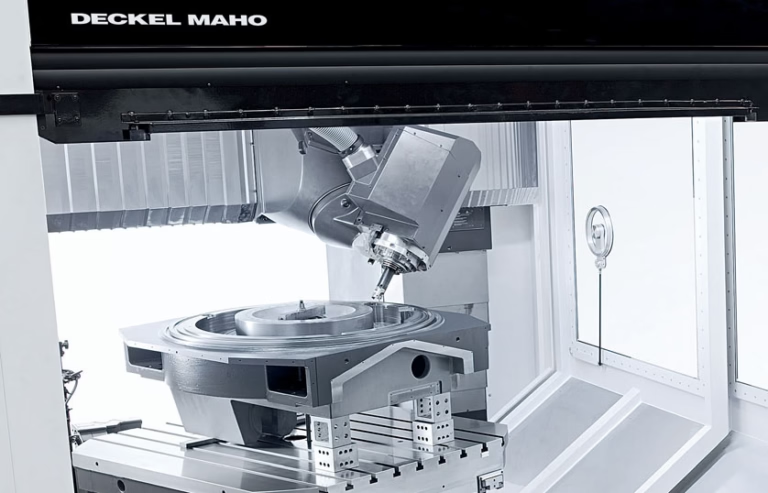
The axis mix decides how many times your part is touched. That number drives cost and error at the same time. A 5-axis center machines five faces in one setup, so the datum never moves between operations. We run 16 simultaneous 5-axis centers, 12 four-axis mills, 27 three-axis machines and 16 mill-turn centers across 127 high-precision CNC machines. Different parts land on different machines, and the quote should reflect that.
Work envelope matters as much as axis count. Our largest travel is 4,000 × 400 × 150 mm, with medium platforms at 750 × 1,150 × 550 mm and 600 × 600 × 600 mm, and compact ones at 500 × 500 × 450 mm and 500 × 310 × 200 mm. A Ø400 mm rotary table handles round parts that need indexing. If your part does not fit, no amount of skill helps.
Ask what happens when a machine is down or booked. A single-plant shop with two 5-axis mills has a thin fallback. We operate three wholly-owned plants and a Singapore factory, so work can move between sites without re-quoting.
How to verify tolerance claims from any machine shop
A tolerance on a website is a marketing statement until inspection data backs it. Our standard is ±0.005 mm (±0.0002 in), but that number applies to specific features under specific conditions. Bore diameters, flatness, perpendicularity and position each have their own callout, and some are easier to hold than others.
Ask three questions. Which features do you inspect? With what equipment? What report comes with the parts? A shop that measures only the outside envelope is not checking the features that make your assembly work. We inspect 100% of parts before shipment, covering raw material check, in-process monitoring and final inspection, with reports on request.
Surface finish follows the same logic. Turning and milling hold different finishes, and deep pockets are harder than open faces. We quote Ra 0.8–1.6 μm as standard machined finish, with Ra 0.2–0.8 μm available when the drawing calls for it. If your finish requirement drives a secondary operation, say so early. It changes both price and schedule.
Tight tolerances on non-functional surfaces are the most common cost trap in RFQs. A cosmetic face does not need ±0.005 mm. Mark the features that mate, seal or locate, and leave the rest at general tolerance. Shops quote what you draw, not what you meant.
Lead time, MOQ and quote format as selection criteria
A local shop within driving distance feels faster. That holds only if it can make the part. Distance adds shipping days, but a shop that needs three setups and an outside finishing vendor can lose more time than a container crossing the Pacific. Compare total days from drawing release to parts at your dock, not miles.
Our schedule runs on three checkpoints. Quotation and free DFM analysis within 12 hours. Production can start within 24 hours of approval. Parts ship in 3–5 days. Historical late-delivery probability sits below 2%. Those numbers assume a released drawing and available material, so confirm stock for specialty alloys before you commit to a date.
MOQ reveals who a shop is built to serve. A supplier with a 1,000-piece minimum is not set up for prototype iteration, and the quote will show it. We run no minimum order quantity, from one prototype to 10,000+ part runs, using the same inspection standard for both. That matters when you need three design revisions before tooling.
Read the quote format closely. A single line item hides setup, programming, fixturing, material and finishing. Ask for the breakdown on the first order. It tells you where cost can be removed on the second revision, and it exposes shops that pad setup time.
Materials, finishing and certifications to check
Material range signals what a shop actually cuts. We machine aluminum grades 6061, 6061-T6, 2024, 5052, 5083, 6063, 6082, 7075 and ADC12; stainless 303, 304, 316, 316L, 420, 430, 431, 440C and 17-4PH; steels including 1018, 1045, 4130, 4140, 4340, A36 and tool steel; copper and brass C101, C103, C110, beryllium copper, C27400, C28000 and C36000; titanium TA1, TA2, TC4, plus Inconel and magnesium AZ31B and AZ91D; and plastics from ABS and POM to PEEK and carbon fibre.
Finishing is where schedules slip when it is outsourced. We handle anodizing in clear, colour, hardcoat and conductive types, electroless nickel, zinc, silver and gold plating, powder coating, black oxide, bead blasting, tumbling, brushing and polishing, plus laser marking with a minimum character height of 1.5 mm. Keeping finishing in-house removes a vendor handoff from your timeline.
Certifications should match your industry, not just exist. ISO 9001:2015 covers general quality management. IATF 16949:2016 applies to automotive and EV programs. ISO 13485:2016 applies to medical devices. ISO 27001:2022 covers information security, which matters when you upload proprietary CAD. We hold all four.
Confidentiality is part of the quote. Uploads are secure and confidential, and we sign NDAs on request. If a supplier treats file handling as an afterthought, treat that as a signal about how they treat your drawings.
Step by step: vetting a supplier in one week
Run these steps in order. Stop at the first one that fails, because later steps depend on earlier answers.
- 1Send one representative part, not the whole BOMPick the part with the tightest tolerance or the most faces. The reply shows whether they read the drawing. Expect DFM comments within 12 hours.
- 2Ask for the axis mix and work envelope in writingGet the machine list with travel dimensions. Confirm your part fits the quoted machine before you discuss price.
- 3Request a sample inspection reportAsk for a report on a comparable part, with feature callouts. Look for measured values, not just pass or fail.
- 4Confirm the finishing routeAsk whether anodizing, plating or coating happens in-house or through a vendor. Note the added days either way.
- 5Check certificates against your industryMatch ISO 9001, IATF 16949 or ISO 13485 to your program. Ask for the scope, not the logo.
- 6Run a one-piece order before the production runUse no-MOQ terms to test quality and communication. Measure the parts yourself. Then release the larger quantity.
- 7Sign the NDA before sending full CADSend simplified geometry for the quote, full data after the agreement. Keep revision control on your side.
Frequently asked questions
Is a local cnc machine service near me always faster?
Only when the local shop can make the part without outsourcing. A nearby 3-axis shop that sends parts out for anodizing can take longer than a shop that machines and finishes in one facility.
Measure from drawing release to parts at your dock. Add shipping days for a distant supplier, then add vendor handoffs for the local one. The comparison is usually closer than it looks.
What tolerance should I expect on a standard CNC quote?
General machining holds around ±0.05 mm on most features. Our standard is ±0.005 mm when the drawing calls for it, verified by inspection.
Do not apply the tight number to every dimension. Mark functional features and leave cosmetic faces at general tolerance. It lowers cost without affecting fit.
Do I have to order a minimum quantity?
Not with us. We quote from one prototype to 10,000+ part runs, and the inspection standard does not change with quantity.
Shops that require a 1,000-piece minimum are built for production. If you are still iterating on design, that structure works against you.
How do I know my design files stay confidential?
Ask about file handling before you upload. We keep uploads secure and confidential and sign NDAs on request. Our ISO 27001:2022 certification covers information security management.
Send simplified geometry with the first RFQ. Release full CAD after the NDA is signed.
Which certifications matter for automotive or medical parts?
IATF 16949:2016 for automotive and EV programs, ISO 13485:2016 for medical devices. ISO 9001:2015 is the baseline for general industrial work.
Ask for the certificate scope. A logo without a scope statement proves nothing about the process your part will run through.
What makes a part unsuitable for a 3-axis machine?
Features on more than three faces, deep pockets with tight position tolerance, and parts that need a single datum across multiple operations. Multiple setups multiply error.
If your part needs four or more rotations to reach all features, quote it on a 4-axis or 5-axis center instead. Fewer setups usually cost less in total.
Send drawings and get a quote in 12 hours
Upload your CAD for a quotation and free DFM analysis. No minimum order quantity, from one prototype to 10,000+ parts.
12-hour quoteNo MOQ100% inspectionNDA on request
More from GreatLight
We publish setup notes, tooling trials and inspection data from the factory floor.











