
CNC Machine Outsource Services: How to Choose a Partner
This guide is for engineers and sourcing managers who need to place machined parts with an outside shop. It covers the numbers worth checking before you send an RFQ, the tolerances and finishes that are realistic to ask for, and the signs that a supplier will miss your date.
CNC Machine Outsource Services: In This Article
- 1
- 2
- 3
- 4
- 5
- 6
- 7
- 8
What matters before you outsource
CNC Machine Outsource Services: What to Compare
Use the same questions with every supplier and score the answers.
| Criterion | What to ask | Realistic target |
|---|---|---|
| Tolerance | Can you hold this on the stated feature size? | ±0.005 mm on critical features |
| Lead time | When do chips actually start flying? | Quote in 12 h, ship in 3–5 days |
| MOQ | Will you run a single prototype? | No minimum order quantity |
| Certification | Which quality systems are audited? | ISO 9001, IATF 16949, ISO 13485 |
| Data handling | Who sees our drawings and for how long? | ISO 27001, NDA on request |
| Inspection | What is checked before the box closes? | 100% inspection, reports on request |
| Size range | What is the largest part you can cut? | Up to 4,000 mm |
| Finishing | Is surface treatment in-house or brokered? | Anodizing to laser marking |
Pick the shop that answers the technical questions
If two suppliers quote within 10% of each other, choose the one that gave you specific DFM feedback, named the machine, and put the inspection scope in writing. Price is easy to compare. Engineering judgment is not.
Match the Process to the Part, Not the Other Way Around
The first question to settle is whether your part geometry suits 3-axis, 4-axis or 5-axis work. A flat plate with holes on one face is 3-axis work and should be priced as such. A housing with features on five sides needs either multiple setups or a simultaneous 5-axis center, and those two routes produce different cost and different stack-up error.
Tolerance claims deserve scrutiny. A shop advertising ±0.005 mm is describing what its machines can hold under good conditions, not a blanket promise on every dimension of every part. On a 4,000 mm long extrusion, thermal drift across the bed will eat that budget. Ask which features the tight tolerance applies to and how they are verified.
Surface finish follows the same logic. Ra 0.2–0.8 μm usually means a finishing pass with a small stepover and a sharp tool, which adds cycle time. If your drawing says Ra 1.6–3.2 μm, you are paying for as-machined output and that is often enough for brackets, covers and fixtures.
Wall thickness is the quiet constraint. Thin aluminium walls below 1 mm deflect under cutting force and chatter shows up as a finish problem, not a dimensional one. If the design allows 1.5–2 mm walls, the shop can run faster and the parts come back more consistent.
- 15-axis pays offFeatures on four or five faces, deep pockets, or undercuts that would need custom fixturing.
- 23-axis is cheaperPrismatic parts, plates and simple turned components with tolerances looser than ±0.02 mm.
- 3Watch the datumAsk the shop to confirm which face is the primary datum before quoting.
Read Lead Time as a Capacity Statement
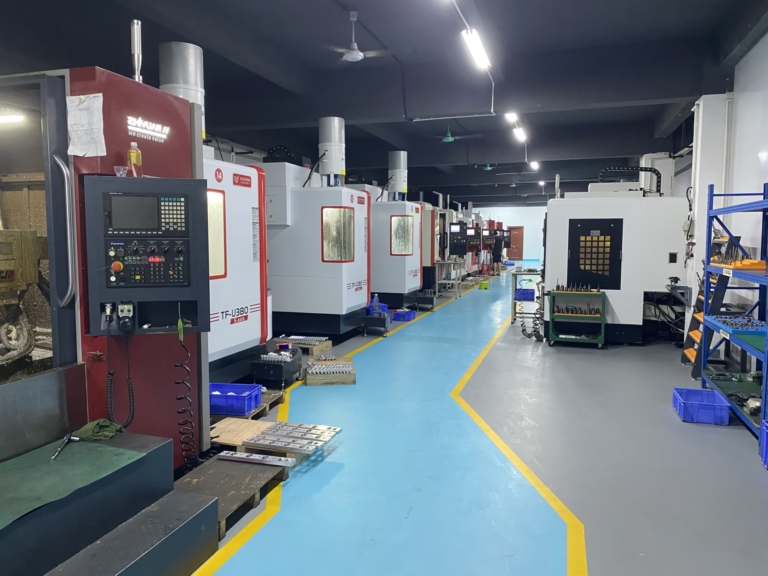
A quoted lead time is really a statement about free spindle hours. Shops with a deep machine list can absorb a rush job without pushing other work aside. GreatLight runs 127 high-precision CNC machines, including 16 simultaneous 5-axis centers, 12 four-axis mills, 27 three-axis machines and 16 mill-turn centers across three plants totaling 7,600 m².
Ask when production starts, not just when parts ship. A 3–5 day ship window only holds if the shop can start cutting within 24 hours of drawing release. If material has to be ordered and the fixture has to be designed first, that window stretches and nobody tells you until week two.
For repeat work, ask how the shop stores your fixture and program. A supplier that keeps the setup on file can restart a job in days. One that rebuilds the fixture each time will quote the same lead time but deliver later.
Historical performance is worth requesting. A shop tracking its own on-time rate can tell you the number. If the answer is vague, treat the lead time as optimistic.
- 1Quote and DFMWithin 12 hours, including free manufacturability analysis.
- 2Production startWithin 24 hours of drawing and material release.
- 3ShippingParts ship in 3–5 days on standard work.
MOQ, Unit Cost and Where the Money Goes
Minimum order quantity is the fastest way to tell which customers a shop is built for. A supplier with no MOQ will run one prototype and a 10,000 part run on the same floor. That flexibility matters in product development, where the first ten parts are a design check and the next thousand are a production trial.
Unit cost on small quantities is dominated by setup, not material. Programming, fixturing and first-article inspection are fixed costs spread over the batch. On a five-part order, setup can be 60–70% of the price. On a 5,000-part order it drops to a rounding error.
Material choice swings cost more than most engineers expect. 6061-T6 is cheap and machines well. 17-4PH stainless and Ti-6Al-4V cost more per kilogram and cut 3–5 times slower, so the machining time, not the stock, drives the quote.
Get the quote broken into material, machining, finishing and inspection. A single lump sum hides where to negotiate and makes it impossible to compare two suppliers fairly.
- 1Prototype to productionNo minimum order quantity, from one part to 10,000+ runs.
- 2Setup dominates small batchesAsk what the setup charge covers before you compare totals.
- 3Finishing is a separate lineAnodizing, plating and powder coating should be itemized.
Certifications, Inspection and Data Handling
Certifications tell you which industries a shop is audited for. ISO 9001:2015 covers general quality management. IATF 16949:2016 adds automotive traceability and PPAP discipline. ISO 13485:2016 is the medical device standard. ISO 27001:2022 covers information security, which matters when your drawings are the product.
Inspection depth is the practical question. A shop running 100% inspection before shipment checks raw material on arrival, monitors dimensions in process, and does a final pass before the box closes. Reports can be supplied on request. That last part is worth confirming early, because some shops charge extra for a dimensional report.
Ask how non-conformances are handled. Every shop produces a bad part occasionally. The difference is whether you hear about it before the shipment or after your assembly line stops.
For medical and automotive work, ask for the sample approval route. A first article inspection report on the first part of a new program catches a misread drawing before 500 parts are cut wrong.
- 1Quality systemsISO 9001:2015, IATF 16949:2016, ISO 13485:2016, ISO 27001:2022.
- 2Inspection100% before shipment, with reports available on request.
- 3ConfidentialitySecure uploads and an NDA available on request.
Warning Signs in the First Two Emails
A quote that arrives without a single question about the drawing is a warning. Tolerances, datums and finish callouts usually need at least one clarification. A shop that quotes silently either read it perfectly or did not read it at all.
Vague answers about capacity are the second flag. If you ask how many machines the shop runs and the reply is a marketing paragraph, you cannot judge whether your job fits. Concrete numbers matter: machine count, axis configuration, maximum part size, and the largest part the shop has actually cut.
Watch for finishing that is always subcontracted with no named partner. Surface treatment is where schedules slip, because the shop is waiting on someone else. In-house anodizing, plating, powder coating and laser marking remove that dependency.
Finally, check how the shop handles your files. A supplier that asks you to email a STEP file to a personal address is not treating your design as confidential. Secure upload and a signed NDA are the baseline.
- 1No DFM feedbackA real shop flags thin walls, deep pockets and tight radii before quoting.
- 2No machine listYou cannot judge fit without axis count and size range.
- 3Brokered finishingEvery outsourced step is a schedule risk you did not choose.
A Six-Step Way to Vet a CNC Outsourcing Partner
Run the same steps with every supplier so the comparison is fair.
- 1Send a drawing with real tolerancesInclude GD&T, datums, surface finish and material spec. A drawing marked ±0.05 mm general tolerance will get a faster, cheaper quote than one padded with ±0.005 mm everywhere.
- 2Read the DFM notes, not just the priceGood feedback names specific features: a 0.8 mm wall, a 12 mm deep 3 mm wide slot, a radius smaller than the tool. That tells you the shop modeled the part.
- 3Ask for the machine that will run the jobGet the axis configuration and work envelope. For parts near 4,000 mm, confirm the bed size before you commit.
- 4Confirm the lead time in writingSeparate quote turnaround, production start and ship date. A 12-hour quote and a 24-hour production start are different promises.
- 5Agree the inspection scopeDecide up front whether you need a first article report, a full dimensional report, or just a certificate of conformance.
- 6Sign the NDA before you send production filesKeep the RFQ package to the minimum needed for pricing, and release full CAD only after the NDA is countersigned.
Common questions about outsourcing CNC work
What tolerance should I put on a general drawing note?
A general note of ±0.1 mm covers most brackets, covers and housings and keeps the quote low. Put the tight tolerance only on the features that need it, usually bearing bores, dowel holes and sealing faces.
If a feature truly needs ±0.005 mm, call it out individually and say how it will be measured. A tolerance nobody can inspect is a tolerance nobody can hold.
Is there a minimum order quantity?
GreatLight has no minimum order quantity. We run single prototypes and 10,000+ part production runs on the same equipment.
Small orders cost more per part because setup is spread over fewer pieces. That is normal and worth expecting rather than negotiating away.
How fast can parts ship?
Quotation and free DFM analysis come back within 12 hours. Production can start within 24 hours, and parts ship in 3–5 days on standard work.
Rush jobs depend on machine availability at the moment you release the drawing. Ask before you promise a date to your own customer.
Which materials can be machined?
Aluminium grades 6061, 6061-T6, 2024, 5052, 5083, 6063, 6082, 7075 and ADC12. Stainless 303, 304, 316, 316L, 420, 430, 431, 440C and 17-4PH.
Steel 1018, 1045, 4130, 4140, 4340, A36 and tool steel. Copper and brass including C36000. Titanium TA1, TA2, TC4, plus Inconel and magnesium alloys. Plastics from ABS and POM to PEEK and carbon fibre.
How are my drawings protected?
Uploads are secure and confidential. An NDA is available on request and we hold ISO 27001:2022 for information security.
Send only what the quote requires at first. Full production CAD can follow once the NDA is signed.
What finishing can be done in-house?
Anodizing in clear, colour, hardcoat and conductive variants. Electroless nickel, zinc, silver and gold plating. Powder coating and black oxide. Bead blasting, tumbling, brushing and polishing.
Laser marking and engraving are available down to a minimum character height of 1.5 mm.
Send a drawing and get a real answer
Upload your STEP file and we will return a quote with DFM notes within 12 hours. No minimum order quantity, secure uploads, NDA on request.
12-hour quote100% inspectionNo MOQ
More from GreatLight
We publish setup notes, tooling trials and inspection data from the factory floor.











