
CNC Loading and Unloading: How Smart Automation Works
This page explains the mechanics of automated CNC loading and unloading for engineers and buyers. It covers gripper types, part presentation, cycle-time math, and the part families where a robot cell is worth the capital. You will also see the cases where manual load stays the better choice.
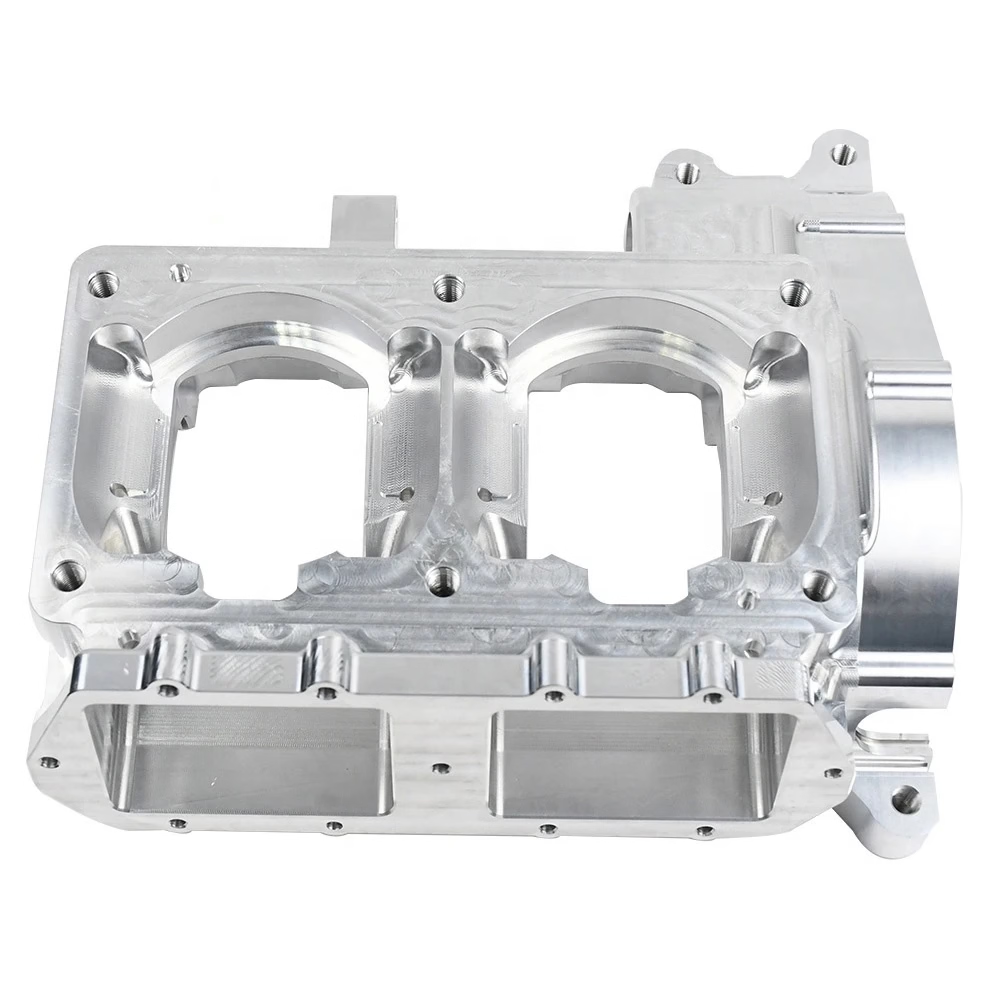
What CNC Loading and Unloading Actually Moves
Automated handling is a material loop wrapped around a machine tool. Four motions repeat: pick the blank, place it in the workholding, cut, then remove the finished part. On a lathe the loop adds a chuck or collet cycle. On a mill it adds a vise, fixture plate or tombstone. Each motion has a time cost, and that cost decides whether automation pays.
The loop is not the same as the cutting cycle. A machine may cut for 8 minutes and sit idle for 3 more while an operator walks over, opens the door, blows chips, unclamps and reloads. That idle time is what a cell removes. Where the cut is short, the handling share is large and automation gains are easy to see.
Part presentation matters as much as the robot. A blank thrown into a bin cannot be gripped reliably. Blanks must arrive at a known position: a tray pocket, a magazine slot, a pallet nest, or a conveyor with a hard stop. The presentation error becomes the robot's positioning error, and it stacks on top of gripper repeatability.
Cycle time math is simple. Total time equals cut time plus load time plus any queue or transfer time. If the load step drops from 40 seconds to 8 seconds on a 90-second cycle, the machine gains roughly 25 percent more parts per shift. That number, not the robot's speed rating, is the one to quote to finance.
Gantry, Robot Arm and Pallet Systems
A gantry loader rides above the machine and drops parts straight down through the spindle axis. It fits lathes and mills with an open top or a dedicated loading window. Travel is short and rigid, so cycle times are fast, often under 6 seconds for a small shaft. The trade-off is limited reach. A gantry usually serves one machine, sometimes two.
A robot arm reaches further and can serve several machines from one base. A 6-axis arm with a payload of 10 to 50 kg covers most automotive and electronics parts. Reach of 1,300 to 1,800 mm lets one arm feed two mills and a deburring station. Pick-and-place repeatability of ±0.02 mm to ±0.05 mm is normal, which is fine when the workholding has a lead-in chamfer.
Pallet systems move the part on a fixture plate, not in a gripper. A pallet pool with 6 to 12 stations lets a machine cut while the operator loads the next pallet outside the enclosure. Setup changes happen off-machine. This is the best fit for high-mix work with 20 to 200 parts per batch, because the pallet carries its own zero point.
A mill-turn center with a Ø400 mm rotary table can combine turning and milling in one setup. Adding a robot or gantry to that machine removes a second handling step. Fewer setups means fewer chances to lose datum, which is often worth more than the raw cycle-time gain.
- 1Gantry loaderFast, compact, one or two machines. Best for shafts and small housings.
- 2Robot armFlexible reach, serves several machines, needs safe part presentation.
- 3Pallet poolOff-machine setup, good for high-mix batches and tight datum control.
- 4Mill-turn plus robotOne handling step for turned and milled features on the same part.
When Automation Loses to Manual Load
Short runs do not justify a cell. If a batch is 5 parts and the next order is a different geometry, the fixture, gripper and program changeover eats the gain. Manual load with a quick-change vise can be ready in 15 minutes. A robot cell may need an hour of teaching and jaw changes.
Awkward geometry defeats simple grippers. Thin walls, flexible seals, loose tolerances on the blank, and parts that tangle in a bin all push toward manual handling or a custom nest. A blank with ±1 mm casting variation may need a compliant gripper or a vision check before the robot commits.
Surface finish can also veto a gripper. A cosmetic anodized face or a polished sealing surface cannot take jaw marks. You either grip on a sacrificial boss, use vacuum, or hand-load the last op. Each workaround adds cost and a failure mode.
One more boundary is inspection. If every part needs a CMM check, the handling loop is not the bottleneck. The measuring step is. Automating load without automating inspection just moves the queue.
Holding ±0.005 mm Through the Load Cycle
Automation does not improve machine accuracy. It protects it by making every load identical. A robot that places a blank into the same nest with ±0.03 mm repeatability lets the fixture do the final locating. The fixture, not the gripper, sets the datum.
Chip control becomes critical once the door stays closed. A nest pocket that fills with chips will seat the next blank high by 0.1 mm or more. Air blast, through-spindle coolant, and a sloped nest floor are standard fixes. This is the most common cause of a good cell drifting out of tolerance.
Thermal drift still applies. A machine that runs unattended for 6 hours will grow. In-process probing every 20 to 50 parts and a tool-wear offset keep the size centered. Without probing, an automated cell can produce a full tray of scrap before anyone sees a trend.
For parts held at ±0.005 mm, we probe the first article and then sample every 25 parts. Reports are available on request. The handling method never replaces inspection, it only feeds it faster.
Manual Load vs Gantry vs Robot vs Pallet
Match the handling method to batch size, part geometry and datum needs.
| Method | Best batch size | Cycle gain | Main limit |
|---|---|---|---|
| Manual load | 1–20 parts | Baseline | Operator idle time, fatigue |
| Gantry loader | 500+ parts | 20–35% | Short reach, one machine |
| Robot arm | 200–5,000 parts | 15–30% | Needs fixed part presentation |
| Pallet pool | 20–200 parts | 10–25% | Fixture cost per part family |
| Mill-turn + robot | 100–2,000 parts | 20–40% | Higher cell integration cost |
Verdict
Choose a robot cell when batches run 200 parts or more and the blank can be presented in a fixed nest. Stay manual when batches are under 20 parts, the blank varies, or the part needs a CMM after every op.
Frequently Asked Questions
Does automated loading change the tolerance we can hold?
No. The machine and fixture set the tolerance, not the loader. Automation helps by repeating the same placement every cycle, which removes operator-to-operator variation.
For work at ±0.005 mm we still probe the first article and sample during the run.
How do you handle parts that cannot take gripper marks?
We grip on a sacrificial boss, use soft jaws lined with POM or urethane, or switch to vacuum for flat panels. A cosmetic face is never used as a gripping surface.
The added operation is quoted, not hidden.
What batch size makes a robot cell worthwhile?
Roughly 200 parts and up for a robot arm, and 500 and up for a dedicated gantry. Below that, fixture and gripper changeover usually costs more than the cycle-time gain.
High-mix work with 20 to 200 parts per batch suits a pallet pool better.
Can you run lights-out production?
We run unattended shifts on parts with stable geometry and reliable chip evacuation. Tool life monitoring and in-process probing are required.
Parts with strict surface or burr requirements still get a manual check.
Do you need a special blank tolerance for automation?
A consistent blank helps. For castings and forgings we prefer ±0.5 mm or tighter on the locating features. Wider variation needs a compliant gripper or a vision check.
We review the blank drawing during DFM before quoting.
How is confidentiality handled for customer drawings?
Uploads stay secure and confidential. We hold ISO 27001:2022 and sign an NDA on request.
Your part files are used only for quoting and machining.
Send Your Part for a Handling Review
Share a drawing and we will tell you whether manual load, a gantry, a robot or a pallet pool fits your batch, with a quote and free DFM analysis in 12 hours.
12-hour quoteFree DFM analysis100% inspectionNDA on request
More from GreatLight
We publish setup notes, tooling trials and inspection data from the factory floor.











