
CNC Center Specifications: A Buyer's Guide to the Numbers That Matter
A machining center datasheet lists hundreds of values. Most of them do not decide whether your part comes out right. This guide walks through the CNC center specifications that actually constrain a job: work envelope, spindle, table load, axis count, and stated accuracy. Read it before you send an RFQ.
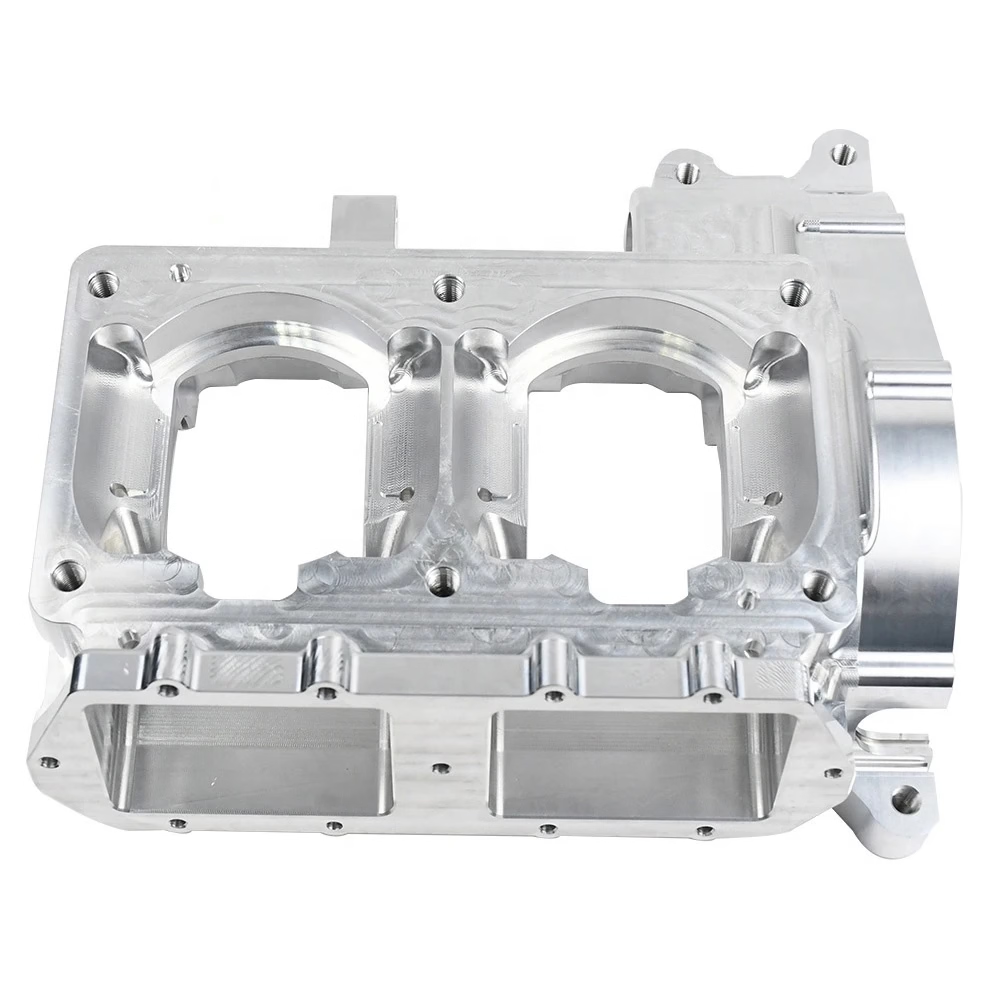
Travel and table size set the ceiling
The first number to check on any CNC center specifications sheet is the axis travel: X, Y, and Z. Travel is the distance the spindle can move, not the size of the part you can cut. A 4,000 mm X travel does not mean a 4,000 mm part fits, because the fixture, tool holder, and clearance eat into that range before the first cut starts.
Table size matters just as much. A part can fit inside the travel envelope and still fail because there is no room to clamp it. On a 500 × 500 mm table, a 480 mm plate leaves almost nothing for clamps, so the part either moves or gets machined in two setups with a seam in the middle.
Add the fixture envelope to the part envelope before you compare. A part that needs 350 mm of Z travel with a 150 mm vise and a 100 mm tool holder needs 600 mm of Z on the machine. That is the number to check, not the raw part height.
Workholding also depends on weight. A heavy steel block on a light table will sag, and the cut will drift. Table load ratings are usually listed in kg, and they are worth reading before you commit a large part to a small machine.
- 1Check travel plus fixtureSubtract vise, chuck, and tool holder length from Z travel.
- 2Check table load in kgA 500 kg part on a light table causes deflection.
- 3Check clearance at the cornersRotary tables reduce usable travel near the edges.
3-axis, 4-axis, or 5-axis: the real difference
Axis count is the most misunderstood line on a CNC center specifications sheet. A 3-axis machine moves the part in X, Y, and Z while the tool stays vertical. It handles flat plates, pockets, and prismatic parts well. It struggles with undercuts, deep side walls, and any feature that faces away from the spindle.
A 4-axis machine adds a rotary table, usually around the X axis. Now you can index the part to four sides without re-clamping, so a shaft with cross holes or a block with features on four faces stays in one setup. The rotary table is indexed, not continuously interpolated, so it is a positioning tool rather than a contouring tool.
A 5-axis machine adds a second rotary axis, so the tool can tilt relative to the part. That is what lets you machine a contoured surface in one pass, reach under a flange, and use a short, stiff tool on a deep pocket. It also means the CAM programmer has to think about tool axis direction, not just toolpath shape.
The trade-off is not just cost. Five-axis setups need more planning, more simulation, and more spindle time per feature in some cases. For a simple bracket, a 3-axis machine is faster and cheaper. For a turbine blade or a medical implant with compound curves, 5-axis is the only way to hold the tolerance without five separate fixtures.
- 13-axis suits flat, prismatic workBest for plates, pockets, and through holes.
- 24-axis cuts re-clampingIndex four faces in one setup with a rotary table.
- 35-axis reaches undercutsTilting tool axis machines compound curves in one pass.
Spindle speed and power: what the material demands
Spindle speed is listed in rpm, but the number that matters for a given material is surface speed. Aluminium likes high rpm and high feed. Titanium and Inconel like low rpm, high torque, and a rigid setup. A spindle rated at 24,000 rpm is not automatically better than one at 12,000 rpm; it depends on what you are cutting.
Spindle power, usually in kW, sets the depth of cut you can take without stalling. A 5 kW spindle can rough aluminium aggressively but will struggle in 4140 steel. A 20 kW spindle with a geared head can take heavy cuts in steel, but it may not reach the rpm needed for small cutters in aluminium.
Spindle taper matters too. BT30 and HSK-E40 are common on high-speed machines with small tools. BT40, CAT40, and HSK-A63 handle larger tools and heavier cuts. If your part needs a Ø20 mm end mill at 100 mm depth, a small taper will chatter no matter how good the rest of the machine is.
Cooling through the spindle is a spec worth checking for deep holes. Through-spindle coolant at 70 bar clears chips from a Ø8 mm hole at 10× diameter depth. Without it, the drill pecks, the chips recut, and the hole drifts.
- 1Match rpm to materialAluminium wants high rpm; titanium wants torque.
- 2Check kW against cut depthA 5 kW spindle stalls in heavy steel roughing.
- 3Check taper against tool sizeBT40 handles larger tools than BT30.
Positioning accuracy vs. repeatability
Machine specs usually list positioning accuracy and repeatability as separate values, and the difference matters. Positioning accuracy is how close the machine gets to a commanded point. Repeatability is how close it returns to the same point on the next cycle. A machine can have mediocre accuracy and excellent repeatability, which is fine for production runs.
The tolerance on your drawing is not the same as the machine's accuracy spec. Thermal growth, tool wear, fixture deflection, and material spring-back all add error. A machine rated at ±0.005 mm positioning accuracy will not hold ±0.005 mm on a part if the shop floor swings 5 °C during the day.
That is why a stated tolerance like ±0.005 mm comes with conditions: temperature-controlled room, sharp tool, rigid setup, and a finishing pass with light depth of cut. In a normal job shop, ±0.02 mm is a realistic everyday number for most materials and features.
Surface finish is a separate capability. Ra 0.8–1.6 μm is a standard machined finish. Ra 0.2–0.8 μm needs a finishing pass with a small stepover and a sharp tool, and it costs more time. Specify the finish you actually need; over-specifying finish is one of the most common ways to inflate a quote.
- 1Repeatability drives productionA machine that returns to the same point cuts consistent parts.
- 2Tolerance needs conditions±0.005 mm assumes stable temperature and a rigid setup.
- 3Finish has a priceRa 0.2–0.8 μm needs extra finishing time.
Controller, CAM, and post-processor fit
The controller brand on a CNC center specifications sheet tells you what the machine can interpolate and what your CAM software needs to support. Heidenhain and Siemens controls handle 5-axis interpolation well and are common on European machines. Fanuc is everywhere and has a deep post-processor library. The brand matters less than whether your CAM package has a proven post for that exact control model.
Offline programming compatibility is the line to check if you plan to run complex parts. A machine that only accepts programs from the operator console will slow you down on 5-axis work. A machine that accepts CAM output from HyperMill, NX, or Mastercam keeps the spindle cutting while the next job is programmed.
Look at the control's look-ahead and feed-rate limiting. High-speed contouring needs the control to process blocks ahead of the cutter and slow down on tight corners. Without it, the machine overshoots and the surface shows faceting.
Tool management is part of the same system. A 30-tool magazine with a broken-tool detector saves manual checks on a long run. A 12-tool magazine means more stops. Neither is wrong; it depends on how many tools your part needs.
- 1Post-processor availabilityCheck that your CAM package supports the control model.
- 2Look-ahead for contouringHigh-speed milling needs block look-ahead to avoid faceting.
- 3Tool magazine sizeA 30-tool magazine reduces stops on complex parts.
Which machine class fits which part
Use this as a first filter before you request a quote.
| Machine class | Typical travel | Best for | Watch out for |
|---|---|---|---|
| 3-axis vertical | 750 × 1,150 × 550 mm | Plates, brackets, pockets | No access to undercuts |
| 4-axis with rotary | Ø400 mm rotary table | Shafts, cross holes, four-face parts | Indexed, not contoured |
| 5-axis simultaneous | 500 × 500 × 450 mm | Compound curves, deep pockets | Needs CAM and simulation time |
| Large gantry | 4,000 × 400 × 150 mm | Long structural parts | Limited Z and tool clearance |
| Mill-turn | Ø400 mm × 1,000 mm | Turned parts with milled features | Setup planning is complex |
The short version
If your part fits a 3-axis envelope and has no undercuts, do not pay for 5-axis time. If it has compound curves or features on five faces, 5-axis is the only setup that holds tolerance without stacking fixtures. Match the machine to the part, not the part to the machine.
Common questions
Does a higher spindle rpm always mean a better machine?
No. High rpm helps small tools in aluminium and plastics. Steel and titanium need torque at lower rpm. A 12,000 rpm spindle with a geared head can out-cut a 24,000 rpm spindle in 4140 steel.
Match the spindle to the material you cut most often, not to the highest number on the sheet.
How do I know if my part needs 5-axis machining?
Look for features that face away from the spindle, compound curves, or deep pockets that need a short tool. If you can machine the part in two or three 3-axis setups without losing tolerance at the seam, you probably do not need 5-axis.
If the part has a contoured surface that must blend across faces, 5-axis is usually the cheaper route once you count fixture and setup time.
What tolerance can a shop actually hold?
±0.005 mm is achievable on critical features with a stable setup, sharp tool, and temperature control. For everyday features on most materials, ±0.02 mm is a realistic number.
Ask the shop which features need the tight tolerance. Applying it to every dimension raises cost without improving function.
Does table load matter for small parts?
Only if you stack many parts on a fixture or run a heavy vise. The load rating protects the table and the linear guides from deflection.
For a single small part, table load is rarely the limiting factor. Travel and clamping space usually are.
What is the difference between positioning accuracy and repeatability?
Positioning accuracy is how close the machine gets to a commanded point. Repeatability is how close it returns to the same point on the next cycle.
Production runs care more about repeatability. A machine that hits the same point every time will make consistent parts even if that point is slightly off the nominal.
Do I need through-spindle coolant?
For holes deeper than 5× diameter, yes. Through-spindle coolant at 70 bar clears chips and keeps the drill on center.
For shallow holes and open pockets, flood coolant is enough. Adding through-spindle coolant to a job that does not need it raises the hourly rate.
Send the drawing, get a process answer
Tell us the material, tolerance, and quantity. We will match the part to a machine class and send a quote with free DFM analysis within 12 hours.
12-hour quote100% inspectionNo minimum orderNDA on request
More from the shop floor
We publish setup notes, tooling trials and inspection data from the factory floor.











