
China's 5 Axes CNC Processing Manufacturers: How to Compare
This page is for engineers and sourcing staff who need to pick a 5-axis supplier in China and want a checklist instead of a list of names. It covers machine configurations, the difference between simultaneous 5-axis and 3+2, what tolerances are realistic, and how to read an inspection report. You will be able to tell which shops can actually hold your part.
What this guide covers
Five-axis capacity is easy to claim and hard to verify. Here is what to check before you send a drawing.
Simultaneous 5-axis is not the same as 3+2
Almost every supplier page in China says 5-axis. The number that matters is how many of those machines run five axes at the same time. A 3+2 machine tilts the table to a fixed angle, locks it, then cuts with three linear axes. The setup is fast and rigid, and for a part with five or six faces it is often the cheaper route. But the tool cannot follow a continuously changing surface normal, so a twisted blade or a port with a compound angle will come out faceted.
A true simultaneous machine moves X, Y, Z, A and C together while the cutter is in the material. That is what makes a sculpted surface come off the tool at Ra 0.8–1.6 μm without hand polishing, and what lets a single setup reach five faces of a prismatic housing. The trade-off is programming time and a slower feed on tight corners, so shops do not run every job this way.
Before you compare suppliers, ask how many simultaneous centers they own and what travels those machines have. At GreatLight we run 16 simultaneous 5-axis machining centers, alongside 12 four-axis mills and 27 three-axis machines. A shop with two 5-axis machines and forty 3-axis machines will quote your complex part, then move it to a 3-axis cell after the first article.
Machine travel decides whether your part fits at all. Our large frame handles 4,000 × 400 × 150 mm, medium frames cover 750 × 1,150 × 550 mm and 600 × 600 × 600 mm, and compact cells run 500 × 500 × 450 mm and 500 × 310 × 200 mm. A Ø400 mm rotary table sets the practical limit for parts that need full rotation.
When 5-axis helps and when it does not
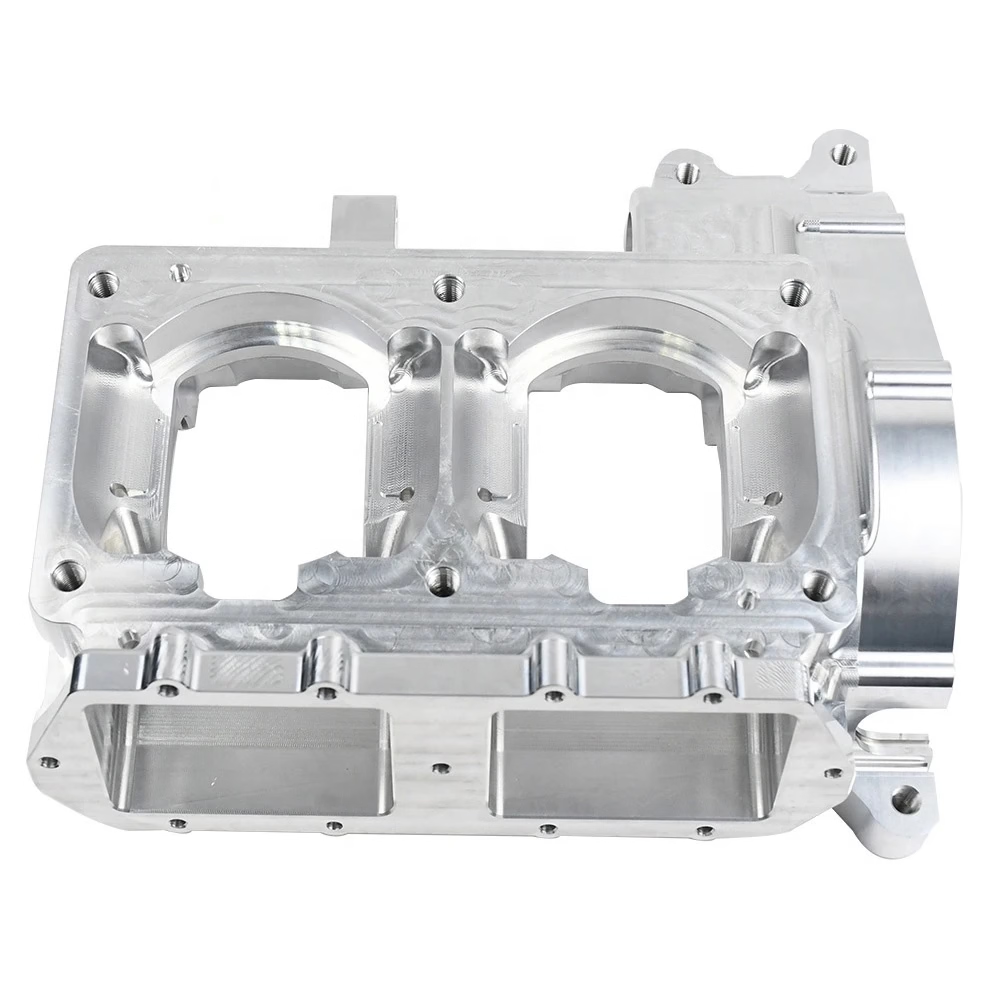
Five-axis work earns its cost in three situations. The first is accessibility: a deep pocket, an undercut, or a face that a three-axis spindle simply cannot reach without a second or third setup. The second is position tolerance: features that must stay true to each other across five faces, such as bolt patterns on a gearbox housing or a manifold with angled ports. The third is surface continuity on curved geometry.
There are also cases where we steer customers away. A flat plate with through holes and a couple of pockets runs faster and cheaper on a three-axis mill. A turned shaft with a cross hole usually belongs on a mill-turn center, not a 5-axis mill. If a part is prismatic and every feature is reachable from two directions, the extra axis adds programming hours and buys nothing.
Setup count is the number to watch in a quote. Each additional setup adds fixturing, a re-datum, and a stack-up of positional error. A part that needs five setups on a 3-axis machine may need one on a 5-axis machine. That reduction is often worth more than the hourly rate difference, especially on runs of 50 to 500 pieces.
For prototypes, the calculation changes again. One-off parts rarely justify a dedicated fixture, so we often cut them from a single billet with soft jaws and leave stock for a finishing pass. Design changes are easier to absorb when the datum stays in the same setup.
Which machine class fits which part
Use this as a first filter before you send an RFQ.
| Part characteristic | Best machine class | Why |
|---|---|---|
| Flat plate, holes from two faces | 3-axis mill | Two setups, lowest hourly cost |
| Shaft with cross holes | Mill-turn center | Turning and milling in one setup |
| Housing, five faces, tight true position | Simultaneous 5-axis | One datum, no re-fixturing |
| Blade or impeller, twisted surface | Simultaneous 5-axis | Cutter follows surface normal |
| Angled ports, six faces, moderate volume | 3+2 (positioned 5-axis) | Rigid locked table, fast setup |
| Large frame, 4,000 mm long | Large 5-axis frame | Travel 4,000 × 400 × 150 mm |
What tolerances a China 5-axis shop can hold
A tolerance claim means nothing without the inspection method behind it. ±0.005 mm is achievable on a well-maintained simultaneous machine with temperature control, a warm-up cycle, and a probe on the table. It is not achievable on a machine that sits in a workshop with the roller door open, and no amount of quoting will change that.
The part geometry sets the real limit. A 50 mm aluminum bracket is a different problem from a 900 mm steel frame. Thermal drift over a long cycle, tool deflection in a deep pocket, and workholding stiffness all move the number. For most production parts we hold ±0.005 mm on critical features and ±0.05 mm on non-critical ones, and we tell customers which is which on the drawing review.
Surface finish follows the same logic. Ra 0.2–0.8 μm normally means a finishing pass with a small stepover, sometimes followed by polishing. Ra 0.8–1.6 μm comes straight off a clean finishing pass on aluminum or brass. Ra 1.6–3.2 μm is a normal as-machined result and is fine for most brackets and housings.
Inspection is where you separate shops. We check raw material certificates on arrival, monitor in-process dimensions, and run a final inspection on 100% of parts before shipment, with reports available on request. Ask any supplier what they measure, with what, and how often the equipment is calibrated.
Documents and questions that filter the list fast
Certification is a starting filter, not a ranking. ISO 9001:2015 covers general quality management. IATF 16949:2016 matters if you are buying automotive or EV parts. ISO 13485:2016 applies to medical device work, and ISO 27001:2022 is about how your files and drawings are protected. A shop that holds all four has been audited on process, traceability, and data handling.
Then ask for the DFM feedback loop. The useful answer is not a price, it is a short list of features that will be hard to machine and a suggested change. We return a quotation and free DFM analysis within 12 hours, and production can start within 24 hours after drawing approval. Standard parts ship in 3–5 days.
Material range is another quick filter. Aluminum 6061 and 7075, stainless 303, 304, 316L and 17-4PH, steel 4140 and 4340, titanium TC4, Inconel, and engineering plastics such as POM and PEEK all behave differently on a 5-axis machine. A supplier who lists everything but stocks nothing will sub-contract the material and lose a week.
Finally, ask about confidentiality. Drawings for an unreleased product should not sit in a shared folder. Uploads are handled as confidential, and we sign an NDA on request before any file moves.
One more question is worth asking: who programs the part. On complex 5-axis work the programmer decides whether the job runs in one setup or four. Ask to speak with the person who will write the toolpaths, not only the sales contact.
Common questions
How do I tell simultaneous 5-axis from 3+2 before I place an order?
Ask for the machine model and the number of simultaneously controlled axes, not the number of axes on the spec sheet. A 3+2 machine has five axes but only three move at once.
Then send a test part with a compound-angle surface and check the surface for faceting. If the shop can show a CMM report on that surface, the answer is usually clear.
Is ±0.005 mm realistic for every 5-axis part?
No. It applies to critical features on a rigid setup with temperature control. Long parts, thin walls, and deep pockets will carry looser numbers.
We mark critical and non-critical tolerances during drawing review so both sides agree on what will be measured.
What is the smallest and largest part you can machine?
The largest frame travels 4,000 × 400 × 150 mm. Medium cells cover 750 × 1,150 × 550 mm and 600 × 600 × 600 mm, and compact cells cover 500 × 500 × 450 mm and 500 × 310 × 200 mm.
Small parts are limited by workholding, not by the spindle. Below roughly 5 mm, fixturing and tool access become the real constraint.
Do you have a minimum order quantity?
No. We run from one prototype to 10,000+ part runs on the same process.
Prototype and production parts are cut on the same machine class where possible, so the first article reflects what you will get in volume.
Which certifications should I ask for?
ISO 9001:2015 for general quality management. Add IATF 16949:2016 for automotive, ISO 13485:2016 for medical, and ISO 27001:2022 if your drawings are sensitive.
We hold all four. Ask for the scope statement, not just the certificate number.
How fast can I get parts?
Quotation and free DFM analysis come back within 12 hours. Production can start within 24 hours after approval, and standard parts ship in 3–5 days.
Complex geometry or a new material can push the first article out. We will say so in the quote rather than after the order.
Send a drawing and get a DFM answer, not a sales pitch
Upload your files and we will return a quotation, a machinability note, and a realistic tolerance call within 12 hours.
12-hour quote100% inspectionNDA on request









