
China's CNC Center Serves Egypt: What Engineers Should Check
This page explains how a China CNC center serves Egyptian buyers: what Dongguan capacity actually looks like, which parts fit, how tolerances and materials are held, and how parts reach Cairo or Alexandria. Written for design and sourcing engineers who compare a Chinese supplier against a local machine shop.
How to read this page
Capacity, tolerances, materials and logistics, in the order an engineer would ask about them.
What a Dongguan CNC center can actually hold
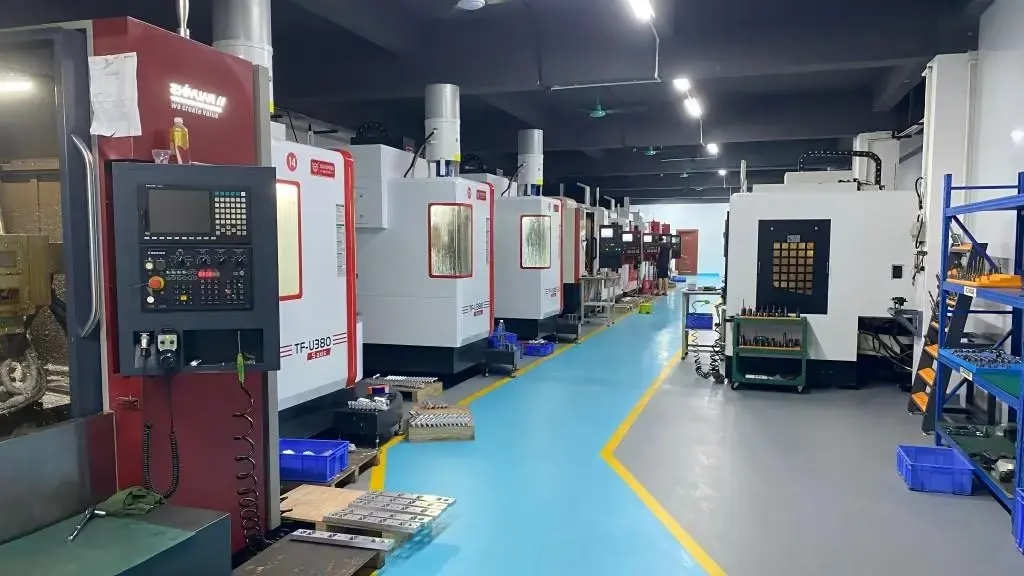
Egyptian buyers usually arrive with one of two problems: a part that is too complex for the local shop, or a part that is simple but needed in volume at a price the local shop cannot reach. Both are capacity questions. GreatLight runs 127 high-precision CNC machines across three wholly-owned plants covering 7,600 m², with 150 technicians in Dongguan, China, plus a factory in Singapore. That spread matters because a job rarely sits on one machine from start to finish.
The fleet breaks down by axis count. There are 16 simultaneous 5-axis machining centers, 12 four-axis mills, 27 three-axis machines and 16 mill-turn centers. Maximum processing size is 4,000 mm, with travels of 4,000 × 400 × 150 mm on the large frame, 750 × 1,150 × 550 mm and 600 × 600 × 600 mm on the medium frames, and 500 × 500 × 450 mm or 500 × 310 × 200 mm on the compact machines. A Ø400 mm rotary table covers round work that would otherwise need a second setup.
Axis count is not a marketing number. It decides how many faces you can cut in one fixturing. A housing with bores on four sides is a 5-axis job if you want true position held between them, because the part stays clamped while the table indexes. Put the same part on a three-axis mill and you add setups, and every setup adds stack-up.
When a job does not fit, it usually fails on one of three limits: the part is longer than 4,000 mm, the wall is thin enough that clamping distorts it, or the feature needs a tool reach the geometry cannot give. Say so early. A re-orientation or a soft-jaw fixture is cheaper than a redesign.
Tolerances, finish and inspection
GreatLight machines to ±0.005 mm (±0.0002 in) on features that need it. That is a shop-floor capability, not a claim that every dimension on every drawing lands there. Tolerance costs money in proportion to how tight it is, so the useful question is which features actually carry function. A bearing bore at ±0.005 mm and a clearance hole at ±0.2 mm should not be priced the same way, and on a well-marked drawing they are not.
Surface finish is quoted the same way. As-machined aluminum lands around Ra 1.6–3.2 μm. A finish pass gets you Ra 0.8–1.6 μm, which is where most sealing faces and sliding surfaces sit. Fine work reaches Ra 0.2–0.8 μm, usually on hydraulic or optical parts. If your drawing calls Ra 0.4 μm on a non-functional face, expect a question back.
Inspection runs through the whole order, not just at the end. Raw material is checked on arrival, in-process dimensions are monitored while the part is still on the machine, and every part is inspected before shipment. Reports are available on request. For Egyptian buyers who cannot fly in for a first article, that paper trail is often the only visibility they get, so ask for it on the first order rather than the third.
The shop holds ISO 9001:2015, IATF 16949:2016, ISO 13485:2016 and ISO 27001:2022. IATF 16949 matters if your end customer is an automotive or EV tier, ISO 13485 if the part is a medical device component, and ISO 27001 covers how your files are handled.
Which process fits which part
Pick by geometry and volume, not by habit.
| Part type | Best fit | Why |
|---|---|---|
| Single prototype, simple shape | 3-axis mill | Lowest setup cost, fastest to first part |
| Housing with bores on 4+ faces | 5-axis center | One fixturing, true position held between faces |
| Shaft with turned and milled features | Mill-turn center | Turning and milling in one cycle, no re-chuck |
| Thin-wall enclosure | 5-axis, light passes | Fewer setups, less clamping distortion |
| Round flange, Ø400 mm or less | Rotary table | Indexing without re-fixturing |
| Long frame over 4,000 mm | Split or re-design | Exceeds maximum processing size |
Materials and finishes we keep in stock
Aluminum covers most of what ships to Egypt: 6061, 6061-T6, 2024, 5052, 5083, 6063, 6082, 7075 and ADC12 die-cast alloy. Stainless runs from 303 and 304 through 316, 316L, 420, 430, 431, 440C and 17-4PH (SUS630). Steels include 1018, 1045, 4130, 4140, 4340, A36 and tool steel. Copper and brass grades are C101, C103, C110, beryllium copper, C27400, C28000 and C36000. Titanium and specialty stock covers TA1, TA2, TC4 (Ti-6Al-4V), Inconel, and magnesium AZ31B or AZ91D. Plastics include ABS, PC, PMMA, POM, PA, PEEK, PP, HDPE and carbon fibre.
Machining is not the end of the route. Anodizing comes in clear, colour, hardcoat and conductive versions. Electroless nickel, zinc, silver and gold plating are available, along with powder coating and black oxide. Bead blasting, tumbling, brushing and polishing handle the cosmetic side. Laser marking and engraving are done in-house down to a minimum character height of 1.5 mm, which is the practical floor for a readable serial number or part mark.
Two material notes worth raising before you send a drawing. First, 7075 machines well but does not anodize to the same cosmetic uniformity as 6061, so a hardcoat part in 7075 will show colour variation. Second, 17-4PH in the H900 condition is tough on tooling; if the drawing allows annealed stock with a post-machining heat treat, cost and lead time both improve.
Mixing families in one order is normal here. A prototype bracket for an EV cable route and a machined sensor housing can run in the same shop without a separate supplier for each, which is the main reason buyers consolidate a mixed BOM into one Chinese order.
How the Egypt route works in practice
The commercial model is deliberately flat. There is no minimum order quantity, so one prototype and a 10,000+ part run sit on the same quote sheet. Quotation and a free DFM analysis come back within 12 hours. Production can start within 24 hours of a released order, and parts typically ship in 3–5 days. Historical late-delivery probability is below 2%, which is a record of past performance, not a promise about your specific job.
DFM feedback is where most of the value sits for a first-time buyer. If a corner radius is smaller than the tool that has to reach it, if a pocket is deeper than four times its width, or if a tolerance is called on a datum that cannot be reached with the part clamped, that comes back before cutting starts. Fixing it on a screen costs nothing. Fixing it after a shipment reaches Alexandria costs a lot more.
Shipping to Egypt runs by air or sea. Air freight suits a prototype or a small batch of high-value parts and clears through Cairo International Airport. Sea freight suits volume and moves through Alexandria or Damietta. Customs paperwork needs a clear commercial invoice with harmonized codes, material description and declared value per line item. Vague descriptions slow clearance more than anything else on the document side.
Confidentiality is covered. Uploads stay private, and an NDA is available on request before you send drawings. For companies in defense-adjacent, medical or automotive programs, that is usually the first document exchanged, not the last.
Questions Egyptian engineers ask
Can a China CNC center serve a one-off prototype for an Egyptian company?
Yes. There is no minimum order quantity, so a single part can be quoted and run. Prototypes usually use three-axis milling or turning unless the geometry needs five-axis work.
The same quote sheet covers runs up to 10,000+ parts, so a prototype that later goes to production does not need a new supplier and a new first-article approval.
How do we verify tolerances when we cannot visit the factory?
Ask for an inspection report with the first shipment. Every part is inspected before shipment, and raw material and in-process checks happen earlier in the route.
For critical features, name them on the drawing as inspection points. That tells the shop which dimensions to record rather than measuring everything at the same weight.
Which certifications matter for automotive or medical work?
IATF 16949:2016 is the one automotive and EV buyers look for. ISO 13485:2016 applies to medical device components. ISO 9001:2015 covers general quality management, and ISO 27001:2022 covers information security.
If your end customer audits your supply chain, tell us at the quote stage so the paperwork is prepared in the right format.
What document problems slow customs clearance in Egypt?
The commercial invoice is the usual culprit. Vague descriptions like 'metal parts' or 'samples' get held. List the material, the process and the declared value per line item.
Harmonized codes should match the actual part, not the closest generic category. A clean invoice clears faster than a detailed packing list with a weak invoice.
When is a Chinese CNC center the wrong choice?
When the part needs daily engineering iteration with the shop floor, or when the geometry is simple enough that a local machinist can hold it at a comparable price, the freight and customs lead time is hard to justify.
Very large or very heavy parts also stop making sense. Maximum processing size here is 4,000 mm, and freight on oversized work can outweigh the machining saving.
What does DFM feedback change on a typical part?
It usually removes one or two features that cost more than they are worth: a tight radius in a deep pocket, a tolerance on a non-functional face, or a finish spec that no one will ever measure.
The part still does its job. The difference shows up on the quote and on the first-article inspection time.
Send drawings, get a quote and a DFM read within 12 hours
Upload your files and we will come back with pricing, a manufacturability review and the process route, covered by an NDA if you need one.
12-hour quoteNo MOQ100% inspectionNDA on request









