
Cheap CNC Solutions Without Losing Tolerance
This page is for engineers and buyers who need low-cost machined parts but still have to hold a real tolerance. We break down where the cost in a CNC part actually sits, which design and material choices remove it, and when sending a drawing to a service shop costs less than buying a machine.
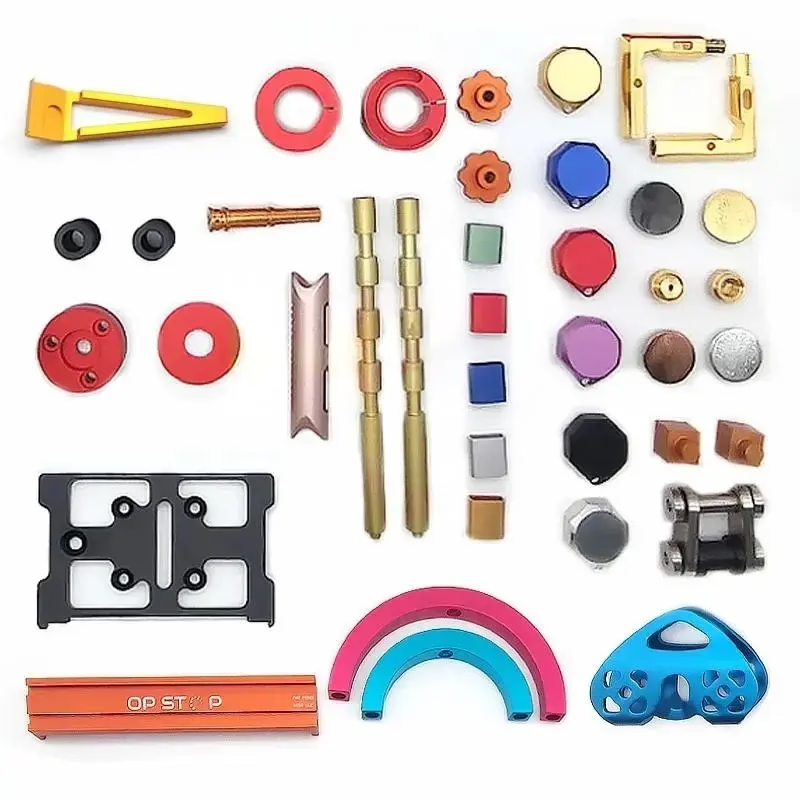
What Actually Drives the Price of a Machined Part
Most of the cost in a CNC part is not the metal. It is the time the spindle spends cutting, the number of setups, and the labor needed to inspect what comes off the table. A 200 g aluminium bracket can cost three times more than a 900 g one if the lighter part has deep pockets, thin walls, and two tight bores that need a separate fixture.
So when people search for cheap cnc solutions, the useful question is not "who is cheapest" but "which of the cost drivers can I remove without losing function". Setup count, tool changes, and inspection time are the three largest levers a designer controls. Material is fourth.
Take setup count first. Every time a part is flipped, re-clamped, and re-zeroed, you add handling time and you add stack-up error. A part that machines from two sides needs two setups. The same part redesigned so that all critical features sit on one face can often run in a single 5-axis setup, which removes a fixture, a re-datum, and a queue wait.
Tool changes matter more than people expect. A pocket with a 3 mm corner radius can be cleared with a Ø6 mm end mill. Drop that radius to 1 mm and the tool drops to Ø2 mm, which means slower feed rates, more passes, and a much higher chance of tool breakage. Rounded internal corners are one of the cheapest design changes available.
- 1Setup countEach extra face adds handling and stack-up error.
- 2Corner radiusLarger internal radii allow bigger, faster tools.
- 3Wall thicknessThin walls force light passes and extra support.
- 4Inspection loadEvery tight callout adds measuring time per part.
Design Choices That Lower the Unit Price
Tolerance is the most expensive line item on most drawings. A bore held at ±0.05 mm can be produced with a standard reamer. The same bore at ±0.005 mm needs a boring head, a warm-up cycle, and a CMM check on a sample basis. If only two dimensions on a part are functional fits, mark those two and open the rest to general tolerance.
Depth-to-diameter ratio is the second one. A Ø4 mm hole that is 40 mm deep needs a long, slender drill that wanders and breaks. Keep blind holes to about 4× diameter when you can, and specify a flat-bottom or corner-relief only where a mating part truly needs it.
Surface finish follows the same logic. Ra 1.6–3.2 μm is what a normal milling cut produces. Chasing Ra 0.2–0.8 μm means slower passes, different tooling, and often a second operation. Unless the surface is a seal face or a sliding contact, as-machined finish is usually enough.
Finally, keep the part self-supporting. A shape that needs a custom soft jaw or a support block adds fixture design time that lands on the first article. Simple prismatic geometry with flat clamping faces often runs at a materially lower piece price than an organic shape of the same size.
- 1Tighten selectivelyHold ±0.005 mm only on functional fits.
- 2Hole depthStay near 4× diameter for blind holes.
- 3FinishRa 1.6–3.2 μm unless it is a sealing or sliding face.
- 4Clamping facesFlat faces keep fixture cost near zero.
Pick Material for the Part, Not for the Spec Sheet
Aluminium 6061-T6 is the default for low-cost machined parts. It cuts fast, holds ±0.005 mm without drama, takes anodizing well, and is widely available in plate and bar. For most brackets, housings, and fixture plates, switching from stainless to 6061 is the single largest cost reduction available.
Stainless 303 and 304 cost more for two reasons: the material price and the cutting time. 303 machines freely because of its sulfur content, so it is the better choice when corrosion resistance is required and the part is not welded. 304 is tougher on tooling and usually slower. 17-4PH adds heat treatment to the routing, which adds days and cost.
Plastics are often the cheapest route for prototypes and low-load parts. POM and ABS machine quickly and need no finishing. PEEK is the opposite: expensive stock and slow cutting, reserved for high-temperature or chemical exposure. Carbon fibre and glass-filled grades wear tools fast, so expect a higher price per part than the same shape in unfilled plastic.
Do not over-specify the alloy. If a 6061 bracket passes the load case, 7075 adds cost without adding value. If corrosion is not a factor, 1018 or 1045 steel is cheaper than stainless and machines cleanly.
- 16061-T6Fast cutting, stable tolerance, anodizes well.
- 2303 vs 304303 machines freely; 304 is tougher and slower.
- 317-4PHAdds heat treatment and lead time.
- 4POM and ABSCheap for prototypes, no finishing needed.
Cost and Capability Trade-offs by Route
Use this to decide between a service shop, a small in-house machine, and a low-cost process before you commit a design.
| Route | Typical part size | Tolerance | Best for |
|---|---|---|---|
| Service shop, 3-axis | Up to 4,000 mm | ±0.005 mm | Prismatic parts, flat features, one or two faces |
| Service shop, 5-axis | Up to 750 × 1,150 × 550 mm | ±0.005 mm | Complex geometry, angled faces, single setup |
| Service shop, mill-turn | Ø400 mm rotary table | ±0.005 mm | Shafts and housings with turned and milled features |
| Desktop CNC, in-house | Under 500 mm | ±0.05 mm and looser | Teaching, jigs, non-critical fixtures |
| 3D printing | Under 300 mm | ±0.1 mm and looser | Fit checks and low-load prototypes |
| Sheet metal | Up to 4,000 mm | ±0.1 mm | Enclosures and brackets from flat stock |
When a Service Shop Beats Buying a Machine
A desktop CNC machine looks cheap at the point of purchase. Add the vise, tooling, a CAM license, a computer to run it, and the floor space, and the entry figure rises quickly. Then add the learning curve. Most buyers take weeks before the first part comes out on size, and the scrap produced along the way is not free.
For one or two prototypes, outsourcing almost always wins. You pay for machine time and setup, not for idle capacity. With no minimum order quantity, a shop can run one part and then run the same program at a 10,000-part volume without a re-quote, which removes the awkward gap between prototype and production.
In-house machines start to make sense when the part never changes, the tolerance is loose, the material is easy, and the machine can run most of the day. That combination is narrower than it sounds. Once a part needs a ±0.005 mm fit, a 5-axis feature, or a report with the shipment, the equipment and metrology cost more than the outsourcing route.
A hybrid works well for many teams: keep a small machine for fixtures and quick jigs, and send functional parts to a shop that already has the spindles, the fixtures, and the inspection. The fixture work stays fast, and the critical parts stay accurate.
- 1OutsourcePrototypes, tight fits, 5-axis features, one-off runs.
- 2Keep in-houseRepeat parts, loose tolerance, simple material.
- 3HybridSmall machine for jigs, shop for functional parts.
Finishing, Inspection, and Where They Add Cost
Finishing is usually a separate operation with its own queue. Anodizing, plating, and powder coating add both cost and days to the schedule, and they can change dimensions slightly. If a bore is anodized after machining, plan for the coating thickness in the drawing or mask the bore.
Bead blasting and tumbling are cheaper than plating and cover tool marks well. Brushing gives a directional finish that hides scratches on flat panels. Laser marking is inexpensive but needs a minimum character height of 1.5 mm to stay legible after coating.
Inspection scales with the number of controlled dimensions. A part with three callouts can be checked with calipers in seconds. A part with thirty can need a CMM program and a report per lot. If the drawing says 100% inspection on everything, expect that cost in the price.
We inspect every part before shipment and can supply reports on request. Raw material checks, in-process monitoring, and final inspection are standard. The honest advice is to keep controlled dimensions to the ones that matter, because every extra one is paid for on every part.
- 1Coating thicknessBudget for it on bores or mask them.
- 2Bead blastingCheap way to cover tool marks.
- 3Laser markingMinimum character height 1.5 mm.
- 4ReportsAsk for what the assembly actually needs.
How We Keep Low-Cost Parts Repeatable
Cost control only works if the second order matches the first. We keep the same program, the same fixture, and the same tool list between runs so that a part made in month one and a part made in month six measure the same. That is what makes a low piece price useful rather than a one-time event.
Our shops run 127 high-precision CNC machines, including 16 simultaneous 5-axis machining centers, 12 four-axis mills, 27 three-axis machines, and 16 mill-turn centers. Maximum processing size is 4,000 mm, with travels from 500 × 310 × 200 mm up to 4,000 × 400 × 150 mm. The right machine for the part keeps cycle time down.
Materials on hand cover aluminium 6061, 6061-T6, 2024, 5052, 5083, 6063, 6082, 7075, and ADC12; stainless 303, 304, 316, 316L, 420, 430, 431, 440C, and 17-4PH; steels 1018, 1045, 4130, 4140, 4340, A36, and tool steel; copper and brass grades; titanium TA1, TA2, TC4, Inconel, and magnesium AZ31B and AZ91D; plus ABS, PC, PMMA, POM, PA, PEEK, PP, HDPE, and carbon fibre.
Quality management is certified to ISO 9001:2015, IATF 16949:2016, ISO 13485:2016, and ISO 27001:2022. Uploads are treated as confidential and an NDA is available on request. Quotation and free DFM analysis come back within 12 hours, production can start within 24 hours, and parts ship in 3–5 days.
- 1RepeatabilitySame program, fixture, and tool list each run.
- 2Machine matchPart routed to the machine that cuts it fastest.
- 3CertificationsISO 9001, IATF 16949, ISO 13485, ISO 27001.
- 4TurnaroundQuote in 12 hours, ship in 3–5 days.
Questions Engineers Ask About Low-Cost CNC
How do I get a lower price without losing the tolerance that matters?
Mark only the functional fits as tight and leave the rest at general tolerance. On most parts that is two or three dimensions.
Then look at internal corner radii and hole depth. Larger radii and shallower holes let the shop use bigger tools and faster passes, which is where the real saving sits.
Is a desktop CNC machine actually cheaper than outsourcing for a prototype?
At the point of purchase, sometimes. With tooling, CAM software, workholding, and the learning curve included, usually not for a one-off.
Outsourcing also gives you inspection data and a repeatable program, which a first-time in-house setup rarely produces on the first run.
Can cheap CNC solutions hold ±0.005 mm?
Yes, on the right machine and the right material. We hold ±0.005 mm (±0.0002 in) on aluminium, stainless, steel, and titanium parts.
The limit is usually geometry, not price. Very thin walls, deep small holes, and long unsupported features push the achievable tolerance outward no matter who machines the part.
What is the cheapest material for a machined bracket?
Aluminium 6061-T6 in most cases. It cuts fast, holds tolerance, and costs less per part than stainless or steel of the same shape.
If corrosion is not a factor and stiffness matters, 1018 or 1045 steel can beat stainless on price. Avoid 7075 unless the load case needs it.
Do I need an NDA before sending drawings?
Not required, but available. Uploads are treated as confidential and access is limited to the people running the job.
If your program requires a signed NDA before release, we can execute one before any file is transferred.
How fast can a low-cost run ship?
Quotation and free DFM analysis come back within 12 hours, and production can start within 24 hours of approval.
Standard parts ship in 3–5 days. Historical late-delivery probability is below 2%.
Send the Drawing, Get a Costed Route Back
Upload your files and we return a quote plus a free DFM analysis within 12 hours. No minimum order quantity, from one prototype to 10,000+ part runs.
12-hour quoteFree DFMNo MOQNDA on request









