
Ceratizit Publishes Up2date Catalog with New Cutting Tool Lines
This page covers what the Ceratizit UP2DATE catalog release actually adds for milling and drilling, and which of those tools you can run on your machines. It is written for process engineers and shop programmers who have to pick a cutter, set feeds and speeds, and hit a tolerance on the first run. Read it and you can decide whether any of these tool families belong in your standard setup.
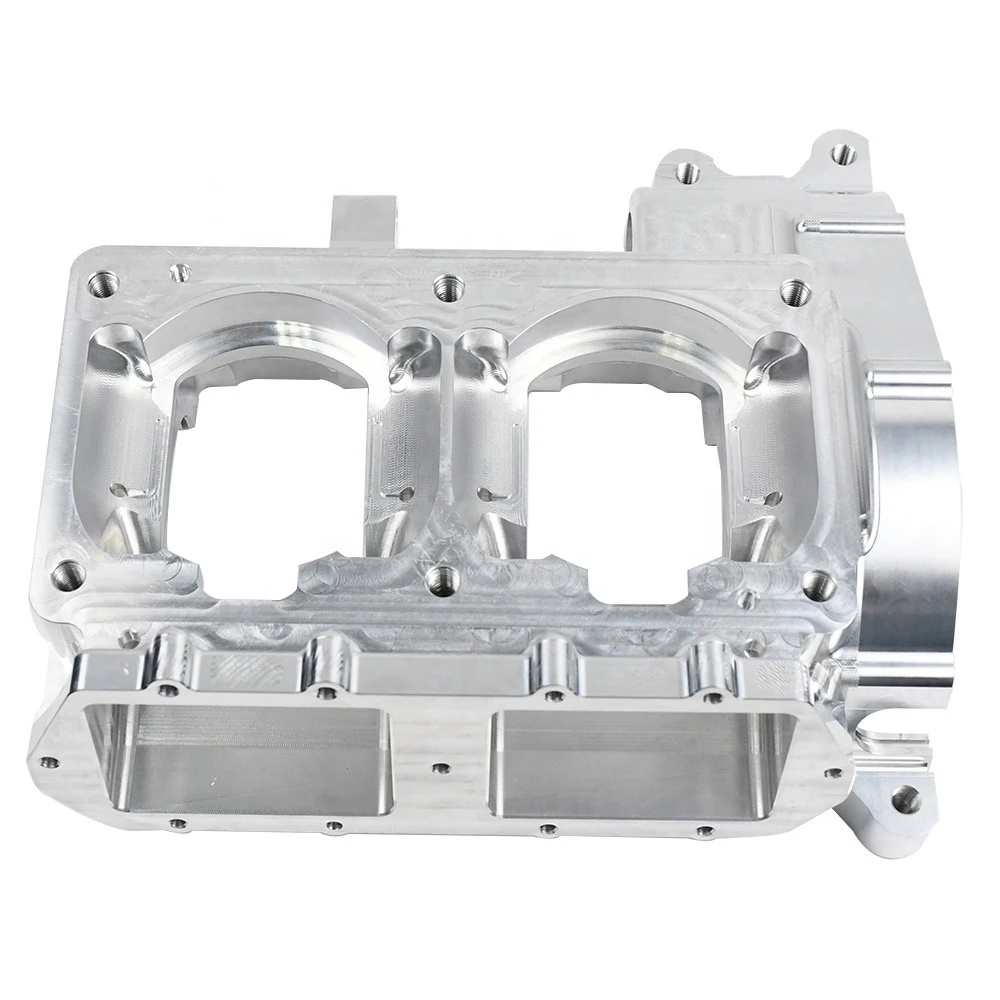
How to read a tool catalog like this one
A catalog release matters only if the inserts and holders drop into a process you already run.
What the catalog release tells a shop floor
When Ceratizit publishes an UP2DATE catalog, the useful information is not the page count. It is the geometry and the insert grades. A tool family is worth a setup change only when it removes an operation, shortens a cycle, or holds a tolerance your current cutter cannot. Everything else is shelf stock.
A catalog entry gives you a starting point for feeds and speeds, not a validated process. The cutting data in the book assumes a rigid setup, a specific workpiece hardness, and a coolant strategy. Change any of the three and the numbers move. Treat the printed values as a baseline, then dial them in on your own material lot.
Tool life claims are the hardest part to compare across brands. One supplier measures wear on a flank face at a fixed cut length. Another runs until surface finish drifts out of spec. Neither is wrong, but the numbers do not transfer. Ask what the test workpiece was, and at what depth of cut the tool was run. That answer tells you more than the headline figure.
For a job shop, a new tool earns its place in the crib when it solves a recurring problem. Roughing a deep pocket with long overhang. Drilling a small hole in stainless without walking. Milling a thin wall without chatter. If the new geometry targets one of those, it is worth a trial. If it only promises a marginal step up, keep the tool you already have dialed in.
Slotting and tangential milling: where each system fits
Multifunctional face and side milling systems aim at parts with complex contours that would otherwise need two setups. The pitch and the insert pocket angle decide what the cutter can do. A close pitch gives more teeth in the cut and a smoother surface, but it needs a stable spindle and enough horsepower. A coarse pitch clears chips better in deep slots and aluminum.
Internal coolant matters more than most catalogs admit. Through-tool coolant reaches the cutting edge in a deep slot where flood coolant never arrives. On steel and cast iron, that difference shows up as insert life and as chip evacuation. If your machine has through-spindle coolant, tooling that uses it is a real gain. If it does not, do not buy on that feature alone.
Tangential milling systems use a different insert orientation, which puts the cutting force more directly into the insert body. The result is a stronger edge for heavy roughing and interrupted cuts. The trade is a narrower application window: these tools shine on steel and cast iron blocks, and they are less suited to light finishing passes on aluminum.
Mounting options change how a tool fits your existing holders. Shell mill arbor, face mill body, and shank versions of the same cutting geometry let you move a proven insert between a large gantry machine and a smaller 40-taper mill. That flexibility is worth checking before you standardize on one body style.
Matching tool family to part and machine
Use this as a first filter before you open the catalog pages.
| Tool family | Best for | Watch out for |
|---|---|---|
| Slot and contour mill | Deep slots, complex profiles, steel and aluminum | Needs rigid setup and good chip evacuation |
| Tangential mill | Heavy roughing, interrupted cuts, cast iron | Narrow finishing window on soft alloys |
| Micro drill | Small holes in complex geometry, stainless | Requires high spindle speed and runout control |
| Through-coolant cutter | Deep pockets, difficult chip evacuation | Only useful on machines with through-spindle coolant |
Micro drilling: the setup decides the result
Micro drills fail for reasons that have little to do with the drill. Runout at the holder is the usual cause. A drill that leaves the spindle 0.02 mm off center will bend and snap in stainless before it cuts ten holes. Check the holder and the collet before you blame the tool geometry.
Peck depth and feed per revolution set the chip. In 316 stainless, a feed that is too light work-hardens the bottom of the hole, and the next peck has to cut through hardened material. A feed that is too heavy breaks the drill. The window is narrow, which is why test cuts matter more here than anywhere else.
Hole depth to diameter ratio drives everything. Past about 8×D, chip evacuation becomes the limiting factor, and through-coolant or an external high-pressure line is close to mandatory. Below 3×D, a simple peck cycle with good coolant usually runs without drama.
Runout, coolant, and peck depth matter more than coating choice on a micro drill. A coating helps, but it cannot rescue a bad setup.
Deciding whether to change a proven process
A new tool family should earn its place. The test is simple: does it remove a setup, cut cycle time by a meaningful margin, or hold a tolerance that your current cutter struggles with? If the answer is no, the cost of retraining, re-fixturing, and re-proving the process is not worth a marginal gain.
Run a controlled trial. One part number, one material lot, one machine. Log cycle time, surface finish, and insert consumption. Compare against the tool you already trust, not against a catalog claim. A 10% cycle gain on a roughing operation is real money over a year. A 2% gain usually disappears into setup variance.
Consider your spindle and coolant first. A high-feed cutter that needs 30 kW of spindle power is useless on a 40-taper machine that produces 15 kW. Coolant-through inserts are a waste on a machine without through-spindle delivery. Match the tool to the machine you own, not the machine in the catalog photo.
The same logic applies to our own work. When we quote a part, the tooling choice comes from the material, the tolerance, and the machine that will run it. A tool is only good if it fits the process around it.
Questions engineers ask about this catalog
Does the Ceratizit UP2DATE catalog replace older tool lines?
A catalog release adds and updates families; it does not automatically discontinue every older insert. Check the specific grade and geometry you use against the new listing before you assume it is gone.
If a tool you run daily is being phased out, plan the transition with a trial run, not on the day the old stock runs out.
How do I compare cutting data between two brands?
Line up the test conditions: workpiece material and hardness, depth of cut, coolant, and the wear criterion. Cutting speed alone means little without those.
When conditions are unknown, run your own test on your material. Two or three parts is enough to see whether the tool behaves.
Can I run these tools on a 3-axis machine?
Most face and slot milling bodies work on a 3-axis machine as long as the spindle interface and power match. The limitation is the part geometry, not the tool.
Features that need undercuts or angled faces still require 4-axis or 5-axis motion. The tool does not change that.
What runout should I hold for micro drills?
Tighter is better, and the practical target is under 0.01 mm total indicated runout at the cutting edge. Above that, small drills in stainless tend to snap.
Measure at the drill, not at the holder taper. The error that matters is the one at the tip.
Is through-coolant tooling worth it without a through-spindle machine?
Rarely. Without delivery through the spindle, the internal channels do nothing, and you pay for a feature you cannot use.
External high-pressure coolant can help in deep pockets, but it is not the same as through-tool delivery.
How do I trial a new cutter without risking a production order?
Run it on scrap or on a low-quantity job first. Log cycle time, finish, and tool wear against your current cutter.
Keep the old tool in the program until the new one proves out. Switching mid-order is how schedules slip.
Send us the drawing and the material
We review your part, pick the tooling that fits the machine, and come back with a quote and a DFM note.
12-hour quote100% inspectionNo minimum order









