
Causes of Deformation in the Thermal Treatment of Steel Parts
Distortion after hardening is rarely one mistake. It comes from phase transformation volume change, thermal gradients, and stress already locked in the part. This page is for engineers and buyers who need to decide what to fix before the part reaches the furnace.
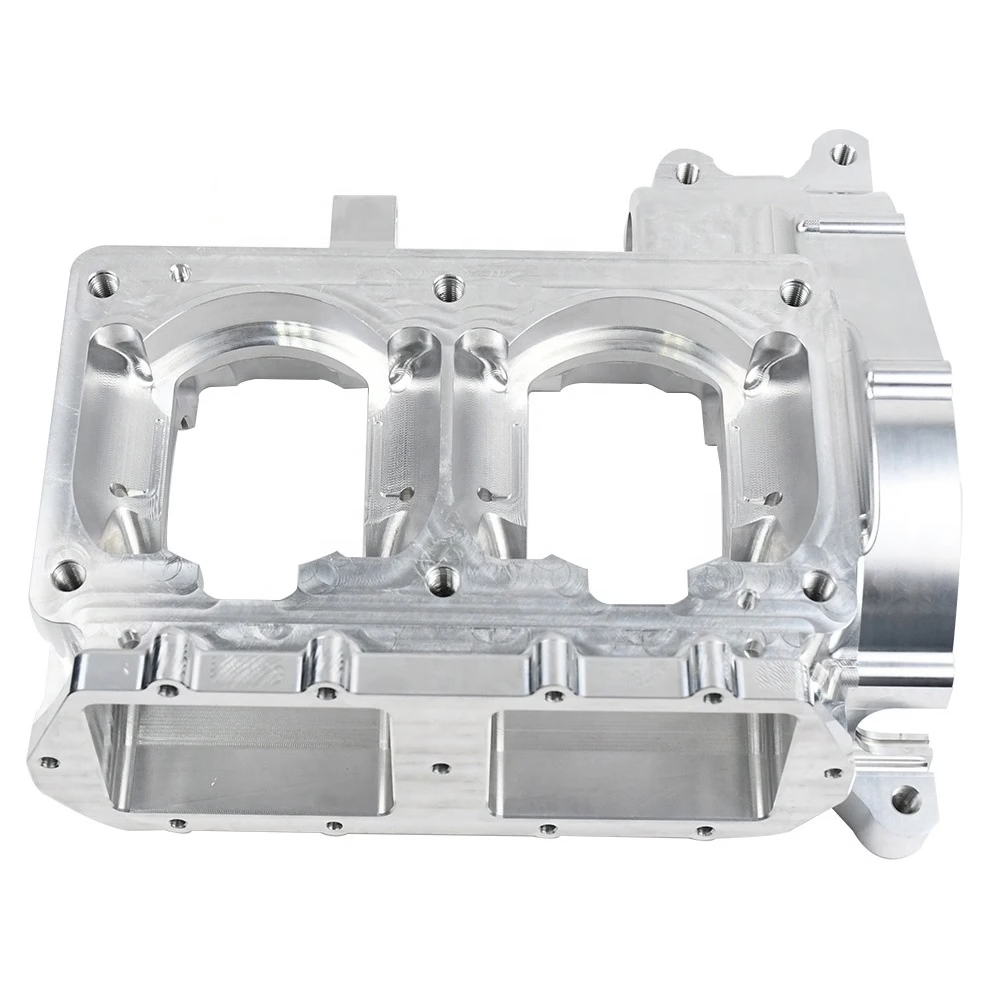
What Actually Moves the Part
Three mechanisms cause most of the dimensional change you measure after quenching.
Phase Transformation and Volume Change
When you austenitize steel, the crystal structure changes from body-centered cubic ferrite and pearlite to face-centered cubic austenite. Austenite packs atoms more efficiently, so the volume per unit mass drops during heating. On cooling, that same volume comes back, and when the part transforms to martensite it comes back larger than it started. A 1045 or 4140 section can grow several tenths of a percent in length, which on a 200 mm shaft is a visible number, not a rounding error.
Carbon content drives how much of this you get. Low-carbon steels such as 1018 form little martensite and move less. Medium-carbon grades like 4140 and 4340 transform more completely, so the volume change is larger. Alloying elements shift the transformation start and finish temperatures, which changes when the growth happens relative to the cooling curve.
The shape of the part decides where the growth lands. A thin wall cools fast and transforms early; a heavy boss cools slowly and transforms late. The two regions end up fighting each other, and the part bends toward whichever side finishes transforming last. Uniform section thickness is the single most effective fix, and it is decided at the design stage, not in the furnace.
Not every steel behaves the same way. Maraging and precipitation-hardening grades such as 17-4PH shrink slightly during aging instead of growing, because the transformation path is different. Tool steels with high carbide content move less in one direction and more in another after rolling, which is why directionality matters for long parts.
Thermal Gradients and Thermal Stress
During heating and cooling, the surface and the core are never at the same temperature. The surface wants to expand or contract first; the core resists. That mismatch produces thermal stress, and once it passes the yield strength of the steel at that temperature, the deformation becomes plastic and permanent.
Quenching makes this worse because the cooling rate is high by design. A water-quenched 1045 part can see surface-to-core temperature differences of several hundred degrees in the first seconds. Oil and polymer quenchants slow the early stage and cut the gradient, at the cost of a shallower hardened case.
Section size sets the ceiling here. A 25 mm round bar in 4140 quenched in oil can usually be brought through without exceeding yield. The same steel at 100 mm diameter needs a different quenchant or a different hardenability grade, because the core simply cannot follow the surface.
Acute stress shows up as a crack. Chronic stress shows up as a bend or twist that appears after the part is already cool. Both come from the same source, and both respond to slower, more even cooling rather than to a tighter final tolerance.
Residual Stress from Machining and Cold Work
Stress that was already inside the blank does not disappear when the part goes into the furnace. It relaxes, and relaxation means movement. Cold-drawn bar, cold-rolled plate, and heavily ground surfaces all carry stress from the operations that made them.
Machining adds its own layer. A heavy roughing pass with a dull tool leaves a tensile skin. The part holds its shape while the stressed skin is balanced against the core, then bows once heat treatment releases the balance.
Pre-hardening stock removal is the standard countermeasure. Leave 0.5–1.5 mm per side after roughing, stress-relieve at 550–650 °C, then finish. The number depends on how much material was removed and how asymmetric the part is.
Cold work is a related trap. A bent or straightened shaft carries stress at the bend. It looks straight on the bench and comes out of the quench curved. Straightening after heat treatment helps only if the stress is redistributed, not just reversed.
When the Three Causes Stack Up
In practice, the three mechanisms overlap. A part with unequal sections transforms unevenly, cools unevenly, and releases stress unevenly, all at the same time. Separating them after the fact is difficult, so the useful work happens before heat treatment.
A quick diagnostic order helps. Check whether the part grew or shrank overall, since growth points to transformation and a pure bend points to stress. Check whether the distortion repeats across a batch, because a repeatable pattern is a design or process issue rather than a random furnace problem.
A batch that moves in different directions from part to part usually points to loading. Parts stacked too tightly cool at different rates on different faces. Spacing them on a fixture, or hanging them, often removes more variation than any change to the quench tank.
Fixtures cost money and floor space. For a one-off prototype they are rarely worth it. For a 10,000-part run, a fixture that holds a 0.05 mm straightness band usually pays for itself in the first few batches of scrap it prevents.
Which Cause Dominates in Common Cases
Use this to pick the first thing to change. It is not a substitute for a distortion trial on the actual part.
| Part feature | Likely dominant cause | First countermeasure |
|---|---|---|
| Thin wall next to heavy boss | Transformation timing | Balance section thickness in design |
| Long shaft, straight after grinding | Residual stress | Stress-relieve before finish grinding |
| Large diameter 4140 round | Thermal gradient | Switch to slower quenchant or higher hardenability |
| Flat plate, bow after quench | Residual stress from rolling | Stress-relieve the plate before machining |
| Gear with thin web | Thermal gradient plus transformation | Support the web during quenching |
| Small part, whole batch curves same way | Loading and stacking | Space parts on a fixture, control orientation |
Common Questions from Engineers
How much dimensional change should we expect from quenching?
For medium-carbon steels such as 1045 and 4140, growth after martensitic hardening commonly lands in the range of 0.1 to 0.3 percent of the dimension, depending on carbon content and section size.
That is a planning number, not a tolerance. If a feature is held to ±0.005 mm, hardening should happen before the final machining pass, not after it.
Can we machine a hardened part back to size?
Yes, within limits. Parts up to roughly 45 HRC can be finished with carbide tooling, and harder parts are usually ground or jig-bored.
The practical constraint is that grinding removes the stressed skin and can release new stress. A light, symmetric cut with a dressed wheel disturbs the part less than a heavy pass.
Does a slower quench always reduce distortion?
It reduces thermal gradient, but it may not reduce transformation distortion, and it lowers hardness depth.
A slower quenchant helps most on heavy sections and on parts where the failure mode is a bend. It helps least on thin, complex parts where the main problem is uneven section thickness.
Should we specify stress relief before heat treatment?
For parts with heavy stock removal, long slender geometry, or a straightness callout, yes. The usual range is 550–650 °C followed by slow cooling.
Skip it for small, near-net blanks with light finishing cuts. The extra furnace cycle adds cost and time without changing the outcome.
What information helps a machine shop avoid this problem?
Send the drawing with the heat treatment callout, the material grade, and the hardness range. Tell us which dimensions are functional and which are cosmetic.
If distortion is already a known issue on this part, say so. We can leave stock for post-hardening finishing instead of trying to hit final size before the furnace.
Does the choice of steel grade matter more than the process?
Both matter, and they trade off. A higher-hardenability grade such as 4340 hardens deeper but moves more during transformation. A lower-carbon grade like 1018 moves less but will not reach the same hardness.
Pick the grade that meets the mechanical requirement first, then control distortion through section design, stock allowance, and quench control.
Plan the Heat Treatment Before the First Cut
Send the drawing and the hardness callout. We will tell you what stock to leave and where the distortion risk sits.
12-hour quote100% inspectionNo minimum order quantity









