
Casting vs Molding: The Difference Between Casting and Molding
Both processes fill a cavity with material, so the names get swapped all the time. They do not behave the same way in tooling cost, wall thickness or tolerance. This guide is written for design engineers and sourcing engineers who need to pick a process before the drawing is frozen. By the end you will know which parts belong in a cast metal route, which belong in a molded plastic route, and when neither one is the right answer.
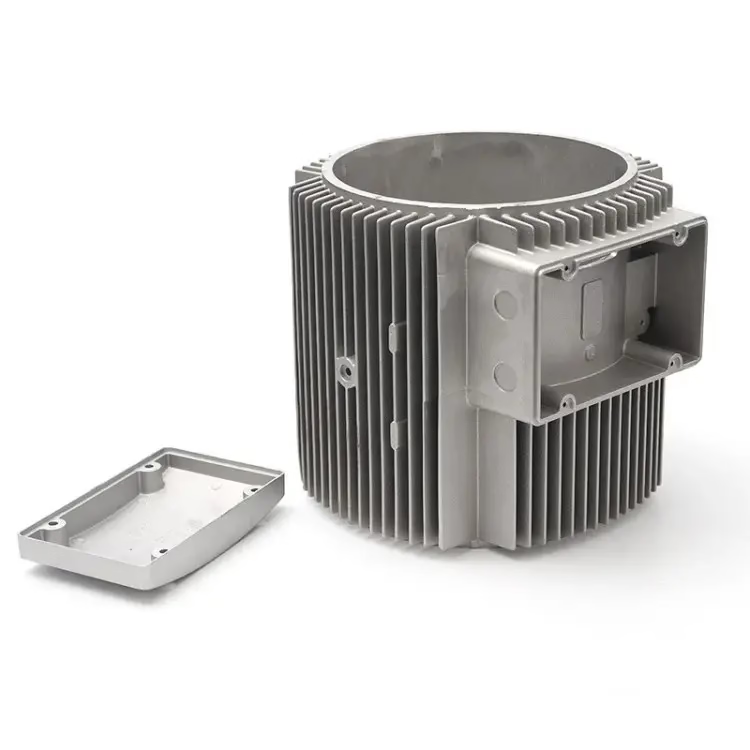
What Casting and Molding Actually Do
One pushes liquid metal into a steel die. The other pushes heated plastic into a machined tool. The rest of the comparison follows from that.
Casting: Molten Metal Poured Into a Cavity
Casting starts with a material that is liquid at high temperature. Molten aluminum, zinc or magnesium is poured or injected into a cavity and left to freeze. The cavity is either a sand mold that is broken away after solidification or a steel die that opens and ejects the part. Sand casting, investment casting, gravity die casting and high-pressure die casting all sit under this one word.
The important physical fact is shrinkage. Metal contracts as it cools, so the cavity has to be oversized and the part has to be fed with extra metal while it solidifies. Internal porosity is the normal risk, and it is managed with gate design, venting and process control rather than eliminated.
Casting is a metal process in most shops. If you hear it applied to resin, the shop usually means vacuum casting, which is a urethane poured into a silicone tool. That is a prototyping method, not a production metal route, and it is worth confirming which one a supplier is quoting.
- 1Best forComplex internal cavities, thin walls, high-volume metal parts
- 2Typical metalsAluminum ADC12, zinc alloys, magnesium, steel, Inconel
- 3Main riskPorosity and shrinkage voids inside thick sections
- 4Tooling lifeSteel dies run tens of thousands of shots before refurbishment
Molding: Softened Plastic Forced Into a Tool
Molding takes a polymer, heats it until it flows, and forces it into a machined steel or aluminum tool under pressure. Injection molding is the dominant version. Blow molding, compression molding and transfer molding handle hollow parts, thermosets and rubber.
Plastic shrinks too, but on a different scale and in a more predictable way. A well-run mold holds wall thickness and features far tighter than a casting, because the melt viscosity is higher and the cavity pressure is controlled in a closed loop. Cycle times are measured in seconds, not minutes.
The trade-off is upfront cost. A hardened steel injection mold for a mid-size part is a serious investment, and it only pays back across a production volume. For twenty parts, the tooling dominates the piece price and the math does not work.
- 1Best forHigh-volume plastic parts with repeatable dimensions
- 2Typical materialsABS, PC, PA, POM, PEEK, PP, HDPE
- 3Main riskWarp, sink marks and short shots if cooling is uneven
- 4Tooling lifeHundreds of thousands of cycles on hardened steel
Where the Casting Molding Difference Shows Up
Material suitability is the first split. Casting covers metals and a few ceramics. Molding covers thermoplastics, silicones and some composites. Very few parts can genuinely go either way, so the material choice usually settles the process before any cost discussion starts.
Production speed reads differently at different volumes. A sand casting can be made from a pattern in days with almost no tooling. An injection mold takes weeks to cut and try out. Once the mold exists, though, it outruns casting by a wide margin on cycle time. High-volume plastic parts are molded for exactly this reason.
Precision and surface finish depend more on the process variant than on the category. Die casting holds ±0.05 mm on stable features and leaves a fine but visible skin. Injection molding holds tighter tolerances on molded dimensions and can produce an optical-grade surface straight from the tool. Sand casting needs machining on any face that has to seal or fit.
- 1Cast metalMachining allowance is normal on critical faces
- 2Molded plasticNet shape is common; secondary ops are cosmetic
- 3Wall thicknessCasting handles 2–4 mm metal walls; molding prefers uniform 1.5–3 mm
- 4DraftBoth need draft, typically 1–2° for casting, 0.5–2° for molding
Casting vs Molding at a Glance
Use this as a first filter before you talk to a supplier.
| Factor | Casting | Molding |
|---|---|---|
| Base material | Molten metal, some ceramics | Thermoplastic, silicone, composite |
| Tooling | Pattern or steel die | Machined steel or aluminum tool |
| Tooling lead time | Days to weeks | Weeks for a hardened tool |
| Cycle time | Minutes per shot | Seconds per cycle |
| Typical tolerance | ±0.05 mm on stable features | Tighter on molded dimensions |
| Surface as made | Skin with visible texture | Smooth to optical grade |
| Economic volume | Low to very high | High volume for hard tools |
| Draft angle | 1–2° typical | 0.5–2° typical |
| Internal voids | Porosity risk in thick sections | Warp and sink instead |
| Post-processing | Machining, deburring, coating | Trimming, painting, plating |
Choosing Between Casting and Molding
Pick casting when the part is metal, when the geometry has internal passages that would be expensive to machine, or when the volume is high enough that a die pays for itself. Automotive housings and pump bodies are cast because a machined version would remove most of the blank as chips.
Pick molding when the part is plastic and the annual volume justifies a tool. Consumer electronics enclosures, medical disposables and connectors are molded for consistency and speed. If the volume is under a few thousand pieces, a machined or 3D printed version usually beats the tooling cost.
There is a third case that catches a lot of projects. The geometry is settled but the volume is still uncertain, or the mechanical properties of a cast or molded part matter more than the process name. Here a CNC machined prototype in the final alloy tells you more about fit and function than a cast or molded sample in a substitute material. Machining from solid also avoids the porosity question entirely, which matters for pressure-tight parts.
- 1Choose casting ifMetal part, complex cavity, volume above a few thousand
- 2Choose molding ifPlastic part, high volume, consistent cosmetic finish
- 3Choose CNC ifLow volume, tight tolerance, or the alloy must be final
- 4Watch outCasting porosity and molding warp both hide until testing
Limits of Each Process, and How They Are Handled
Casting limitations are mostly about internal soundness. Thick sections cool slower than thin ones, so the last metal to freeze can pull a void. Designers reduce this by keeping wall thickness uniform, adding fillets and putting the thick features where a riser can feed them. When a casting still needs a sealed face, the standard fix is to machine that face after casting.
Molding limitations are about flow and cooling. Long thin sections may not fill, and uneven cooling bends the part after ejection. Gate location, cooling channel layout and packing pressure are the levers. Glass-filled resins shrink less but wear the tool faster, so the tool steel grade has to match the material.
Both processes leave something for a finishing operation. Castings need flash removal, sometimes heat treatment, and often a machined datum before any secondary operation can be trusted. Molded parts need gate trimming and, if the surface is visible, a texture or paint step. Neither process delivers a finished part straight off the machine in most cases.
- 1Casting fixUniform walls, risers, and machining on sealing faces
- 2Molding fixGate placement, cooling layout, packing profile
- 3Shared needA machined datum before inspection or assembly
Casting and Molding Questions Engineers Ask
Is vacuum casting the same as casting metal?
No. Vacuum casting in the prototyping world means pouring urethane resin into a silicone tool under vacuum. It produces small batches of plastic-like parts with good surface detail.
Metal casting under vacuum is a different process used to reduce gas entrapment in the die. When a supplier quotes vacuum casting, confirm which material you are getting.
Which process holds tighter tolerances?
Molding generally holds tighter tolerances on molded dimensions because the cavity pressure is controlled and the material shrinks predictably.
Casting tolerances depend heavily on the variant. Die casting is much tighter than sand casting. On either route, any face that must seal or locate is usually machined afterward.
Can a cast part be machined to a tight tolerance?
Yes, and it often is. A machining allowance of 0.5–1.5 mm on critical faces lets a shop cut the datum and the sealing surface after casting.
The limit is porosity. If a void sits just under the surface, machining can open it. Pressure-tight parts are better machined from solid or cast with a thicker section in that area.
What volume makes molding cheaper than machining?
It depends on part size and tool cost, but the crossover for a small plastic part is often in the low thousands of pieces per year.
Below that, the tooling amortization keeps the molded piece price high. A machined or printed part wins on total cost.
Do both processes need draft angle?
Yes. A part that has to leave a cavity needs draft, otherwise it drags on the wall and damages the surface.
Casting usually wants 1–2°. Molding can run 0.5° on shallow features and 1–2° on deep ones. Add draft in the model, not in the tool shop.
How does GreatLight handle cast or molded parts that need finishing?
We machine castings and molded parts as a secondary operation, cutting datums, sealing faces and mounting bores to ±0.005 mm where the drawing calls for it.
Our finishing line covers anodizing, plating, powder coating, bead blasting and laser marking. Inspection reports are available on request, and a DFM review comes back with the quotation.
Send the Drawing, Get a Process Recommendation
Upload a STEP file and we will come back with a quotation, a DFM analysis and a clear recommendation on whether the part should be cast, molded or machined.
12-hour quote±0.005 mm tolerance100% inspection









